Historic site · BEIJING
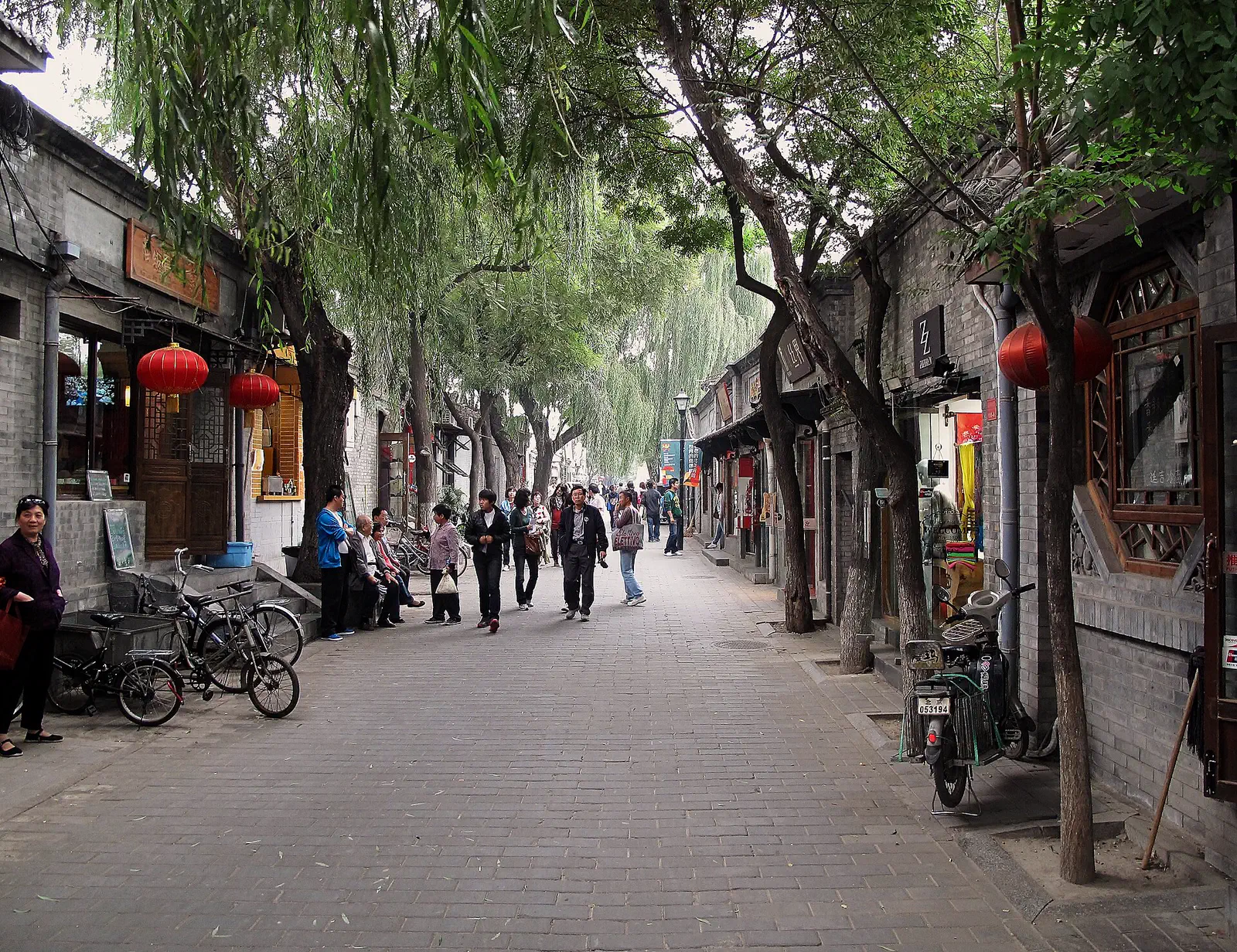
Nanluoguxiang Hutong
南锣鼓巷 · Nánluógǔxiàng
About
Restored Yuan-dynasty hutong street, fully pedestrianised. The most-visited hutong tourist district; cafes, boutiques, baozi shops.
Nanluoguxiang — the name translates roughly as South Drum Tower Lane — is a 786-metre hutong running north-south through the Dongcheng district, laid out in this form during the Yuan dynasty in the 13th century. The street is classified as one of Beijing's oldest surviving grid-plan hutongs, where the main lane intersects with eight smaller alleys on each side in a fishbone pattern. The courtyard houses lining these side alleys are the oldest fabric; the main street is the commercialised layer on top.
Commercialisation began in earnest around 2005 and has been aggressive: independent cafes, design boutiques, craft beer bars, baozi and jianbing snack shops, and a density of tourists that on weekend afternoons makes the main street difficult to walk comfortably. For a visitor seeking a sense of hutong life rather than hutong tourism, the 16 side-hutongs are far more rewarding. Mao'er Hutong contains the Former Residence of Wan Rong (the last empress), Prince Qi's Mansion, and a row of relatively intact courtyard-residence gates. Yu'er Hutong has some of the best-preserved courtyard façades. Ju'er Hutong is a well-known example of 1990s courtyard-house renovation by architect Wu Liangyong.
The street connects at its north end with the Gulou Dongdajie intersection and the Drum Tower — a natural combination. The Shichahai lake area and Houhai are a short walk to the west. Nanluoguxiang has its own metro station on Lines 6 and 8, making it one of the most accessible hutong areas in the city. Come on a weekday morning for the quietest experience; the snack economy warms up by late morning.
How to get there
Metro Line 6 or 8 to Nanluoguxiang.
When to visit
Weekday late morning. Avoid weekend afternoons.
History and context
The street plan dates from the Yuan dynasty in the 13th century, when the fishbone grid of eight hutongs to the north and eight to the south of the main lane was laid out. The courtyard fabric accreted over subsequent Ming and Qing centuries. Nanluoguxiang emerged as a hipster and tourist strip in the mid-2000s. The surrounding hutongs are gradually being converted from residential to commercial use.
What the visit is like
The main lane takes 1–2 hours at a stroll, but the side hutongs — Mao'er Hutong and Yu'er Hutong in particular — reward wandering off the axis. The strip is touristy on weekends and evenings and quieter on weekday mornings. Snack shops and cafes generally open by late morning. The paved main lane is wheelchair-accessible; the side hutongs have uneven flagstones and occasional steps at courtyard entrances.
Photography
The courtyard doorways and carved stone drums on Mao'er Hutong photograph well in morning light. The tricycle taxis waiting near the north entrance are a recognisable frame. The main lane is lantern-lit after dark and reads well from mid-street with a wider lens. Drones are not permitted in Beijing's inner-ring hutongs — the airspace is restricted and enforcement is routine.
Overlooked details
The Former Residence of Qi Baishi — the ink painter — sits on a side hutong and is easy to miss. The Former Residence of Mao Dun — the novelist — is similarly quiet. Look for the surviving stone door-guardians known as mendunshi flanking older courtyard gates; their carved rank hints at the original occupant's status. A handful of Prince Gong style tea houses operate in restored courtyards off the main lane.
Where to eat nearby
The tourist strip itself is expensive and often mediocre. Walk 5 minutes north to the Gulou — Drum Tower — area for Ghost Street noodles and cheaper snack stalls. Peking-duck shops on nearby side hutongs are generally better value than the main-lane restaurants. The bottled yoghurt drink shops with ceramic jars are ubiquitous — they are a local staple rather than a tourist novelty and cost a few yuan.
Common misconceptions
It is not the "authentic" Beijing hutong experience — that would be the still-lived-in hutongs west of Andingmen and further out from the tourist ring. The main lane is a commercial strip; the adjacent hutongs are still partly residential and quieter. Foreign tourists often walk only the main lane and conclude that hutongs are shopping streets — the side alleys tell a different story.
Other attractions in Beijing
Itineraries featuring this site
- Beijing 3-day blitz — first-timer fast pass
3d · Three full days in Beijing covering the Forbidden City, Great Wall at Mutianyu, the Temple of Heaven and the hutong lanes — the absolute core of the capital for visitors with limited time.
- Beijing weekend — 3 days in the capital
3d · Three days in Beijing covering the Forbidden City, Great Wall at Mutianyu and the Temple of Heaven — the irreducible core of the capital, managed at a pace that avoids pure exhaustion.
- China in 5 days: fastest first-timer route
5d · Beijing's big three sights, a flight south, and two days navigating Shanghai's contrasts.
- Beijing + Shanghai — 5-day first-timer classic
5d · Two of China's three great cities in five days: imperial Beijing followed by the modern skyline of Shanghai, linked by a quick domestic flight or overnight train.
Other historic sites in China
- Ancient Villages of Southern Anhui — Xidi and Hongcun皖南古村落—西递、宏村
UNESCO · UNESCO-listed pair of Ming-Qing Huizhou merchant villages in southern Anhui, renowned for whitewashed walls, inky horsehead gables and moon-shaped ponds.
- Anqing Zhenfeng Pagoda安庆振风塔
A seven-storey Ming Dynasty pagoda standing on the bank of the Yangtze River in Anqing, considered one of the finest riverside pagodas in southern China and long used as a navigation landmark by Yangtze river pilots.
- Archaeological Ruins of Liangzhu City良渚古城遗址
UNESCO · UNESCO-listed archaeological site in Hangzhou preserving the remains of a 5,000-year-old city with a sophisticated water-management system, jade ritual culture and social hierarchy — regarded as one of the earliest state-level societies in East Asia.
- Capital Cities and Tombs of the Ancient Koguryo Kingdom高句丽王城、王陵及贵族墓葬
UNESCO · UNESCO-listed capital cities and royal tombs of the Koguryo Kingdom in Jian, Jilin — the Chinese portion of a transnational heritage property shared with North Korea, representing one of the most powerful states of ancient East Asia.
- Classical Gardens of Suzhou (UNESCO)苏州古典园林
UNESCO · UNESCO-listed collection of private gardens in Suzhou — four inscribed in 1997 and five more added in 2000 — representing the pinnacle of Chinese garden design through the refined integration of architecture, water, rock and plant.
- Danba Tibetan Watchtowers丹巴碉楼
Clusters of ancient stone watchtowers rising above Tibetan village complexes in the Dadu River valley, said to be among the oldest surviving examples of Tibetan defensive architecture.
- Drum Tower and Bell Tower鼓楼钟楼
Yuan-dynasty drum and bell towers that kept official time for imperial Beijing. Climbable; daily drum performances.
- Dujiangyan Irrigation System都江堰
UNESCO · 2,300-year-old irrigation system on the Min River. Still in use. UNESCO-listed jointly with Mt Qingcheng. Engineering rather than architecture, but one of the great works.
Frequently asked questions
- How much does Nanluoguxiang Hutong cost to visit?
- Entry to Nanluoguxiang Hutong is free.
- When is Nanluoguxiang Hutong open?
- Nanluoguxiang Hutong opening hours: Streets 24/7. Most shops 10am–10pm.
- How long do you need at Nanluoguxiang Hutong?
- Allow 1–3 hours for Nanluoguxiang Hutong. Add buffer time if you plan to visit at peak season or include nearby sights in the same trip.
- When is the best time to visit Nanluoguxiang Hutong?
- Weekday late morning. Avoid weekend afternoons.
- How do you get to Nanluoguxiang Hutong?
- Metro Line 6 or 8 to Nanluoguxiang.
Spotted something out of date? Submit a correction.
Research
Cross-checked against primary sources
Verified
Address, hours, fees confirmed at the date shown
Updated
Re-verified periodically; corrections welcome