Cantonese · main
Char Siu (BBQ Pork)
叉烧 · Chāshāo
Cantonese roast pork — marinated, hung in special ovens, glazed with honey and maltose. Eaten over rice or in buns.
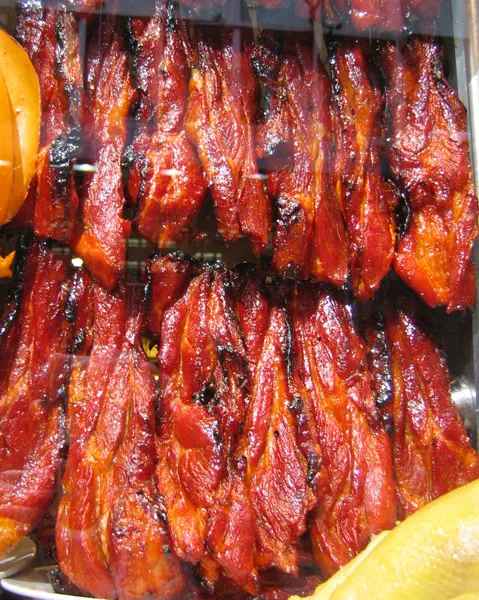
Char siu (lit. 'fork-roast' from the Cantonese) is the canonical Cantonese roasted meat, the centrepiece of the siu mei (roasted-meat) tradition that supplies Hong Kong and Guangdong restaurants and shops with the hanging arrays of lacquered proteins visible in any street-level kitchen window.
The marinade varies by shop but typically combines hoisin sauce, fermented red bean paste (nan ru), honey, dark and light soy sauce, Shaoxing wine, five-spice powder and, in many commercial versions, red food colouring to produce the characteristic deep rust-red exterior. Pork shoulder (the most common cut) is marinated for several hours or overnight, then hung from metal forks in a barrel-shaped roasting oven at around 200°C, where it cooks by radiant heat and basts in its own caramelising sugars as drippings fall.
The result is distinctive: a sweet-savoury exterior with caramelised edges, a tender interior that varies from lean to fatty depending on the cut used. Premium char siu uses pork collar (the fatty neck) for a higher fat content that keeps the meat moist during the high-heat roasting.
Served sliced over rice (char siu fan) with a ladle of sauce and a piece of blanched vegetable, it is a daily working meal across Guangdong and Hong Kong. As a dim sum filling — char siu bao in both baked and steamed forms — it appears on every yum cha cart. As a noodle topping — wonton noodles or won ton mee — it is the standard Cantonese noodle configuration.
Where to try
Hong Kong's Yat Lok, Joy Hing Roasted Meat, Kam's Roast Goose. Guangzhou's siu mei stalls.
Dietary notes
Pork.
Regional variants
The Cantonese original carries a glossy honey-red glaze and a five-spice marinade. Hong Kong versions run slightly sweeter. Fujian shops use red yeast rice for colour rather than added dye. Malaysian char kway teow stalls adapt a leaner char siu suited to stir-frying. Overseas American Chinese 'roast pork' — the strip served with duck sauce — is a distant descendant that trades the maltose lacquer for a thinner sugar glaze.
Where the name comes from
叉燒 chā shāo in Mandarin — cha1 siu1 in Cantonese — literally 'fork-roast'. The name refers to the traditional method of impaling pork strips on long metal forks and hanging them inside an upright cylindrical oven so the drippings fall clear. The technique is attested in Guangdong from at least the Tang dynasty and predates the enclosed brick ovens now used in Hong Kong siu mei shops.
Pairings
Rice — char siu fan is the classic single-plate meal. Cantonese egg tarts as a dessert. Light jasmine tea to cut the richness of the caramelised fat. A small side of pickled mustard greens — cha choy — sharpens the palate between mouthfuls. The roast pork bones are seldom discarded; shops typically simmer them into a stock that returns as the base for wonton noodle soup the following service.
Where to learn to cook it
Hong Kong cooking schools teach the technique as part of the siu mei syllabus. The marinade turns on maltose — the source of the glossy lacquer — plus five-spice, hoisin, soy, honey and red yeast rice. Domestic replication requires an oven or grill capable of holding 220°C or higher for the final glaze pass. Made With Lau on YouTube runs a well-followed home version demonstrating the basting cadence.
Common misconceptions
The red colour comes from maltose caramelisation and red yeast rice — not artificial red food dye — though some commercial shops do add colouring for a more uniform finish. It is roasted in an enclosed oven, not grilled over open coals in the outdoor barbecue sense the English name suggests. Leaner cuts such as pork loin are considered inferior; fattier pork shoulder or collar is the preferred cut for moisture and texture.
Cities to try Char Siu (BBQ Pork)
Other south dishes
- Beef Chow Fun干炒牛河
Flat rice noodles dry-fried with silky marinated beef, beansprouts and spring onion over a fierce wok flame.
- Bubble Tea珍珠奶茶
Taiwanese milk tea served with chewy tapioca pearls (boba) through a wide straw. The foundational format — oolong or black tea shaken with milk and ice — has spawned hundreds of variations across China's enormous tea-chain industry.
- Buddha Jumps Over the Wall佛跳墙
Fujian's banquet centrepiece — a slow-simmered soup of dried abalone, sea cucumber, scallop, ham and 20+ other ingredients.
- Cantonese Roast Goose烧鹅
Whole goose roasted to crisp-skinned tenderness. The most prized of the Cantonese siu mei roasted meats.
More Cantonese dishes
- Beef Chow Fun干炒牛河
Flat rice noodles dry-fried with silky marinated beef, beansprouts and spring onion over a fierce wok flame.
- Cantonese Roast Goose烧鹅
Whole goose roasted to crisp-skinned tenderness. The most prized of the Cantonese siu mei roasted meats.
- Char Siu Bao (BBQ Pork Buns)叉烧包
Steamed white buns with a sweet-savoury BBQ pork filling. Two styles: traditional steamed and modern baked.
- Cheung Fun (Rice Noodle Roll)肠粉
Translucent rice-flour roll filled with shrimp, beef or BBQ pork. Served with sweet soy sauce.
- Claypot Rice煲仔饭
Rice steamed in a clay pot over charcoal with toppings like lap cheong, chicken or salted fish, finished with a soy-sesame dressing.
- Dim Sum點心
The Cantonese tradition of small shared dishes served during morning or midday tea (yum cha). Har gow, siu mai, char siu bao, cheung fun, lo mai gai, chicken feet, and egg tarts are the pillars of the format. Eaten communally over tea and conversation.
- Double-Skin Milk Pudding双皮奶
Cantonese set water-buffalo milk pudding from Shunde. Two thin 'skins' on the surface; subtly sweet.
- Egg Tart蛋挞
A baked pastry shell filled with a smooth, lightly sweetened egg custard — a Hong Kong and Macao staple.