CITY · FUJIAN
Fuzhou
福州 · Fúzhōu
Overview
Capital of Fujian, on the southeast coast. Three Lanes and Seven Alleys historic district, the Fujian tea heritage, and the gateway to Wuyi Mountain.
Fuzhou is the capital of Fujian province, an ancient port city on the Min River with a history of maritime trade that predates the Song dynasty. It tends to be skipped by foreign visitors who head directly to Xiamen, but Fuzhou has a more interesting historical core and a food culture that is arguably more distinctive.
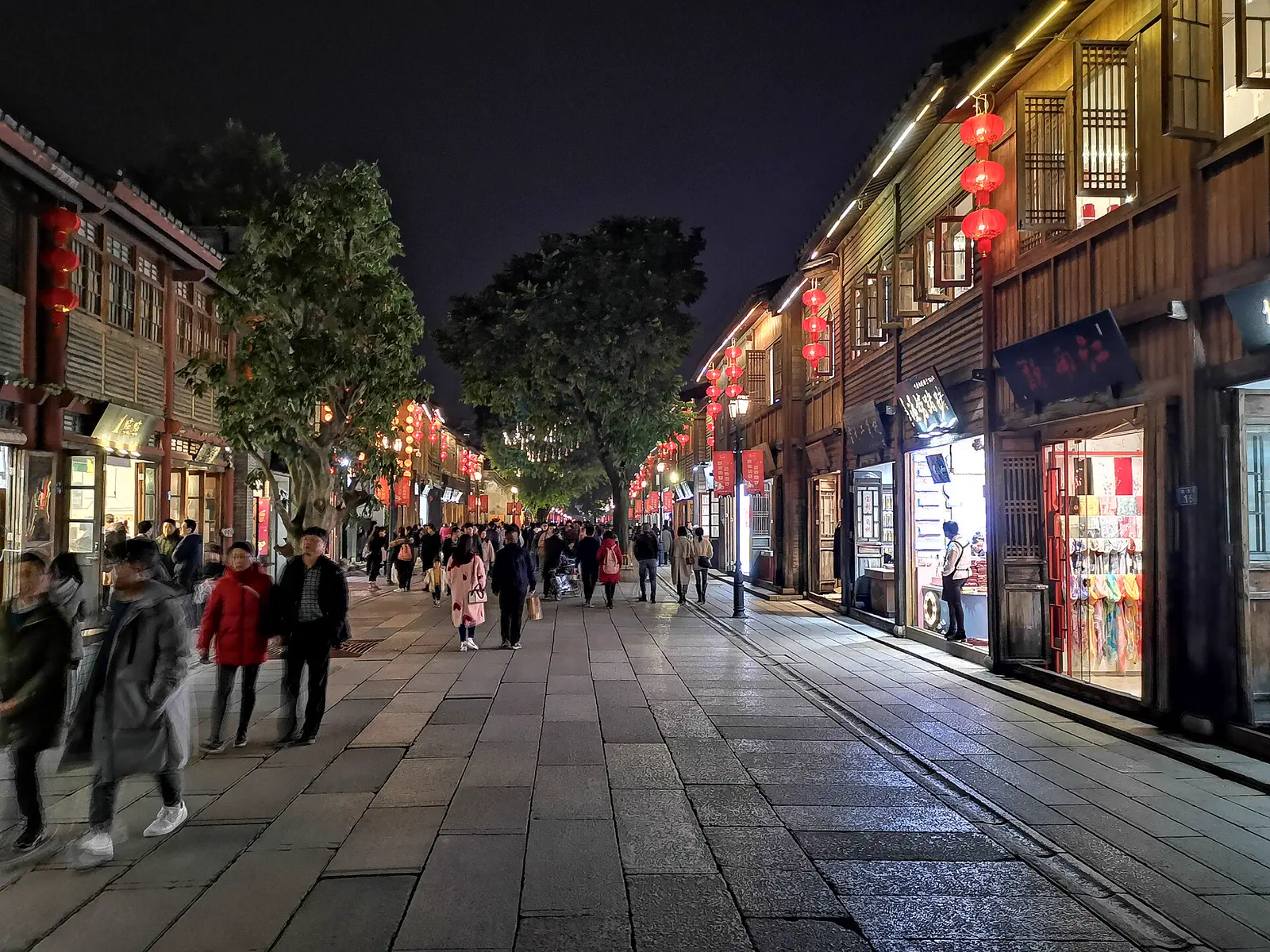
The Three Lanes and Seven Alleys district (Sanfang Qixiang) is the centrepiece. The pattern of three north-south lanes and seven east-west alleys was established in the Tang dynasty and the district retains — after extensive restoration — a concentration of late-Ming and Qing-era wooden architecture found nowhere else in Fujian. The buildings are the courtyard residences of merchant families and minor officials: two and three storey timber-framed structures with ornate carved brackets, whitewashed gable walls, and interior rock gardens. Several are open as museums or have been converted into teahouses and restaurants within the historic fabric. The district functions as both a living neighbourhood and a heritage site, which makes it more interesting than a pure reconstruction.
Fuzhou sits at a crossroads in Chinese migration history. The Hokkien-speaking people of coastal Fujian were among the most prolific emigrants of the nineteenth and early twentieth centuries, dispersing to Southeast Asia, the Philippines, Taiwan, and further. The overseas Chinese communities of Singapore, Malaysia, Indonesia, and the Philippines are substantially Hokkien-speaking and maintain cultural and religious connections to Fujian. The Fuzhou connection is particularly strong in the Fujianese American community.
Fujian cuisine (Min cai) is one of China's eight canonical regional styles. It is built on the light handling of seafood, the use of red rice wine (Fujian red wine) in braising and saucing, and a preference for subtle flavour over assertive seasoning. The canonical Fujian dish is Buddha Jumps Over the Wall (fo tiao qiang): a slow-braised composite of abalone, sea cucumber, shark fin (now often substituted), fish maw, scallops, pork, and various other ingredients, assembled in a clay pot and steamed for hours. The smell is strong enough that the name implies even a Buddhist monk would break his vows for it. Fish balls, oyster pancakes, and light broths define the everyday register.
Wuyi Mountain (Wuyishan), four hours north by high-speed rail, is a UNESCO World Heritage site and the home of the oolong rock teas — Da Hong Pao, Rou Gui, Shui Xian — that are among the most valued teas in China. The mountain landscape of eroded red-rock cliffs and bamboo forest is worth the trip independently of the tea.
What to see
- Three Lanes and Seven Alleys historic district
- West Lake Park
- Yongtai Village
- Wuyi Mountain — extension day trip / overnight
What to eat
- Buddha Jumps Over the Wall (佛跳墙) — the canonical Fujian banquet dish
- Fish balls and oyster omelette
- Fujian red wine fish stew
Getting there
Fuzhou Changle (FOC) airport, 50 km southeast. Fuzhou Station and Fuzhou South HSR: Xiamen 1h 30m, Shanghai 5h 30m.
Getting around
Metro and bus.
Where to stay
Sanfang Qixiang area.
We list neighbourhoods, not specific hotels — we don't endorse hotels.
When to go
October–April. Summer typhoon season.
Budget guide (CNY per day)
| Backpacker | ¥240 |
| Mid-range | ¥540 |
| Comfortable | ¥1300 |
Other cities in Fujian
- Quanzhou泉州
UNESCO World Heritage Site (2021) for its role as the maritime Silk Road's medieval emporium. Mosques, churches, Hindu temples, Buddhist monasteries — Marco Polo's 'Zaytun', the largest port in the world in the 13th century.
- Wuyishan (Mount Wuyi)武夷山
UNESCO mixed natural-and-cultural heritage site (1999). The most-celebrated oolong tea region in the world (Da Hong Pao, Lapsang Souchong), set against Danxia geological landscapes and Han-dynasty Yuewang Cheng walled-town remains.
- Xiamen厦门
Coastal Fujian island-and-mainland city. Gulangyu (UNESCO) is a car-free European-villa island; the city has clean beaches, a relaxed pace and the warmest mainland climate north of Hainan.
- Yongding永定
A Hakka county in western Fujian containing the largest concentration of tulou — circular and square earthen fortress buildings of the Hakka people — inscribed as a UNESCO World Heritage Site.
Food of Southern China
- Beef Chow Fun干炒牛河
Flat rice noodles dry-fried with silky marinated beef, beansprouts and spring onion over a fierce wok flame.
- Bubble Tea珍珠奶茶
Taiwanese milk tea served with chewy tapioca pearls (boba) through a wide straw. The foundational format — oolong or black tea shaken with milk and ice — has spawned hundreds of variations across China's enormous tea-chain industry.
- Buddha Jumps Over the Wall佛跳墙
Fujian's banquet centrepiece — a slow-simmered soup of dried abalone, sea cucumber, scallop, ham and 20+ other ingredients.
- Cantonese Roast Goose烧鹅
Whole goose roasted to crisp-skinned tenderness. The most prized of the Cantonese siu mei roasted meats.
Fuzhou weather by month
| Month | Jan | Feb | Mar | Apr | May | Jun | Jul | Aug | Sep | Oct | Nov | Dec |
|---|---|---|---|---|---|---|---|---|---|---|---|---|
| High °C | 16 | 17 | 21 | 24 | 27 | 30 | 34 | 33 | 31 | 27 | 23 | 17 |
| Low °C | 8 | 9 | 11 | 14 | 19 | 23 | 26 | 25 | 23 | 19 | 14 | 9 |
| Rain mm | 31 | 91 | 115 | 105 | 197 | 338 | 143 | 248 | 96 | 51 | 62 | 47 |
| Rain days | 6 | 11 | 14 | 12 | 17 | 22 | 16 | 21 | 13 | 8 | 7 | 7 |
2019–2023 average via Open-Meteo ERA5 (ERA5 reanalysis). "Rain days" = days per month with ≥1 mm precipitation.
Frequently asked questions
- When is the best time to visit Fuzhou?
- The best months to visit Fuzhou are October, November, December, March, and April. October–April. Summer typhoon season.
- How many days do you need in Fuzhou?
- Plan 2 days for Fuzhou if you want to see the headline sights without rushing — Three Lanes and Seven Alleys historic district, West Lake Park, Yongtai Village. Add an extra day for day trips from the city or for repeat visits to your favourite neighbourhood.
- How do you get around Fuzhou?
- Metro and bus.
- What's the daily budget for Fuzhou?
- Budget guide for Fuzhou: backpackers from around ¥240/day, mid-range travellers ¥540/day, comfortable trips from ¥1300/day. These ranges cover accommodation, food, local transport and one paid sight per day, and exclude flights to and from the city.
- Where should you stay in Fuzhou?
- Sanfang Qixiang area.
Spotted something out of date? Submit a correction.
Research
Cross-checked against primary sources
Verified
Address, hours, fees confirmed at the date shown
Updated
Re-verified periodically; corrections welcome