CITY · GUIZHOU
Zhaoxing
肇兴 · Zhàoxīng
Overview
The largest Dong village in China, with five timber drum towers, covered wind-and-rain bridges, and an intact living Dong culture in the mountains of southeastern Guizhou.
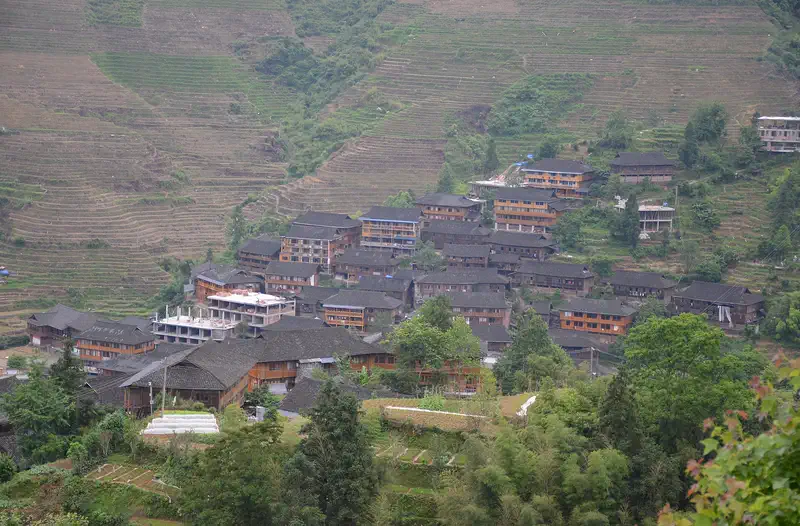
Zhaoxing is a Dong minority village in Liping County, southeastern Guizhou, set in a narrow valley at approximately 550 metres elevation. It is considered the largest Dong village in China by population and cultural completeness. The village is architecturally defined by five drum towers — multi-storey wooden pagoda structures that serve as community meeting places and festival stages — and several wind-and-rain bridges (feng yu qiao), covered wooden bridges with pavilion roofs that are the Dong's most distinctive engineering contribution. Both tower and bridge construction use no nails — the wood is joined entirely through mortise and tenon carpentry.
The Dong people of southeastern Guizhou are known for their polyphonic choral singing tradition — Grand Song (Dong Da Ge) — which was inscribed on the UNESCO Intangible Cultural Heritage list. The singing involves multiple vocal parts without instrumental accompaniment and is performed at community gatherings, festivals and as a form of social courtship. Live performances occur in the village square and drum towers during festival periods.
Zhaoxing is less developed for mass tourism than Xijiang Miao Village, preserving a quieter atmosphere. The surrounding villages — Tangán, Jitang, Xiaohuang — are accessible by road and offer further examples of Dong architecture and culture. The county town of Liping is 60 km away and provides the main transport connections.
The village's relative remoteness has slowed infrastructure development — this is both its appeal and its practical limitation for those accustomed to city conveniences.
Cultural & access notes
Zhaoxing is a working Dong community where daily life happens around and alongside tourism. Drum towers are not decorative objects — they are used for village meetings, dispute resolution and community decision-making. Ask before entering if a gathering is in progress. The polyphonic singing tradition is a serious cultural form — attending a live performance with respectful attention is the appropriate response.
What to see
- Five drum towers — the defining communal architecture of Zhaoxing village
- Wind-and-rain bridges — nailless covered wooden bridges at the village entrance
- Dong Da Ge (Grand Song) performance — polyphonic choral singing at festival events and community gatherings
- Village rice terraces — cultivated hillsides above and around the settlement
- Tangguan — a scenic old village 3 km from Zhaoxing with a particularly beautiful setting
- Xiaohuang Village — a renowned Dong singing village reachable by day trip
What to eat
- Sour fish (suanyu) — the Dong signature preservation method: fish fermented in rice bran
- Sour pork (suanrou) — similarly fermented pork, served with rice
- Sticky rice dishes — glutinous rice in bamboo or stone-pot preparations
- Wild fern fronds stir-fried with chilli
- Rice wine — village-brewed spirit offered at community events
Getting there
The nearest railway station is at Congjiang, approximately 75 km south, on the Guiyang-Guangzhou high-speed line. From Congjiang, minibuses or hired vehicles cover the mountain road to Zhaoxing in about 1.5 hours. From Kaili by road, the journey is approximately 3 hours via mountain roads. Liping county town (60 km north) has bus connections to Kaili and Guiyang.
Getting around
Zhaoxing itself is navigable on foot — the main village is compact. Surrounding villages require hiring a vehicle or walking the mountain paths. Electric scooters are available for rent in the village.
Where to stay
Guesthouses within the village offer basic but authentic accommodation in traditional Dong buildings. The village has several options from dormitory-style to simple private rooms. Amenities are basic by urban standards; electricity and water are reliable.
We list neighbourhoods, not specific hotels — we don't endorse hotels.
When to go
April–May and September–November are ideal. The major festivals include the Dong New Year (11th lunar month) and the Dong singing competitions and festivals in various villages through the year. Summer is rainy and humid but the village is accessible.
Budget guide (CNY per day)
| Backpacker | ¥150 |
| Mid-range | ¥300 |
| Comfortable | ¥600 |
Safety notes
The mountain roads around Zhaoxing are narrow and winding; they can be difficult after heavy rain. The village itself is safe for independent travellers. Phone signal can be weak in the valley — download offline maps before arriving.
Nearby attractions
Day trips within 150 km

Other cities in Guizhou
- Anshun安顺
A Guizhou plateau city and gateway to Huangguoshu Falls — China's largest waterfall — and to the Tunpu villages where descendants of Ming-dynasty Han settlers maintain a 600-year-old cultural enclave.
- Guiyang贵阳
Capital of Guizhou, gateway to the Miao and Dong ethnic-minority villages and to the Huangguoshu Waterfall — China's largest. Cool mountain climate, sour and spicy local cooking.
- Kaili凯里
The hub city of Guizhou's Miao minority heartland, gateway to hundreds of traditional Miao and Dong villages and one of the densest concentrations of ethnic minority textile, silver and music cultures in China.
- Tongren铜仁
A Guizhou prefecture-level city and gateway to Fanjingshan — a sacred Buddhist mountain and UNESCO World Heritage Site with a remarkable double-peak rock formation rising above primeval forest.
- Xijiang Qianhu Miao Village西江千户苗寨
The largest Miao village in the world — approximately 1,200 households of stacked wooden stilt houses covering a mountain valley in Guizhou — a living community and Guizhou's single most visited tourist site.
Food of Southwestern China
- Baba Flatbread粑粑
Yunnan's daily flatbread — a thick wheat or rice-flour round cooked on a griddle and eaten plain or stuffed.
- Bang Bang Chicken棒棒鸡
Cold poached chicken shredded by hand, dressed in chilli oil, sesame paste and Sichuan peppercorn.
- Boiled Fish in Chilli Oil水煮鱼
Fish slices submerged in a deep pool of chilli oil and Sichuan peppercorns. Served bubbling.
- Chongqing Hotpot重庆火锅
The original mala hotpot — a simmering cauldron of beef tallow, Pixian doubanjiang and Sichuan peppercorn for communal dipping.
Zhaoxing weather by month
| Month | Jan | Feb | Mar | Apr | May | Jun | Jul | Aug | Sep | Oct | Nov | Dec |
|---|---|---|---|---|---|---|---|---|---|---|---|---|
| High °C | 12 | 13 | 19 | 22 | 26 | 29 | 30 | 31 | 30 | 23 | 19 | 13 |
| Low °C | 5 | 6 | 11 | 15 | 19 | 23 | 24 | 24 | 22 | 16 | 12 | 5 |
| Rain mm | 75 | 106 | 132 | 203 | 258 | 350 | 244 | 149 | 102 | 72 | 70 | 39 |
| Rain days | 14 | 17 | 22 | 20 | 22 | 23 | 22 | 21 | 13 | 11 | 12 | 9 |
2019–2023 average via Open-Meteo ERA5 (ERA5 reanalysis). "Rain days" = days per month with ≥1 mm precipitation.
Frequently asked questions
- When is the best time to visit Zhaoxing?
- The best months to visit Zhaoxing are April, May, September, October, and November. April–May and September–November are ideal. The major festivals include the Dong New Year (11th lunar month) and the Dong singing competitions and festivals in various villages through the year.
- How many days do you need in Zhaoxing?
- Plan 3 days for Zhaoxing if you want to see the headline sights without rushing — Five drum towers, Wind, Dong Da Ge (Grand Song) performance. Add an extra day for day trips from the city or for repeat visits to your favourite neighbourhood.
- Is Zhaoxing safe for tourists?
- The mountain roads around Zhaoxing are narrow and winding; they can be difficult after heavy rain. The village itself is safe for independent travellers. Phone signal can be weak in the valley — download offline maps before arriving.
- How do you get around Zhaoxing?
- Zhaoxing itself is navigable on foot — the main village is compact. Surrounding villages require hiring a vehicle or walking the mountain paths. Electric scooters are available for rent in the village.
- What's the daily budget for Zhaoxing?
- Budget guide for Zhaoxing: backpackers from around ¥150/day, mid-range travellers ¥300/day, comfortable trips from ¥600/day. These ranges cover accommodation, food, local transport and one paid sight per day, and exclude flights to and from the city.
- Where should you stay in Zhaoxing?
- Guesthouses within the village offer basic but authentic accommodation in traditional Dong buildings. The village has several options from dormitory-style to simple private rooms. Amenities are basic by urban standards; electricity and water are reliable.
Spotted something out of date? Submit a correction.
Research
Cross-checked against primary sources
Verified
Address, hours, fees confirmed at the date shown
Updated
Re-verified periodically; corrections welcome