CITY · GUIZHOU
Tongren
铜仁 · Tóngrén
Overview
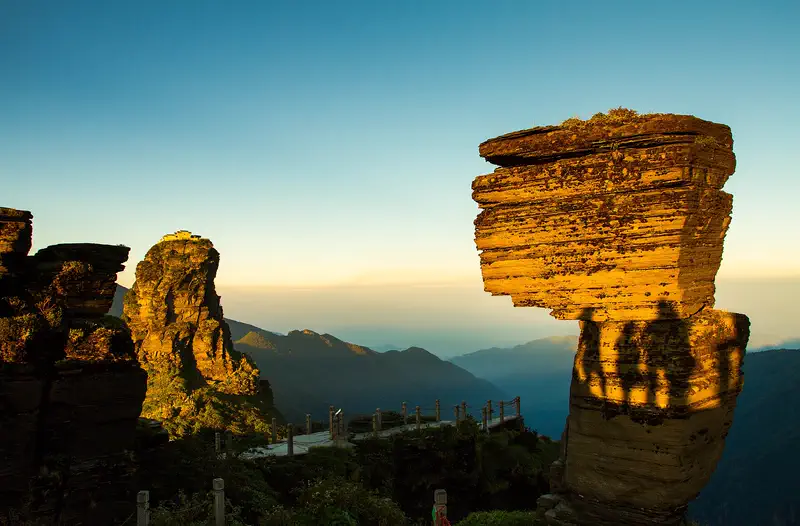
A Guizhou prefecture-level city and gateway to Fanjingshan — a sacred Buddhist mountain and UNESCO World Heritage Site with a remarkable double-peak rock formation rising above primeval forest.
Tongren is a prefecture-level city in northeastern Guizhou, sitting at the eastern edge of the Guizhou plateau where it descends toward Hunan province. The city is the gateway to Fanjingshan (梵净山) — the highest peak of the Wuling Mountain Range at 2,572 metres, inscribed as a UNESCO World Heritage Site in 2018 for its remarkable biodiversity and its unique geological and ecological character.
Fanjingshan is one of the most biodiverse mountain ecosystems in China. The mountain's isolation — it rises as an isolated massif above the surrounding lower terrain — created conditions for the evolution of numerous endemic species, most notably the Guizhou snub-nosed monkey (one of China's rarest primates, with a global population estimated at around 800) and the Fanjingshan fir tree. The mountain also holds the Chinese giant salamander in its streams. The ecological significance of the mountain earned its UNESCO designation based on natural criteria rather than cultural ones.
The cultural character of Fanjingshan is also significant: the mountain is one of China's most important Buddhist sites, with a history of Buddhist activity dating back to the Ming dynasty and the remarkable New Golden Summit — a narrow sandstone pinnacle 100 metres tall with a Buddhist temple split into two by a natural cleft. The image of the two-temple rock is among the most widely reproduced photographs of Guizhou.
Tongren city itself is a river-valley city at the confluence of the Jin and Wujiang rivers. It serves primarily as the transport hub for visiting Fanjingshan, which is 80 km west.
Cultural & access notes
Fanjingshan is an active Buddhist site as well as a nature reserve. Pilgrims from across Guizhou and beyond visit the mountain on temple festival dates. Incense burning and prayer at the summit temples is ongoing. Respect the religious significance of the location alongside its ecological status.
What to see
- Fanjingshan New Golden Summit — the twin sandstone pinnacle with the split Buddhist temple
- Fanjingshan Old Golden Summit — the main peak at 2,493 m with summit shrine
- Guizhou snub-nosed monkey observation — the endemic primate population in the forest
- Primeval forest trails — the intact ancient forest ecosystem of the UNESCO core zone
- Buddhist shrines along the ascent trail — pilgrimage-path temples from the Ming dynasty
- Red Clouds Golden Summit cable car — the gondola to the upper mountain, dramatically positioned
What to eat
- Tongren Lao'erma chilli brand — the city is home to one of China's most famous chilli condiment brands
- Guizhou sour soup hot pot — the fermented vegetable base hot pot widely available
- Smoked pork and dried chilli dishes — a Guizhou mountain staple
- Rice wine and sorghum spirit (moutai country — the Maotai region is to the southwest)
- Wild mountain vegetables and mushroom dishes
Getting there
Tongren Fanjingshan Airport (TEN) has flights from Guiyang, Chengdu, Guangzhou and some other cities. From Guiyang East by high-speed rail approximately 1.5 hours to Tongren South station. Fanjingshan scenic area is 80 km west of Tongren by tourist bus (about 2 hours) or hired vehicle.
Getting around
Tongren city is served by taxis. The journey to Fanjingshan is by bus from Tongren coach station or hired vehicle. Within the scenic area, a cable car serves the upper mountain; the lower approach is by foot on stone steps.
Where to stay
Tongren city has a range of hotels. Accommodation is also available at the Fanjingshan scenic area base (Jiangkou County town) for those starting early. The cable car and summit area do not have accommodation.
We list neighbourhoods, not specific hotels — we don't endorse hotels.
When to go
April–May and September–October are ideal. Spring brings wildflowers and clear mountain visibility. The mountain can be cloudy year-round — clear summit days are more common in autumn. Summer (June–August) is warm and rainy; the forest is magnificent but clouds often obscure the summit. Winter brings snow and ice to the upper mountain.
Budget guide (CNY per day)
| Backpacker | ¥200 |
| Mid-range | ¥420 |
| Comfortable | ¥850 |
Safety notes
The ascent to the New Golden Summit on foot involves steep stairs and exposed sections near the top. The footbridge between the two summit pinnacles is narrow and subject to wind. Not recommended for those with severe vertigo. Mountain weather changes rapidly — bring warm and waterproof layers. The cable car reduces the most strenuous ascent section.
Nearby attractions
Other cities in Guizhou
- Anshun安顺
A Guizhou plateau city and gateway to Huangguoshu Falls — China's largest waterfall — and to the Tunpu villages where descendants of Ming-dynasty Han settlers maintain a 600-year-old cultural enclave.
- Guiyang贵阳
Capital of Guizhou, gateway to the Miao and Dong ethnic-minority villages and to the Huangguoshu Waterfall — China's largest. Cool mountain climate, sour and spicy local cooking.
- Kaili凯里
The hub city of Guizhou's Miao minority heartland, gateway to hundreds of traditional Miao and Dong villages and one of the densest concentrations of ethnic minority textile, silver and music cultures in China.
- Xijiang Qianhu Miao Village西江千户苗寨
The largest Miao village in the world — approximately 1,200 households of stacked wooden stilt houses covering a mountain valley in Guizhou — a living community and Guizhou's single most visited tourist site.
- Zhaoxing肇兴
The largest Dong village in China, with five timber drum towers, covered wind-and-rain bridges, and an intact living Dong culture in the mountains of southeastern Guizhou.
Food of Southwestern China
- Baba Flatbread粑粑
Yunnan's daily flatbread — a thick wheat or rice-flour round cooked on a griddle and eaten plain or stuffed.
- Bang Bang Chicken棒棒鸡
Cold poached chicken shredded by hand, dressed in chilli oil, sesame paste and Sichuan peppercorn.
- Boiled Fish in Chilli Oil水煮鱼
Fish slices submerged in a deep pool of chilli oil and Sichuan peppercorns. Served bubbling.
- Chongqing Hotpot重庆火锅
The original mala hotpot — a simmering cauldron of beef tallow, Pixian doubanjiang and Sichuan peppercorn for communal dipping.
Tongren weather by month
| Month | Jan | Feb | Mar | Apr | May | Jun | Jul | Aug | Sep | Oct | Nov | Dec |
|---|---|---|---|---|---|---|---|---|---|---|---|---|
| High °C | 10 | 12 | 18 | 22 | 26 | 30 | 32 | 33 | 29 | 22 | 18 | 12 |
| Low °C | 3 | 5 | 10 | 13 | 18 | 23 | 25 | 25 | 21 | 15 | 11 | 5 |
| Rain mm | 99 | 108 | 174 | 211 | 255 | 295 | 191 | 165 | 89 | 74 | 92 | 43 |
| Rain days | 14 | 18 | 19 | 17 | 20 | 19 | 17 | 14 | 10 | 12 | 12 | 7 |
2019–2023 average via Open-Meteo ERA5 (ERA5 reanalysis). "Rain days" = days per month with ≥1 mm precipitation.
Frequently asked questions
- When is the best time to visit Tongren?
- The best months to visit Tongren are April, May, September, and October. April–May and September–October are ideal. Spring brings wildflowers and clear mountain visibility.
- How many days do you need in Tongren?
- Plan 3 days for Tongren if you want to see the headline sights without rushing — Fanjingshan New Golden Summit, Fanjingshan Old Golden Summit, Guizhou snub. Add an extra day for day trips from the city or for repeat visits to your favourite neighbourhood.
- Is Tongren safe for tourists?
- The ascent to the New Golden Summit on foot involves steep stairs and exposed sections near the top. The footbridge between the two summit pinnacles is narrow and subject to wind. Not recommended for those with severe vertigo.
- How do you get around Tongren?
- Tongren city is served by taxis. The journey to Fanjingshan is by bus from Tongren coach station or hired vehicle. Within the scenic area, a cable car serves the upper mountain; the lower approach is by foot on stone steps.
- What's the daily budget for Tongren?
- Budget guide for Tongren: backpackers from around ¥200/day, mid-range travellers ¥420/day, comfortable trips from ¥850/day. These ranges cover accommodation, food, local transport and one paid sight per day, and exclude flights to and from the city.
- Where should you stay in Tongren?
- Tongren city has a range of hotels. Accommodation is also available at the Fanjingshan scenic area base (Jiangkou County town) for those starting early. The cable car and summit area do not have accommodation.
Spotted something out of date? Submit a correction.
Research
Cross-checked against primary sources
Verified
Address, hours, fees confirmed at the date shown
Updated
Re-verified periodically; corrections welcome