CITY · GANSU
Zhangye
张掖 · Zhāngyè
Overview
Hexi Corridor city famous for the multicoloured Danxia rainbow mountains (UNESCO) and the 11th-century Giant Buddha Temple housing the largest reclining Buddha in China.
Zhangye was a major Han-dynasty garrison and one of the four founding cities of the Hexi Corridor — the narrow strip of Gansu through which the Silk Road funnelled. The city sits at 1,500 metres in an oasis supplied by Qilian Mountain snowmelt, and the surrounding landscape swings between irrigated farmland and desert depending on the direction.
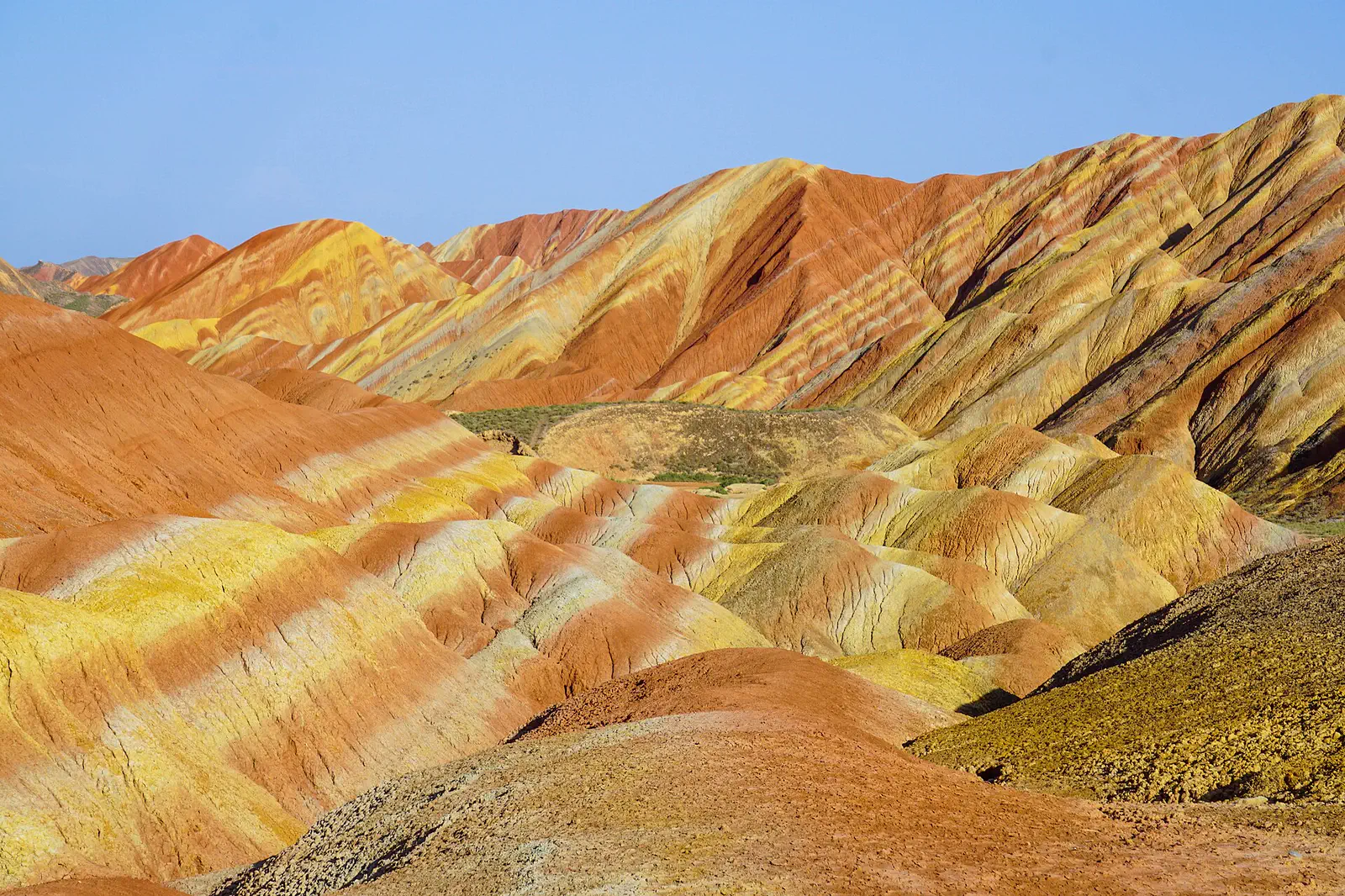
The city's contemporary fame rests on the Zhangye Danxia geopark, 40 km west: multi-coloured sedimentary sandstone formations compressed into horizontal strata of red, orange, purple, ochre and grey, eroded into rounded ridgelines and valleys. The colours are at their strongest at sunrise and sunset, and the difference between midday and golden-hour photography here is genuinely extreme. UNESCO-listed in 2010 as part of the China Danxia group. The geopark has a shuttle-bus system and several viewing platforms at different elevations.
The Giant Buddha Temple (Dafosi, 1098 CE) in central Zhangye houses a 35-metre clay reclining Buddha — the largest indoor reclining figure in China — surrounded by ten disciples and eighteen arhats along the walls of the original Tang-Song hall. Marco Polo is reputed to have spent a year in Zhangye during his 1270s journey through China.
The Mati Temple Grottoes (Fan Ying Grottoes), 65 km south into the Qilian Mountains at 2,030 metres, contain Buddhist cliff-face carvings from the 4th to 14th centuries, with Tibetan Buddhist elements particularly dominant from the Yuan dynasty onward.
What to see
- Zhangye Danxia geopark (UNESCO) — rainbow mountains
- Giant Buddha Temple (1098 CE)
- Mati Temple Grottoes
- Bingou (Ice Gorge) Danxia
What to eat
- Lanzhou-style hand-pulled noodles
- Hexi Corridor lamb
Getting there
Zhangye Ganzhou (YZY) airport. HSR Lanzhou 3h, Dunhuang 2h, Xining 4h.
Getting around
Bus + tour vehicle for the Danxia.
Where to stay
Central Zhangye for the Buddha Temple; near the Danxia entrance for sunrise.
We list neighbourhoods, not specific hotels — we don't endorse hotels.
When to go
May–October.
Budget guide (CNY per day)
| Backpacker | ¥220 |
| Mid-range | ¥500 |
| Comfortable | ¥1100 |
Nearby attractions
Other cities in Gansu
- Dunhuang敦煌
Silk Road oasis town in western Gansu. The Mogao Grottoes (UNESCO) are 492 Buddhist cave temples carved into a cliff between the 4th and 14th centuries — the greatest surviving Silk Road art repository in the world.
- Jiayuguan嘉峪关
A desert city in the Hexi Corridor of Gansu, home to the western terminus of the Ming Great Wall and the Jiayuguan Fort — the First and Greatest Pass Under Heaven — gateway of the ancient Silk Road.
- Lanzhou兰州
Yellow River city stretched along a narrow valley. Gateway to the Silk Road (Dunhuang, Jiayuguan, Zhangye) and the home of Lanzhou hand-pulled beef noodles.
- Tianshui天水
Gansu's second city and a pivotal Silk Road waypoint, most visited for the Maijishan Grottoes — 194 Buddhist cave temples cut into a dramatic isolated butte that represents some of the finest Wei-dynasty sculpture in China.
Itineraries visiting Zhangye
- Gansu and Ningxia — Yinchuan, Lanzhou, Zhangye, Jiayuguan and Dunhuang, 7 days
7d · Seven days across two northwest provinces — the Hui Muslim city of Yinchuan, Yellow River Lanzhou, the Danxia rainbow hills, Jiayuguan Fort and the Mogao Caves at Dunhuang.
- Silk Road — Xi'an, Lanzhou, Zhangye, Jiayuguan, Dunhuang
10d · The Hexi Corridor: Xi'an east-to-west by HSR through the Buddhist cave-temples and Silk Road forts.
- Silk Road — Xi'an to Kashgar, 14 days
14d · The full Hexi Corridor route from Xi'an west through Lanzhou, Dunhuang and the Taklamakan edge to Turpan and Kashgar — the historical Silk Road across northwest China.
- First-timer China — 21 days with northwest Silk Road extension
21d · Three weeks across China: the classic eastern cities, a Yunnan highland loop, and a Silk Road extension through Gansu into the northwest — covering the range of what China actually contains.
Food of Northwestern China
- Biangbiang Noodlesbiáng biáng 面
Wide, hand-pulled, belt-shaped Shaanxi noodles. The 'biang' character is the most complex in the Chinese language.
- Big Plate Chicken大盘鸡
A large-portioned Xinjiang braised chicken dish with potatoes, peppers and thick hand-pulled belt noodles.
- Hand-Grasped Lamb手抓羊肉
Large bone-in lamb pieces boiled in spiced water and eaten by hand — a communal dish of Inner Mongolia and the northwest.
- Laghman (Hand-Pulled Noodles with Lamb)拉条子
Uyghur hand-pulled wheat noodles with a lamb-and-vegetable sauce of tomato, pepper and onion.
Zhangye weather by month
| Month | Jan | Feb | Mar | Apr | May | Jun | Jul | Aug | Sep | Oct | Nov | Dec |
|---|---|---|---|---|---|---|---|---|---|---|---|---|
| High °C | 1 | 5 | 14 | 19 | 24 | 29 | 32 | 30 | 26 | 16 | 8 | 1 |
| Low °C | -12 | -8 | -2 | 3 | 9 | 15 | 17 | 17 | 12 | 3 | -5 | -11 |
| Rain mm | 3 | 4 | 4 | 13 | 24 | 28 | 27 | 52 | 27 | 8 | 6 | 2 |
| Rain days | 1 | 1 | 1 | 4 | 5 | 5 | 6 | 7 | 4 | 2 | 2 | 1 |
2019–2023 average via Open-Meteo ERA5 (ERA5 reanalysis). "Rain days" = days per month with ≥1 mm precipitation.
Frequently asked questions
- When is the best time to visit Zhangye?
- The best months to visit Zhangye are May, June, September, and October. May–October.
- How many days do you need in Zhangye?
- Plan 2 days for Zhangye if you want to see the headline sights without rushing — Zhangye Danxia geopark (UNESCO), Giant Buddha Temple (1098 CE), Mati Temple Grottoes. Add an extra day for day trips from the city or for repeat visits to your favourite neighbourhood.
- How do you get around Zhangye?
- Bus + tour vehicle for the Danxia.
- What's the daily budget for Zhangye?
- Budget guide for Zhangye: backpackers from around ¥220/day, mid-range travellers ¥500/day, comfortable trips from ¥1100/day. These ranges cover accommodation, food, local transport and one paid sight per day, and exclude flights to and from the city.
- Where should you stay in Zhangye?
- Central Zhangye for the Buddha Temple; near the Danxia entrance for sunrise.
Spotted something out of date? Submit a correction.
Research
Cross-checked against primary sources
Verified
Address, hours, fees confirmed at the date shown
Updated
Re-verified periodically; corrections welcome