CITY · GANSU
Tianshui
天水 · Tiānshuǐ
Overview
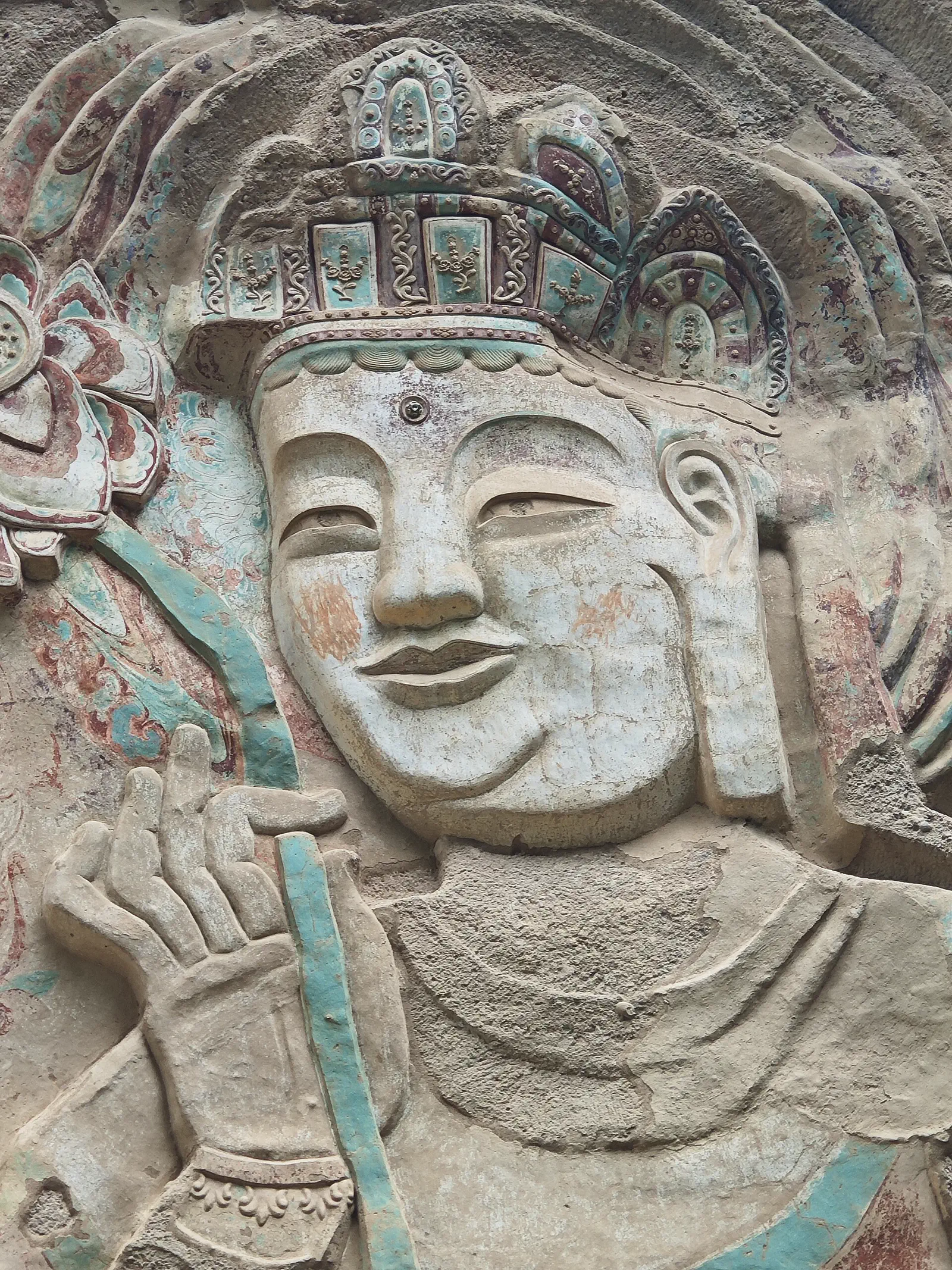
Gansu's second city and a pivotal Silk Road waypoint, most visited for the Maijishan Grottoes — 194 Buddhist cave temples cut into a dramatic isolated butte that represents some of the finest Wei-dynasty sculpture in China.
Tianshui occupies the upper Wei River valley in southeastern Gansu, the natural corridor through which the ancient Silk Road passed between the Guanzhong plain and the Hexi Corridor. The city is one of the oldest continuously inhabited urban areas in China — legend identifies it as the birthplace of Fuxi, a mythological ancestor-figure of the Chinese people — and it accumulated Buddhist, Taoist, and Confucian monuments across successive dynasties.
The overwhelming draw today is Maijishan (Haystack Mountain), 45 km southeast of the city. This isolated sandstone butte, which does indeed resemble an enormous haystack rising from forested hills, was quarried by Buddhist devotees from the Later Qin dynasty (384–417 CE) onwards, who cut 194 caves into its near-vertical face and connected them with a web of timber-and-iron catwalks that remain vertiginous to walk today. The sculptures inside range from Wei-dynasty figures with the characteristic elongated, other-worldly serenity of early Chinese Buddhist art, through Northern Zhou and Sui work, to Tang and Song restorations. The cave murals, though damaged by moisture over the centuries, preserve significant colour in the better-protected interiors. The site is less visited and less over-restored than the more famous Longmen or Yungang grottoes, which gives it an atmosphere of genuine discovery.
Within the city, Fuxi Temple is a substantial Taoist complex dedicated to the mythological founding ancestor, active as a pilgrimage site for Chinese worshippers seeking connections to cultural origins. The Yuquan Monastery, set on a hillside west of the city, mixes Taoist and Buddhist elements in an arrangement of terraced courtyards and timber halls that illustrates how the two traditions coexisted in northwestern China.
Tianshui lies on the Longhai Railway — the main east-west artery through Gansu — making it accessible as a day-stop on journeys between Xi'an and Lanzhou. Rail is the most practical mode of transport; the small airport at Maiji (THQ) operates limited services. The city's food culture reflects its position at the edge of the Guanzhong culinary zone, with lamian hand-pulled noodles and spiced lamb dishes at the core.
Cultural & access notes
The Maijishan catwalks are genuinely exposed — vertigo sufferers should consider this carefully. Photography inside the caves requires a permit in some sections. Flash photography is prohibited universally to protect the pigments.
What to see
- Maijishan Grottoes — 194 Buddhist cave temples on a sandstone butte, iron catwalks and Wei-dynasty sculptures
- Fuxi Temple — large Taoist complex dedicated to the mythological ancestor, continuous pilgrimage site
- Yuquan Monastery — terraced hill monastery blending Taoist and Buddhist traditions west of the city
- Maiji Mountain Scenic Area — forest trails and viewpoints surrounding the grotto complex
- Tianshui Museum — local history and artefacts from the Wei River valley civilisations
- Yimen Ancient Town (Wushan) — preserved traditional streetscape 60 km west
- Dadiwan Archaeological Site — Neolithic settlement with some of the earliest Chinese pottery traditions
- Qinzhou Old District — traditional architecture surviving in the eastern part of the city
What to eat
- Tianshui lamian (天水拉面) — hand-pulled noodles served in broth with beef or lamb, a local everyday staple
- Mahua (馓子) — twisted fried dough snack eaten with tea, common across northwest China
- Tianshui baozi (包子) — steamed buns with spiced lamb or vegetable fillings from street stalls
- Mutton stew (羊肉泡馍) — bread soaked in slow-cooked lamb broth, popular in the older market areas
- Gansu-style cold noodles (凉面) — noodles dressed with chilli oil, vinegar, and cucumber
- Walnuts and dried fruits from the Wei River valley — local agricultural products sold at market stalls
Getting there
Tianshui Maiji Airport (THQ) has flights to Beijing, Xi'an, and Chengdu, though services are limited. Rail is more practical: Tianshui South station on the Longhai line connects to Xi'an (2.5 hours by high-speed), Lanzhou (1.5 hours), and Zhengzhou. From Xi'an, afternoon departures allow an evening arrival. Maijishan is 45 km from the central railway station by bus or taxi.
Getting around
Tourist buses connect Tianshui South station to Maijishan on a seasonal timetable. Taxis to Maijishan take about 50 minutes. City bus services cover the urban area between the east (Qinzhou) and west (Maiji) districts, which are 12 km apart along the river valley.
Where to stay
Mid-range hotels concentrate near the railway station and along the main commercial thoroughfares. Budget guesthouses are available near both Fuxi Temple and the Maijishan park entrance. Accommodation at the Maijishan scenic area itself is limited; most visitors stay in the city and make a day trip.
We list neighbourhoods, not specific hotels — we don't endorse hotels.
When to go
Late spring (April–June) and early autumn (September–October) offer clear skies and mild temperatures for the cave visits. Summer brings more precipitation and haze. The catwalk paths at Maijishan can be slippery after rain; avoid visiting immediately following heavy showers. Winter is cold and dry; the caves are accessible but services around the site are reduced.
Budget guide (CNY per day)
| Backpacker | ¥150 |
| Mid-range | ¥350 |
| Comfortable | ¥750 |
Other cities in Gansu
- Dunhuang敦煌
Silk Road oasis town in western Gansu. The Mogao Grottoes (UNESCO) are 492 Buddhist cave temples carved into a cliff between the 4th and 14th centuries — the greatest surviving Silk Road art repository in the world.
- Jiayuguan嘉峪关
A desert city in the Hexi Corridor of Gansu, home to the western terminus of the Ming Great Wall and the Jiayuguan Fort — the First and Greatest Pass Under Heaven — gateway of the ancient Silk Road.
- Lanzhou兰州
Yellow River city stretched along a narrow valley. Gateway to the Silk Road (Dunhuang, Jiayuguan, Zhangye) and the home of Lanzhou hand-pulled beef noodles.
- Zhangye张掖
Hexi Corridor city famous for the multicoloured Danxia rainbow mountains (UNESCO) and the 11th-century Giant Buddha Temple housing the largest reclining Buddha in China.
Itineraries visiting Tianshui
Food of Northwestern China
- Biangbiang Noodlesbiáng biáng 面
Wide, hand-pulled, belt-shaped Shaanxi noodles. The 'biang' character is the most complex in the Chinese language.
- Big Plate Chicken大盘鸡
A large-portioned Xinjiang braised chicken dish with potatoes, peppers and thick hand-pulled belt noodles.
- Hand-Grasped Lamb手抓羊肉
Large bone-in lamb pieces boiled in spiced water and eaten by hand — a communal dish of Inner Mongolia and the northwest.
- Laghman (Hand-Pulled Noodles with Lamb)拉条子
Uyghur hand-pulled wheat noodles with a lamb-and-vegetable sauce of tomato, pepper and onion.
Tianshui weather by month
| Month | Jan | Feb | Mar | Apr | May | Jun | Jul | Aug | Sep | Oct | Nov | Dec |
|---|---|---|---|---|---|---|---|---|---|---|---|---|
| High °C | 4 | 8 | 14 | 18 | 23 | 27 | 29 | 28 | 23 | 16 | 11 | 5 |
| Low °C | -4 | -2 | 3 | 7 | 11 | 16 | 18 | 18 | 14 | 8 | 2 | -4 |
| Rain mm | 9 | 22 | 39 | 73 | 82 | 88 | 133 | 137 | 91 | 95 | 17 | 9 |
| Rain days | 4 | 6 | 10 | 10 | 11 | 10 | 12 | 14 | 12 | 12 | 6 | 3 |
2019–2023 average via Open-Meteo ERA5 (ERA5 reanalysis). "Rain days" = days per month with ≥1 mm precipitation.
Frequently asked questions
- When is the best time to visit Tianshui?
- The best months to visit Tianshui are April, May, June, September, and October. Late spring (April–June) and early autumn (September–October) offer clear skies and mild temperatures for the cave visits. Summer brings more precipitation and haze.
- How many days do you need in Tianshui?
- Plan 4 to 5 days for Tianshui if you want to see the headline sights without rushing — Maijishan Grottoes, Fuxi Temple, Yuquan Monastery. Add an extra day for day trips from the city or for repeat visits to your favourite neighbourhood.
- How do you get around Tianshui?
- Tourist buses connect Tianshui South station to Maijishan on a seasonal timetable. Taxis to Maijishan take about 50 minutes. City bus services cover the urban area between the east (Qinzhou) and west (Maiji) districts, which are 12 km apart along the river valley.
- What's the daily budget for Tianshui?
- Budget guide for Tianshui: backpackers from around ¥150/day, mid-range travellers ¥350/day, comfortable trips from ¥750/day. These ranges cover accommodation, food, local transport and one paid sight per day, and exclude flights to and from the city.
- Where should you stay in Tianshui?
- Mid-range hotels concentrate near the railway station and along the main commercial thoroughfares. Budget guesthouses are available near both Fuxi Temple and the Maijishan park entrance. Accommodation at the Maijishan scenic area itself is limited; most visitors stay in the city and make a day trip.
Spotted something out of date? Submit a correction.
Research
Cross-checked against primary sources
Verified
Address, hours, fees confirmed at the date shown
Updated
Re-verified periodically; corrections welcome