CITY · HUBEI
Wuhan
武汉 · Wǔhàn
Overview
China's central transport hub at the meeting of the Yangtze and Han rivers. Yellow Crane Tower, East Lake, the spicy noodle breakfast (re gan mian), and the country's largest university belt.
Wuhan is three cities — Wuchang south of the Yangtze, Hankou north of the Yangtze, and Hanyang west of the Han River — fused into one in 1949. Together they make the largest city in central China and the rail interchange where the Beijing-Guangzhou and Shanghai-Chengdu high-speed lines cross, making Wuhan the transit hub of the country. The Wuchang Uprising of October 1911 began the revolution that ended the Qing dynasty; the city retains a distinct identity as the birthplace of Republican China.
The Yellow Crane Tower (Huanghelou) in Wuchang, rebuilt most recently in 1985 on its original site, is the city's symbol and one of China's three Great Towers of the South. The Tang poem by Cui Hao that made it famous ('The Yellow Crane is long departed, never to return; only the Yellow Crane Tower remains...') is carved on entrance plaques in several calligraphic versions. East Lake (Donghu), east of Wuchang, is one of the largest urban lakes in China; the lakeside Hubei Provincial Museum holds the Marquis Yi of Zeng bronzeware — a set of 65 cast-bronze bells tuned to a full musical scale, dated to 433 BCE and still playable. The 100 km East Lake Greenway cycling route circumnavigates the lake through parkland.
Wuhan University's hilltop campus, with its mix of 1930s Nationalist-era and forested hillside, is famous for its cherry blossom in mid-March — one of the most-visited blossom destinations in China. Reservations are typically required during the peak bloom period.
Wuhan's summer climate — flat terrain, river humidity, temperatures reliably above 35°C from late June to early September — is one of the most testing in China. March-April and October-November are the comfortable windows.
What to see
- Yellow Crane Tower (Huanghelou)
- East Lake (Donghu) — bike, hike, or boat; loop is half a day
- Hubei Provincial Museum and the Bianzhong bells
- Wuhan University campus in cherry-blossom season (mid-March)
- Hankou Bund (riverfront) — early-20th-century European-style buildings
- Guiyuan Buddhist Temple
- Tan Hua Lin restored old street
- Three Gorges Dam — 4 hours west, day trip from Yichang
What to eat
- Re gan mian (热干面) — hot dry noodles, the canonical Wuhan breakfast
- Doupi (豆皮) — pan-fried tofu skin and rice cake
- Spicy duck necks (鸭脖) — Wuhan's specialty snack, sold by the catty
- Wuchang fish (a local Yangtze species) steamed
- Mian wo (面窝) — savoury fried dough rings
Getting there
Wuhan Tianhe (WUH) airport, 26 km north — Line 2 metro to the city. Wuhan, Wuchang and Hankou Stations are all major HSR hubs: Beijing 4h, Shanghai 4h 30m, Guangzhou 4h, Chengdu 9h.
Getting around
Metro is essential (12 lines). The three city districts are large; budget time. Bike-share works. Didi works.
Where to stay
Wuchang (Yellow Crane Tower / Wuhan University) for sights. Hankou for the Bund and HSR access. Avoid summer months if possible.
We list neighbourhoods, not specific hotels — we don't endorse hotels.
When to go
March (cherry blossom) — early April; mid-September to early November. Avoid mid-summer.
Budget guide (CNY per day)
| Backpacker | ¥260 |
| Mid-range | ¥580 |
| Comfortable | ¥1300 |
Nearby attractions
China Visit Guide
Hubei Provincial Museum
Hubei Provincial Museum 湖北省博物馆
Major provincial museum east of central Wuhan. Famous for the Bianzhong bell-set of the Marquis Yi of Zeng.
China Visit Guide
Tusi Sites
Tusi Sites 土司遗址
UNESCO-listed trio of tusi chieftain capitals in southwest China — Laosicheng (Hunan), Tangya (Hubei) and Hailongtun (Guizhou) — representing the imperial tusi system of indirect rule over ethnic minority regions.
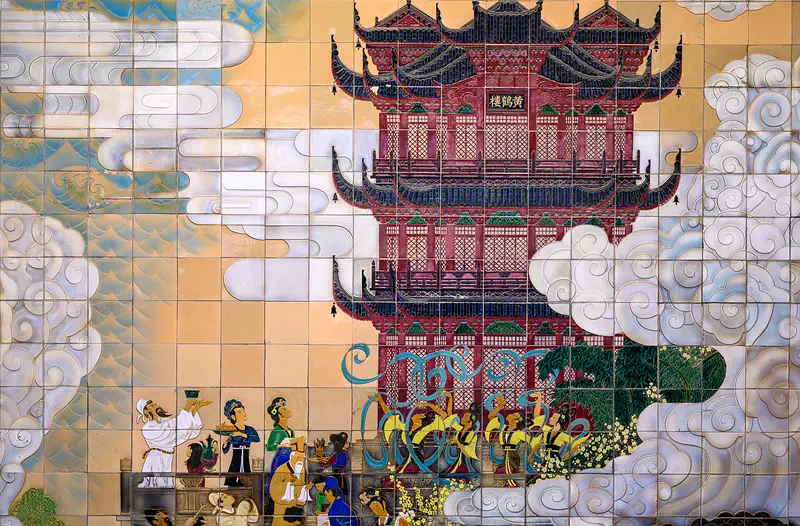
Yellow Crane Tower 黄鹤楼
Reconstructed pavilion overlooking the Yangtze in Wuchang. One of the Three Great Towers of the South.
More on Wuhan
Other cities in Hubei
- Shennongjia神农架
A national park and UNESCO World Biosphere Reserve in western Hubei containing one of China's most intact temperate forest ecosystems, named for the mythical Emperor Shennong who gathered medicinal herbs on its peaks.
- Wudang Mountains武当山
A UNESCO-listed mountain complex of Daoist temples and palaces in Hubei, regarded as the birthplace of Taijiquan and a living centre of Daoist martial arts practice.
- Yichang宜昌
Yangtze River city at the eastern end of the Three Gorges. The Three Gorges Dam (the world's largest hydroelectric station) is 40 km upstream; most Yangtze cruises terminate or originate here.
Itineraries visiting Wuhan
- Yangtze Three Gorges and Wudang Mountain, 7 days
7d · A compact version of the Yangtze cruise combining Chongqing, the three gorges downstream passage, and Wudang Mountain — ending in Wuhan for HSR connections.
- Yangtze Cruise with Add-ons — Chongqing to Wuhan, 10 days
10d · The Yangtze Three Gorges downstream cruise combined with two days in Chongqing and a day each at Fengdu Ghost City and Shennong Stream before arriving in Wuhan.
Food of Central China
- Chairman Mao's Red-Braised Pork毛氏红烧肉
Hunan-style slow-braised pork belly in soy, Shaoxing wine and chilli — the dish Mao Zedong reportedly ate weekly in Zhongnanhai.
- Doupi (Wuhan Tofu Skin)豆皮
Wuhan breakfast: layered pan-fried tofu skin and rice cake with mushroom, ham and bamboo shoots inside.
- Fish Head with Chopped Chilli剁椒鱼头
A whole silver carp head blanketed with fermented chopped red chilli and steamed until the flesh is silky and fiery.
- Hunan Chilli Fried Pork小炒肉
Thin-sliced pork belly wok-fried with fresh long green chillies and fermented black beans — Hunan's most-ordered everyday dish.
Wuhan weather by month
| Month | Jan | Feb | Mar | Apr | May | Jun | Jul | Aug | Sep | Oct | Nov | Dec |
|---|---|---|---|---|---|---|---|---|---|---|---|---|
| High °C | 9 | 12 | 18 | 22 | 26 | 30 | 32 | 33 | 30 | 23 | 18 | 11 |
| Low °C | 2 | 4 | 10 | 14 | 18 | 24 | 26 | 27 | 22 | 15 | 10 | 3 |
| Rain mm | 59 | 56 | 116 | 141 | 163 | 206 | 302 | 103 | 70 | 53 | 54 | 24 |
| Rain days | 9 | 10 | 12 | 10 | 13 | 15 | 15 | 9 | 6 | 8 | 9 | 4 |
2019–2023 average via Open-Meteo ERA5 (ERA5 reanalysis). "Rain days" = days per month with ≥1 mm precipitation.
Frequently asked questions
- When is the best time to visit Wuhan?
- The best months to visit Wuhan are March, April, October, and November. March (cherry blossom) — early April; mid-September to early November. Avoid mid-summer.
- How many days do you need in Wuhan?
- Plan 4 to 5 days for Wuhan if you want to see the headline sights without rushing — Yellow Crane Tower (Huanghelou), East Lake (Donghu), Hubei Provincial Museum and the Bianzhong bells. Add an extra day for day trips from the city or for repeat visits to your favourite neighbourhood.
- How do you get around Wuhan?
- Metro is essential (12 lines). The three city districts are large; budget time. Bike-share works.
- What's the daily budget for Wuhan?
- Budget guide for Wuhan: backpackers from around ¥260/day, mid-range travellers ¥580/day, comfortable trips from ¥1300/day. These ranges cover accommodation, food, local transport and one paid sight per day, and exclude flights to and from the city.
- Where should you stay in Wuhan?
- Wuchang (Yellow Crane Tower / Wuhan University) for sights. Hankou for the Bund and HSR access. Avoid summer months if possible.
Spotted something out of date? Submit a correction.
Research
Cross-checked against primary sources
Verified
Address, hours, fees confirmed at the date shown
Updated
Re-verified periodically; corrections welcome