CITY · HUBEI
Wudang Mountains
武当山 · Wǔdāng Shān
Overview
A UNESCO-listed mountain complex of Daoist temples and palaces in Hubei, regarded as the birthplace of Taijiquan and a living centre of Daoist martial arts practice.
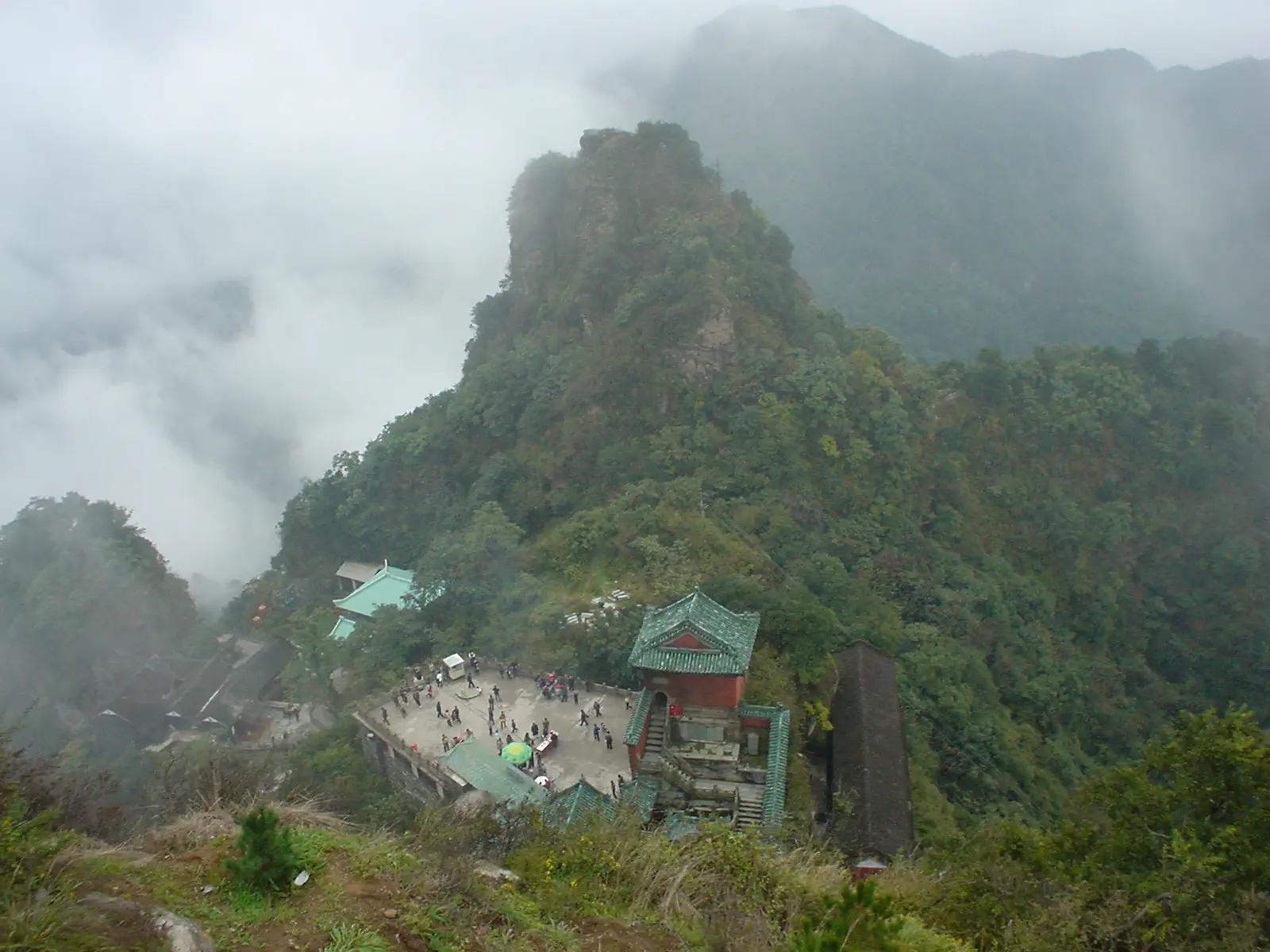
The Wudang Mountains — Wudang Shan — are a range of peaks and ridges in northwestern Hubei province, designated a UNESCO World Heritage Site in 1994 for their remarkable ensemble of Daoist religious architecture spanning the Yuan, Ming and Qing dynasties. The mountain holds over 70 surviving ancient buildings including the Golden Hall perched at the summit of Tianzhu Peak, the Purple Cloud Temple, the Nanyan Palace carved into a cliff face, and the sprawling Xuanwu complex at the base. The Ming Emperor Yongle devoted enormous resources to the mountain between 1412 and 1420, constructing palaces and halls to honour the Daoist deity Xuanwu (Zhenwu), whose protection he credited with helping him seize the throne.
The Wudang Mountains are also the site most associated with the origin of Taijiquan — the slow-motion internal martial art practised globally. The legendary figure of Zhang Sanfeng, said to have created Taijiquan on the mountain, is venerated at several sites, and the tradition of Daoist internal martial arts (wudang wugong) has been practised continuously on the mountain. Today the mountain attracts both religious pilgrims and martial arts students, with a number of schools offering short courses.
The gateway city is Shiyan, a mid-sized industrial city in northwestern Hubei known as the home of Dongfeng Motor. Wudang Shan town (the scenic area base) is about 75 km south of Shiyan city centre. High-speed rail to Wudang Shan station connects to Wuhan in approximately 2 hours. Wuhan is the practical major hub for most visitors.
Cultural & access notes
Wudang is an actively practised Daoist tradition, not a heritage exhibit. Morning and evening ceremonies at the Purple Cloud Temple follow a daily schedule. Visitors should behave appropriately in temple buildings — remove hats, avoid loud conversations, and do not disrupt ongoing ceremonies. Martial arts practice areas near the temples are used by resident students; respectful observation is generally welcomed.
What to see
- Golden Hall (Jin Dian) — gilded bronze hall at the summit of Tianzhu Peak (1,612 m)
- Nanyan Palace — Song-dynasty cliff-face palace with dramatic overhanging settings
- Purple Cloud Temple — major Ming-dynasty complex, the main active monastery
- Xuanwu Hall at the mountain base — gateway temple complex
- Taijiquan practice grounds — early-morning sessions near the Purple Cloud Temple
- Tianzhu Peak cable car — the primary route to the summit zone
- Wudang Shan town — base settlement with accommodation and guesthouses
What to eat
- Daoist vegetarian cuisine — prepared by mountain temples and nearby restaurants
- Jian beef noodles — Hubei-style beef broth noodles in Shiyan and mountain town
- Wild mushroom dishes — foraged mountain varieties in autumn
- Corn and sweet potato — vendors throughout the scenic area
- Sesame oil tofu dishes — a Hubei staple
Getting there
Wudang Shan station on the Hankou-Shiyan high-speed rail line is the most convenient gateway — from Wuhan approximately 2 hours. The station is at the base of the scenic area. The nearest airport is Shiyan Wudangshan Airport, with limited connections; Wuhan Tianhe Airport (WUH) offers far greater route choice. Direct long-distance coaches also run from Wuhan.
Getting around
The scenic area operates shuttle buses between temples. Cable cars serve the upper mountain zone. Walking trails connect the major sites. The summit area around Tianzhu Peak requires a dedicated half-day.
Where to stay
Wudang Shan town at the scenic area base has guesthouses and mid-range hotels. Several monastery-adjacent guesthouses offer simple rooms for visitors wishing to observe morning and evening religious activities. Shiyan has a wider range of urban hotels.
We list neighbourhoods, not specific hotels — we don't endorse hotels.
When to go
April–May and September–November are ideal: clear mountain visibility, moderate temperatures, autumn foliage in October–November. Summer (June–August) is hot and humid with heavy rain. Winter is cold and can be icy above 1,000 m; the Golden Hall is a dramatic snow scene on clear winter mornings.
Budget guide (CNY per day)
| Backpacker | ¥200 |
| Mid-range | ¥420 |
| Comfortable | ¥800 |
Safety notes
The mountain paths are well maintained but the summit zone involves exposed ridges. The climb to the Golden Hall involves narrow stone stairs on a steep ridge — not suitable for those with severe acrophobia. In wet conditions, stone steps become slippery.
Nearby attractions
Day trips within 150 km
Other cities in Hubei
- Shennongjia神农架
A national park and UNESCO World Biosphere Reserve in western Hubei containing one of China's most intact temperate forest ecosystems, named for the mythical Emperor Shennong who gathered medicinal herbs on its peaks.
- Wuhan武汉
China's central transport hub at the meeting of the Yangtze and Han rivers. Yellow Crane Tower, East Lake, the spicy noodle breakfast (re gan mian), and the country's largest university belt.
- Yichang宜昌
Yangtze River city at the eastern end of the Three Gorges. The Three Gorges Dam (the world's largest hydroelectric station) is 40 km upstream; most Yangtze cruises terminate or originate here.
Itineraries visiting Wudang Mountains
- Shaolin and Taoist Mountains Circuit, 7 days
7d · Central China's sacred mountain loop: Shaolin Temple on Song Shan, Mount Hua's vertiginous plank walk, and the Taoist pilgrimage site of Wudang Mountain.
- Yangtze Three Gorges and Wudang Mountain, 7 days
7d · A compact version of the Yangtze cruise combining Chongqing, the three gorges downstream passage, and Wudang Mountain — ending in Wuhan for HSR connections.
Food of Central China
- Chairman Mao's Red-Braised Pork毛氏红烧肉
Hunan-style slow-braised pork belly in soy, Shaoxing wine and chilli — the dish Mao Zedong reportedly ate weekly in Zhongnanhai.
- Doupi (Wuhan Tofu Skin)豆皮
Wuhan breakfast: layered pan-fried tofu skin and rice cake with mushroom, ham and bamboo shoots inside.
- Fish Head with Chopped Chilli剁椒鱼头
A whole silver carp head blanketed with fermented chopped red chilli and steamed until the flesh is silky and fiery.
- Hunan Chilli Fried Pork小炒肉
Thin-sliced pork belly wok-fried with fresh long green chillies and fermented black beans — Hunan's most-ordered everyday dish.
Wudang Mountains weather by month
| Month | Jan | Feb | Mar | Apr | May | Jun | Jul | Aug | Sep | Oct | Nov | Dec |
|---|---|---|---|---|---|---|---|---|---|---|---|---|
| High °C | 0 | 3 | 10 | 13 | 19 | 22 | 23 | 24 | 19 | 12 | 8 | 2 |
| Low °C | -6 | -5 | 0 | 5 | 10 | 14 | 16 | 16 | 12 | 6 | 1 | -5 |
| Rain mm | 27 | 32 | 69 | 72 | 55 | 131 | 128 | 154 | 99 | 117 | 41 | 11 |
| Rain days | 6 | 7 | 10 | 10 | 9 | 12 | 17 | 15 | 12 | 12 | 7 | 3 |
2019–2023 average via Open-Meteo ERA5 (ERA5 reanalysis). "Rain days" = days per month with ≥1 mm precipitation.
Frequently asked questions
- When is the best time to visit Wudang Mountains?
- The best months to visit Wudang Mountains are April, May, September, October, and November. April–May and September–November are ideal: clear mountain visibility, moderate temperatures, autumn foliage in October–November. Summer (June–August) is hot and humid with heavy rain.
- How many days do you need in Wudang Mountains?
- Plan 3 days for Wudang Mountains if you want to see the headline sights without rushing — Golden Hall (Jin Dian), Nanyan Palace, Purple Cloud Temple. Add an extra day for day trips from the city or for repeat visits to your favourite neighbourhood.
- Is Wudang Mountains safe for tourists?
- The mountain paths are well maintained but the summit zone involves exposed ridges. The climb to the Golden Hall involves narrow stone stairs on a steep ridge — not suitable for those with severe acrophobia. In wet conditions, stone steps become slippery.
- How do you get around Wudang Mountains?
- The scenic area operates shuttle buses between temples. Cable cars serve the upper mountain zone. Walking trails connect the major sites.
- What's the daily budget for Wudang Mountains?
- Budget guide for Wudang Mountains: backpackers from around ¥200/day, mid-range travellers ¥420/day, comfortable trips from ¥800/day. These ranges cover accommodation, food, local transport and one paid sight per day, and exclude flights to and from the city.
- Where should you stay in Wudang Mountains?
- Wudang Shan town at the scenic area base has guesthouses and mid-range hotels. Several monastery-adjacent guesthouses offer simple rooms for visitors wishing to observe morning and evening religious activities. Shiyan has a wider range of urban hotels.
Spotted something out of date? Submit a correction.
Research
Cross-checked against primary sources
Verified
Address, hours, fees confirmed at the date shown
Updated
Re-verified periodically; corrections welcome