CITY · HENAN
Kaifeng
开封 · Kāifēng
Overview
Former Northern Song capital (960–1127), 70 km east of Zhengzhou. Reconstructed Song-dynasty themed old town, the Iron Pagoda, and the night market — one of the country's oldest.
Kaifeng was the capital of the Northern Song dynasty from 960 to 1127, during which period it was likely the largest city in the world, with a population estimated at over one million. The city's commercial and cultural life in that era is documented in Along the River During the Qingming Festival (Qingming Shanghe Tu), a 5.25-metre handscroll painted around 1085–1145 CE by Zhang Zeduan, depicting street life along the Bian River during the Qingming festival — shops, boats, acrobats, teahouses, bridges, and thousands of individual figures. It is one of the most-studied paintings in Chinese art history.
The Jurchen Jin dynasty captured Kaifeng in 1127, ending the Northern Song, and the court fled south to Lin'an (modern Hangzhou). What followed for Kaifeng was a series of historical catastrophes: repeated Yellow River flooding, deliberate flooding by the Ming general defending against Li Zicheng's rebels in 1642 (which drowned perhaps 300,000 people and buried much of the city under metres of silt), and later floods. The result is that each flooding event buried the previous city layer under alluvial deposits; Kaifeng sits on top of six previous cities.
The Millennium City Park (Qingming Shanghe Yuan) is a large reconstructed Song-era theme park built around the imagery of Zhang Zeduan's painting. It is theatrical rather than historical — costumed performers, scripted demonstrations, and recreated Song buildings — but it draws large crowds of Chinese visitors who engage enthusiastically with the performative history. The park is more interesting as a window into how the Song is remembered and performed in contemporary China than as a historical document.
The Iron Pagoda (Tieye Ta) is the unreconstructed landmark: a 56-metre Northern Song pagoda built in 1049 CE, covered in glazed brown tiles that give it the colour of iron. It survived the city's various disasters largely intact and remains one of the best-preserved Song-era structures in Henan.
Kaifeng also has a historically significant Jewish community — one of the oldest Jewish settlements in China, present since at least the Song dynasty. The community largely assimilated over subsequent centuries; the original synagogue was destroyed in a Yellow River flood. A Kaifeng Jewish heritage site and small museum document this unusual history.
The Drum Tower night market, occupying streets around the central drum tower, has been a food market for centuries and continues as an active street-food scene.
What to see
- Millennium City Park (Qingming Shanghe Yuan)
- Iron Pagoda
- Drum Tower night market
- Kaifeng Synagogue site (the oldest Jewish community in China)
What to eat
- Five-spice broad-bean cake
- Dabian baozi
- Kaifeng peanut cake
Getting there
Kaifeng HSR station: Zhengzhou 30 min.
Getting around
Walking the central old town.
Where to stay
Around the Iron Pagoda or the Drum Tower.
We list neighbourhoods, not specific hotels — we don't endorse hotels.
When to go
April–May, September–October.
Budget guide (CNY per day)
| Backpacker | ¥200 |
| Mid-range | ¥440 |
| Comfortable | ¥1000 |
Nearby attractions
Day trips within 150 km
Other cities in Henan
- Anyang安阳
UNESCO-listed Yin Xu — the late Shang dynasty capital and the earliest Chinese writing site (oracle bones). One of the cradles of Chinese civilisation; an under-touristed essential for serious history travellers.
- Dengfeng登封
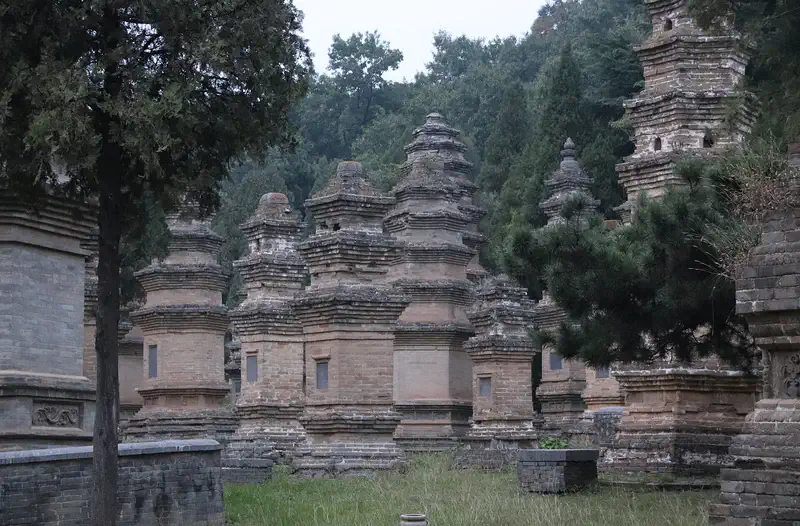
County-level city at the foot of Songshan, home to the Shaolin Temple and the UNESCO-listed Historic Monuments of Dengfeng — the most concentrated gathering of ancient Chinese ceremonial and educational architecture on a single mountain.
- Luoyang洛阳
Ancient capital of 13 dynasties, on the Luo River. Longmen Grottoes (UNESCO), White Horse Temple (the first Buddhist temple in China), and the Peony Festival in April.
- Zhengzhou郑州
Capital of Henan, transport hub of central China, and gateway to the Shaolin Temple, the Yellow River, and the Buddhist cliff carvings of Longmen.
Food of Central China
- Chairman Mao's Red-Braised Pork毛氏红烧肉
Hunan-style slow-braised pork belly in soy, Shaoxing wine and chilli — the dish Mao Zedong reportedly ate weekly in Zhongnanhai.
- Doupi (Wuhan Tofu Skin)豆皮
Wuhan breakfast: layered pan-fried tofu skin and rice cake with mushroom, ham and bamboo shoots inside.
- Fish Head with Chopped Chilli剁椒鱼头
A whole silver carp head blanketed with fermented chopped red chilli and steamed until the flesh is silky and fiery.
- Hunan Chilli Fried Pork小炒肉
Thin-sliced pork belly wok-fried with fresh long green chillies and fermented black beans — Hunan's most-ordered everyday dish.
Kaifeng weather by month
| Month | Jan | Feb | Mar | Apr | May | Jun | Jul | Aug | Sep | Oct | Nov | Dec |
|---|---|---|---|---|---|---|---|---|---|---|---|---|
| High °C | 7 | 11 | 18 | 22 | 28 | 33 | 32 | 31 | 28 | 21 | 15 | 8 |
| Low °C | -3 | 0 | 6 | 10 | 16 | 22 | 24 | 23 | 19 | 11 | 6 | -2 |
| Rain mm | 19 | 20 | 18 | 36 | 45 | 95 | 158 | 172 | 101 | 40 | 29 | 12 |
| Rain days | 3 | 4 | 3 | 5 | 4 | 8 | 12 | 12 | 7 | 6 | 4 | 3 |
2019–2023 average via Open-Meteo ERA5 (ERA5 reanalysis). "Rain days" = days per month with ≥1 mm precipitation.
Frequently asked questions
- When is the best time to visit Kaifeng?
- The best months to visit Kaifeng are April, May, September, and October. April–May, September–October.
- How many days do you need in Kaifeng?
- Plan 2 days for Kaifeng if you want to see the headline sights without rushing — Millennium City Park (Qingming Shanghe Yuan), Iron Pagoda, Drum Tower night market. Add an extra day for day trips from the city or for repeat visits to your favourite neighbourhood.
- How do you get around Kaifeng?
- Walking the central old town.
- What's the daily budget for Kaifeng?
- Budget guide for Kaifeng: backpackers from around ¥200/day, mid-range travellers ¥440/day, comfortable trips from ¥1000/day. These ranges cover accommodation, food, local transport and one paid sight per day, and exclude flights to and from the city.
- Where should you stay in Kaifeng?
- Around the Iron Pagoda or the Drum Tower.
Spotted something out of date? Submit a correction.
Research
Cross-checked against primary sources
Verified
Address, hours, fees confirmed at the date shown
Updated
Re-verified periodically; corrections welcome