CITY · HENAN
Dengfeng
登封 · Dēngfēng
Overview
County-level city at the foot of Songshan, home to the Shaolin Temple and the UNESCO-listed Historic Monuments of Dengfeng — the most concentrated gathering of ancient Chinese ceremonial and educational architecture on a single mountain.
Dengfeng sits within the embrace of Songshan, one of China's five sacred mountains, in the heart of Henan province. The city's name means 'ascending to the peak in tribute', a nod to the imperial sacrificial rituals performed on Songshan since the Han dynasty. For travellers, Dengfeng is primarily the gateway to Shaolin Temple and a remarkable cluster of ancient structures that together form the Historic Monuments of Dengfeng, inscribed on the UNESCO World Heritage List in 2010.
The Shaolin Temple complex occupies a sheltered valley on the northern slopes of Songshan. Founded in 495 CE during the Northern Wei dynasty as a translation centre for Buddhist scriptures, it became associated with Chan (Zen) Buddhism after the Indian monk Bodhidharma is said to have meditated here in the 6th century. The martial arts tradition for which it is now known worldwide grew gradually over the Tang and Song dynasties, reaching its most elaborate codification in the Ming period. The temple complex includes the main hall, the Pagoda Forest — a grove of over 240 brick and stone funerary stupas spanning 1,400 years — and the martial arts training grounds where monks and lay students continue to practise.
Beyond Shaolin, the Historic Monuments of Dengfeng take in the Songyang Academy, one of the four great academies of the Northern Song dynasty; the Zhongyue Temple, the largest Taoist complex in Henan; the Zhou Royal Measurement Platform, a gnomon and star-observation tower used in the 8th century to determine the earth's meridian; and several other Song and Tang structures. The concentration of sites within a compact area makes Dengfeng unusually rewarding for those with a serious interest in Chinese civilisational history.
The city itself is a functional county town with limited conventional tourism infrastructure, which keeps the atmosphere relatively unpolished. A growing number of martial arts schools around Dengfeng accept short-term students — from week-long taster courses to multi-year residencies — attracting a steady stream of international visitors beyond the day-trip crowd from Zhengzhou.
Cultural & access notes
Shaolin Temple is an active Buddhist monastery, not merely a tourist venue. Dress modestly; remove hats inside the main halls; follow the direction of worship (clockwise). The kung fu performances are staged for visitors and are separate from the monks' daily practice. Photography rules inside individual halls vary — ask before pointing a camera.
What to see
- Shaolin Temple — 5th-century Buddhist foundation and birthplace of Chan Buddhism
- Pagoda Forest (Talin) — 240 funerary stupas spanning 14 centuries, an extraordinary necropolis
- Songshan Scenic Area — cable car and walking trails on the sacred mountain
- Zhongyue Temple — the largest Taoist temple complex in Henan province
- Songyang Academy — one of China's four great Song-dynasty Confucian academies
- Zhou Royal Measurement Platform — 8th-century astronomical gnomon used to measure the meridian
- Dengfeng Historic Monuments (UNESCO) — the full cluster of 8 ceremonial structures
- Shaolin martial arts performances — daily shows at the temple complex
- Sanhuang Fortress (Sanhuang Zhai) — restored mountain fortress with panoramic views
What to eat
- Shaolin sushi (素食) — the temple canteen serves simple vegetarian Buddhist cuisine for visitors
- Songshan wild herbs — foraged mountain vegetables served in restaurants near the scenic area
- Henan braised noodles (烩面, huìmiàn) — the provincial staple, thick hand-pulled wheat noodles in lamb broth
- Steamed buns (馒头) from the market town near the temple gate
- Mutton skewers (羊肉串) at evening street stalls in the town centre
- Zhengzhou-style braised dishes available in the larger restaurants
Getting there
No commercial airport serves Dengfeng directly — the nearest is Zhengzhou Xinzheng International Airport (CGO), approximately 80 km away. High-speed rail to Zhengzhou East, then a tourist bus or private vehicle to Dengfeng takes 1.5 hours. From Luoyang, public buses run approximately 2 hours. From the Shaolin Temple main gate, long-distance coaches connect to Zhengzhou, Luoyang, and Kaifeng.
Getting around
The Shaolin Temple complex is 13 km north of Dengfeng city centre — a shuttle bus or taxi is needed. The Songshan Scenic Area entrance is separate from the temple entrance; plan to purchase tickets for each site individually. Within the scenic area, cable cars and electric shuttles reduce walking for those covering multiple sites.
Where to stay
Budget and mid-range hotels cluster near the Shaolin Temple gate and on the main road into the scenic area. Accommodation inside the complex itself does not exist for general visitors. Martial arts schools with dormitory accommodation operate throughout the county for students; short-term visitor stays are sometimes possible by arrangement.
We list neighbourhoods, not specific hotels — we don't endorse hotels.
When to go
Spring (March–May) and autumn (September–November) offer the most comfortable temperatures. Summer is hot and humid with occasional heavy rain. The temple grounds can be extremely crowded during Golden Week holidays and Chinese New Year. Midweek winter visits (December–February) are quieter but cold; snow on Songshan is scenic but ice on paths requires care.
Budget guide (CNY per day)
| Backpacker | ¥160 |
| Mid-range | ¥380 |
| Comfortable | ¥850 |
Nearby attractions
China Visit Guide
Historic Monuments of Dengfeng in 'The Centre of Heaven and Earth'
Historic Monuments of Dengfeng in 'The Centre of Heaven and Earth' 登封'天地之中'历史建筑群
UNESCO-listed ensemble of eight groups of ancient Chinese buildings around Songshan Mountain in Henan, spanning two millennia of astronomical, religious and educational history.
China Visit Guide
Mt Song
Mt Song 嵩山
UNESCO-listed sacred Daoist mountain in central Henan. The Shaolin Temple sits on the western (Shaoshi) slope.
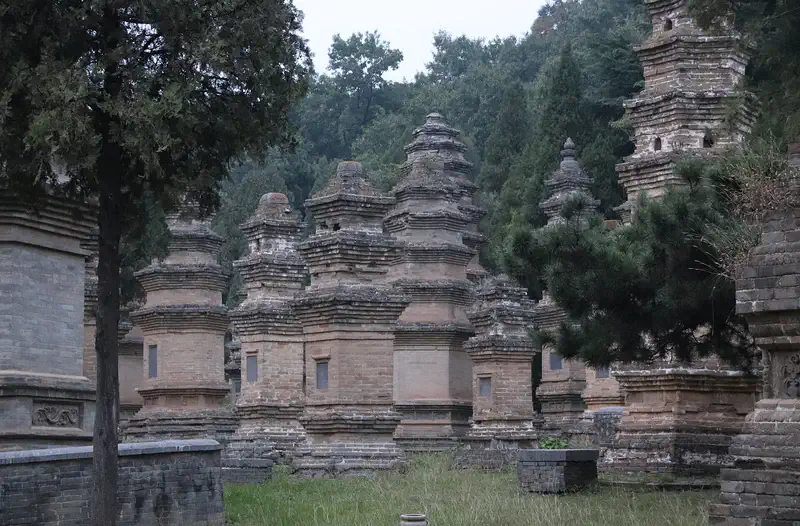
Shaolin Temple 少林寺
Birthplace of Chan (Zen) Buddhism and Chinese martial arts. Active monastery and martial arts school 70 km east of Luoyang at Mt Song.
Day trips within 150 km
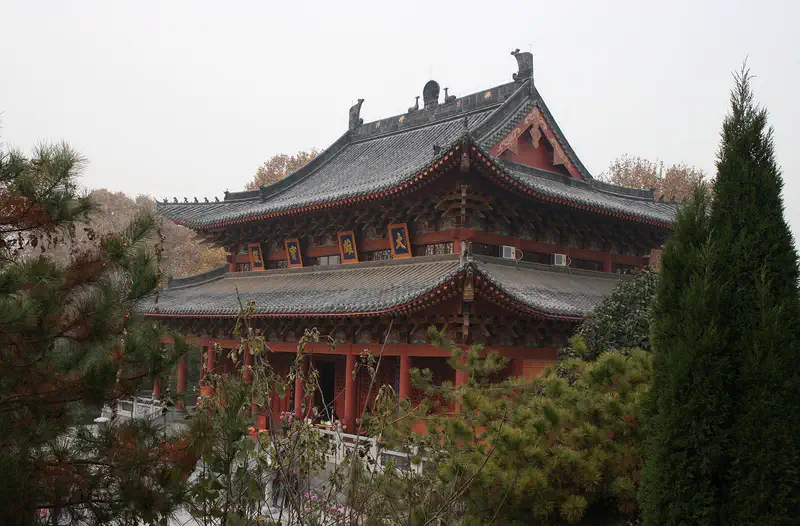
White Horse Temple 白马寺
The first Buddhist temple in China, founded 68 CE. The 'cradle of Buddhism in China'.
≈ 50 km from Dengfeng
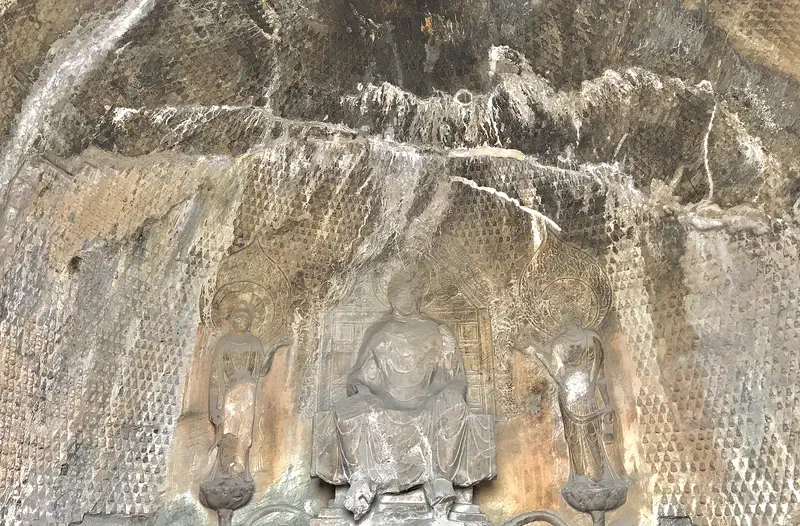
Other cities in Henan
- Anyang安阳
UNESCO-listed Yin Xu — the late Shang dynasty capital and the earliest Chinese writing site (oracle bones). One of the cradles of Chinese civilisation; an under-touristed essential for serious history travellers.
- Kaifeng开封
Former Northern Song capital (960–1127), 70 km east of Zhengzhou. Reconstructed Song-dynasty themed old town, the Iron Pagoda, and the night market — one of the country's oldest.
- Luoyang洛阳
Ancient capital of 13 dynasties, on the Luo River. Longmen Grottoes (UNESCO), White Horse Temple (the first Buddhist temple in China), and the Peony Festival in April.
- Zhengzhou郑州
Capital of Henan, transport hub of central China, and gateway to the Shaolin Temple, the Yellow River, and the Buddhist cliff carvings of Longmen.
Itineraries visiting Dengfeng
- Kung fu and martial arts pilgrimage in 7 days
7d · Beijing, then the Shaolin Temple at Dengfeng, then Wudangshan — the two great schools of Chinese martial arts.
- Shaolin and Taoist Mountains Circuit, 7 days
7d · Central China's sacred mountain loop: Shaolin Temple on Song Shan, Mount Hua's vertiginous plank walk, and the Taoist pilgrimage site of Wudang Mountain.
Food of Central China
- Chairman Mao's Red-Braised Pork毛氏红烧肉
Hunan-style slow-braised pork belly in soy, Shaoxing wine and chilli — the dish Mao Zedong reportedly ate weekly in Zhongnanhai.
- Doupi (Wuhan Tofu Skin)豆皮
Wuhan breakfast: layered pan-fried tofu skin and rice cake with mushroom, ham and bamboo shoots inside.
- Fish Head with Chopped Chilli剁椒鱼头
A whole silver carp head blanketed with fermented chopped red chilli and steamed until the flesh is silky and fiery.
- Hunan Chilli Fried Pork小炒肉
Thin-sliced pork belly wok-fried with fresh long green chillies and fermented black beans — Hunan's most-ordered everyday dish.
Dengfeng weather by month
| Month | Jan | Feb | Mar | Apr | May | Jun | Jul | Aug | Sep | Oct | Nov | Dec |
|---|---|---|---|---|---|---|---|---|---|---|---|---|
| High °C | 6 | 9 | 17 | 21 | 27 | 31 | 31 | 29 | 26 | 19 | 14 | 7 |
| Low °C | -2 | 0 | 6 | 10 | 15 | 21 | 23 | 22 | 18 | 11 | 6 | -2 |
| Rain mm | 19 | 20 | 17 | 35 | 40 | 86 | 148 | 146 | 93 | 61 | 23 | 15 |
| Rain days | 4 | 5 | 4 | 6 | 5 | 9 | 15 | 13 | 9 | 8 | 5 | 2 |
2019–2023 average via Open-Meteo ERA5 (ERA5 reanalysis). "Rain days" = days per month with ≥1 mm precipitation.
Frequently asked questions
- When is the best time to visit Dengfeng?
- The best months to visit Dengfeng are March, April, May, September, October, and November. Spring (March–May) and autumn (September–November) offer the most comfortable temperatures. Summer is hot and humid with occasional heavy rain.
- How many days do you need in Dengfeng?
- Plan 4 to 5 days for Dengfeng if you want to see the headline sights without rushing — Shaolin Temple, Pagoda Forest (Talin), Songshan Scenic Area. Add an extra day for day trips from the city or for repeat visits to your favourite neighbourhood.
- How do you get around Dengfeng?
- The Shaolin Temple complex is 13 km north of Dengfeng city centre — a shuttle bus or taxi is needed. The Songshan Scenic Area entrance is separate from the temple entrance; plan to purchase tickets for each site individually. Within the scenic area, cable cars and electric shuttles reduce walking for those covering multiple sites.
- What's the daily budget for Dengfeng?
- Budget guide for Dengfeng: backpackers from around ¥160/day, mid-range travellers ¥380/day, comfortable trips from ¥850/day. These ranges cover accommodation, food, local transport and one paid sight per day, and exclude flights to and from the city.
- Where should you stay in Dengfeng?
- Budget and mid-range hotels cluster near the Shaolin Temple gate and on the main road into the scenic area. Accommodation inside the complex itself does not exist for general visitors. Martial arts schools with dormitory accommodation operate throughout the county for students; short-term visitor stays are sometimes possible by arrangement.
Spotted something out of date? Submit a correction.
Research
Cross-checked against primary sources
Verified
Address, hours, fees confirmed at the date shown
Updated
Re-verified periodically; corrections welcome