CITY · TIBET AUTONOMOUS REGION
Gyantse
江孜 · Jiāngzī
Overview
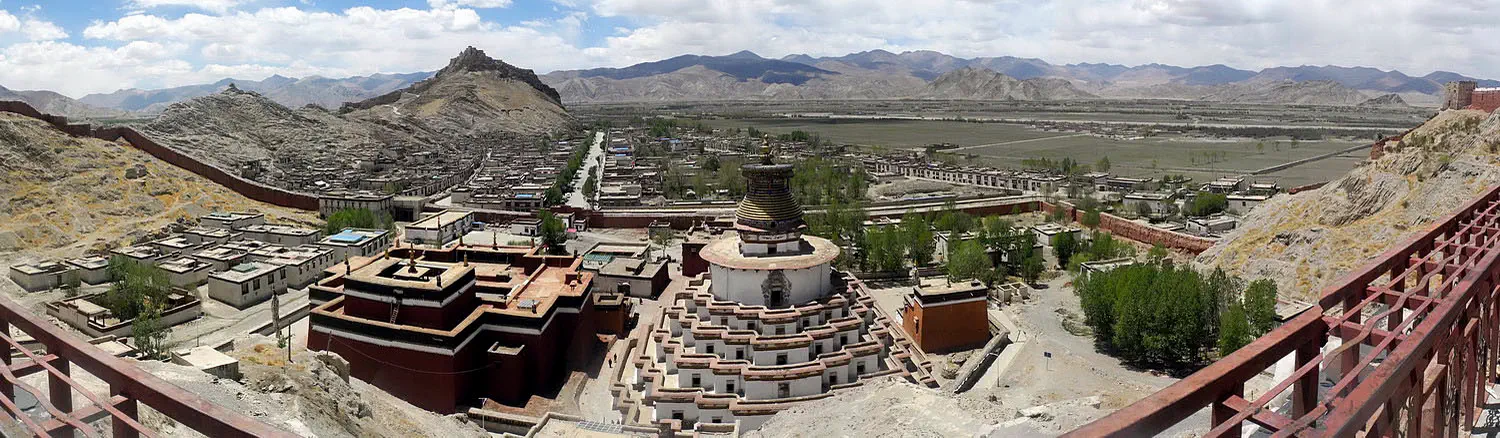
Historic Tibetan town at 4,040m on the Lhasa-Shigatse road. Pelkor Chode Monastery and the 9-tiered Kumbum Stupa are the Tibet route's photographic centrepiece.
Gyantse (Tibetan: rGyal-rtse) sits in the Nyangchu Valley at 4,040 metres, roughly halfway between Lhasa and Shigatse on the southern route through Tsang. Historically one of Tibet's main trading towns — the route from Sikkim and British India passed through here — the town retained substantial medieval domestic architecture longer than most Tibetan settlements; portions of the old earthen-walled lanes survive alongside the monastery compound.
Pelkor Chode Monastery (1418 CE) is the defining site. The monastery complex itself is notable for having been built jointly by the Sakya, Gelugpa and Bodongpa schools at a time of sectarian coexistence unusual in Tibetan history. The Kumbum (literally 'hundred thousand images') — a nine-tiered chorten with 76 chapels stacked in diminishing tiers — is the only intact Tibetan stupa-with-chapel structure of its type remaining anywhere. Each chapel contains painted murals from the 15th century, largely intact, depicting mandalas and deity forms in dense iconographic programmes. Climbing from ground level to the eyes-of-the-stupa viewing tier takes around 30 minutes and passes through rooms that have seen virtually no restoration since their original construction.
The Gyantse Dzong (fortress) occupies the rocky hill above the town — the site of the 1904 British military expedition's siege and the subsequent occupation, documented in the Gyantse Battle Exhibition hall inside the dzong. Views from the battlements extend over the valley in three directions.
What to see
- Pelkor Chode Monastery and the Kumbum Stupa
- Gyantse Dzong (Fortress) — 1904 expedition site
- Tibetan Old Town and the daily morning market
What to eat
- Tibetan momos and butter tea (same as Lhasa)
Getting there
Road from Shigatse (90 min) or Lhasa (5 hours) as part of agency itinerary.
Getting around
Walking the small old town.
Where to stay
Foreign-guest hotels in central Gyantse.
We list neighbourhoods, not specific hotels — we don't endorse hotels.
When to go
May–October.
Budget guide (CNY per day)
| Backpacker | ¥350 |
| Mid-range | ¥700 |
| Comfortable | ¥1500 |
Safety notes
Tibet Travel Permit and licensed-agency tour mandatory.
Nearby attractions
Day trips within 150 km
Other cities in Tibet Autonomous Region
- Lhasa拉萨
Capital of Tibet Autonomous Region, on the Yarlung Tsangpo plateau at 3,656m. Potala Palace, Jokhang Temple, the Barkhor pilgrimage circuit. Independent travel is restricted; Tibet Travel Permit required.
- Nyingchi林芝
Eastern Tibet Autonomous Region at 2,900m — substantially lower elevation than Lhasa. Forested rather than alpine; the Yarlung Tsangpo Grand Canyon and substantial March peach-blossom tourism.
- Shigatse日喀则
Tibet's second city at 3,845m, the seat of the Panchen Lama and home to Tashilhunpo Monastery. Standard inclusion in Lhasa-area Tibet Travel Permit itineraries.
Food of Southwestern China
- Baba Flatbread粑粑
Yunnan's daily flatbread — a thick wheat or rice-flour round cooked on a griddle and eaten plain or stuffed.
- Bang Bang Chicken棒棒鸡
Cold poached chicken shredded by hand, dressed in chilli oil, sesame paste and Sichuan peppercorn.
- Boiled Fish in Chilli Oil水煮鱼
Fish slices submerged in a deep pool of chilli oil and Sichuan peppercorns. Served bubbling.
- Chongqing Hotpot重庆火锅
The original mala hotpot — a simmering cauldron of beef tallow, Pixian doubanjiang and Sichuan peppercorn for communal dipping.
Gyantse weather by month
| Month | Jan | Feb | Mar | Apr | May | Jun | Jul | Aug | Sep | Oct | Nov | Dec |
|---|---|---|---|---|---|---|---|---|---|---|---|---|
| High °C | 4 | 5 | 10 | 13 | 16 | 21 | 20 | 20 | 18 | 15 | 10 | 6 |
| Low °C | -9 | -7 | -4 | -2 | 2 | 7 | 9 | 8 | 6 | 1 | -3 | -6 |
| Rain mm | 4 | 9 | 14 | 25 | 54 | 65 | 134 | 107 | 70 | 20 | 7 | 7 |
| Rain days | 1 | 3 | 5 | 7 | 14 | 12 | 21 | 18 | 13 | 6 | 3 | 2 |
2019–2023 average via Open-Meteo ERA5 (ERA5 reanalysis). "Rain days" = days per month with ≥1 mm precipitation.
Frequently asked questions
- When is the best time to visit Gyantse?
- The best months to visit Gyantse are May, June, September, and October. May–October.
- How many days do you need in Gyantse?
- Plan 2 days for Gyantse if you want to see the headline sights without rushing — Pelkor Chode Monastery and the Kumbum Stupa, Gyantse Dzong (Fortress), Tibetan Old Town and the daily morning market. Add an extra day for day trips from the city or for repeat visits to your favourite neighbourhood.
- Is Gyantse safe for tourists?
- Tibet Travel Permit and licensed-agency tour mandatory.
- How do you get around Gyantse?
- Walking the small old town.
- What's the daily budget for Gyantse?
- Budget guide for Gyantse: backpackers from around ¥350/day, mid-range travellers ¥700/day, comfortable trips from ¥1500/day. These ranges cover accommodation, food, local transport and one paid sight per day, and exclude flights to and from the city.
- Where should you stay in Gyantse?
- Foreign-guest hotels in central Gyantse.
Spotted something out of date? Submit a correction.
Research
Cross-checked against primary sources
Verified
Address, hours, fees confirmed at the date shown
Updated
Re-verified periodically; corrections welcome