CITY · JILIN
Changbaishan
长白山 · Chángbáishān
Overview
Gateway town to the Changbai Mountain Nature Reserve on the Chinese-Korean border, centred on Tianchi — the caldera lake at the summit of the dormant volcano — with significant ski infrastructure, hot springs, and the cultural landscape of the Yanbian Korean Autonomous Prefecture.
Changbaishan sits near the border with North Korea in Jilin province's Yanbian Korean Autonomous Prefecture, a cultural zone where the Chinese Korean (Joseonjok) community maintains distinctive language, cuisine, and traditions alongside the majority Han population. The volcanic Changbai Mountains, known in Korean as Baekdu, form the physical divide between China and North Korea, with the peak straddling the border.
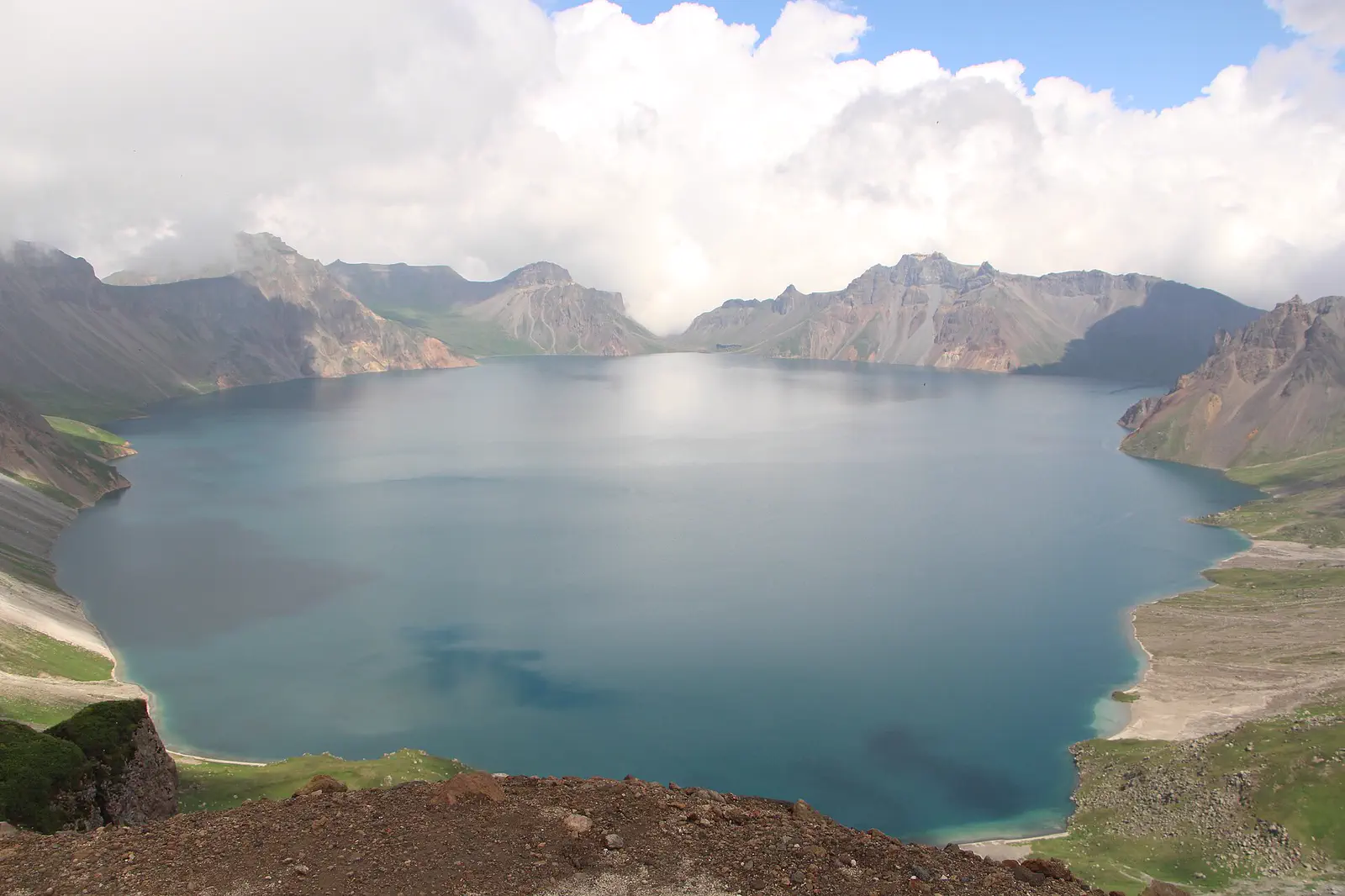
The dominant feature of the landscape is Tianchi — Heaven Lake — a caldera lake sitting in the crater of the volcano at 2,189 metres. Tianchi is one of the deepest volcanic lakes in the world, and on clear days the ring of peaks reflected in its blue surface creates one of the most photographed natural scenes in northeast China. The surrounding alpine tundra, with its dwarf pines and volcanic rock formations, supports a distinctive fauna including the Siberian Tiger in the lower forests (rarely seen but present) and the Changbai specialities of the bird world: Long-tailed Rosefinch, Pallas's Rosefinch, and various boreal species on the alpine slopes.
Beneath the volcanic plateau, the Changbai Mountain hot springs emerge at temperatures reaching 82°C — one of the largest high-temperature volcanic spring zones in China. The springs are both a tourism draw and a culinary quirk: eggs boiled in the natural springs are sold at the roadside as a visitor curiosity.
A purpose-built ski resort — now operated under international management — occupies the lower forested slopes, with lifts reaching into the alpine zone. Snowfall here is heavier and more reliable than at resorts further north, and the season extends from November into April. The resort area contains most visitor accommodation, restaurants, and services; the gateway town is primarily functional.
Access from Yanbian Korean Autonomous Prefecture's capital, Yanji, is three hours by road. The Changbaishan Airport (NBS) near Songjianghe town provides direct connections to major cities, significantly reducing journey times during the peak summer and winter seasons.
What to see
- Tianchi (Heaven Lake) — volcanic caldera lake at 2,189 m on the Chinese-Korean border
- Changbai Waterfall — the outflow of Tianchi, dropping 68 metres from the crater rim
- Changbai Mountain hot springs — volcanic springs reaching 82°C at the base of the falls
- Changbaishan Ski Resort — purpose-built ski area with international infrastructure
- Alpine tundra zone — dwarf pine krummholz and volcanic landscape above the treeline
- Changbai Mountain Nature Reserve forest trails — boreal forests with potential Siberian Tiger territory
- Yanbian Korean Autonomous Prefecture culture — Korean-language signage, restaurants, and traditional architecture in the wider area
- Underground Forest (Diyunlin) — subterranean volcanic crater filled with forest, accessible via staircase
What to eat
- Korean cold noodles (냉면, lěng miàn) — buckwheat noodles in chilled beef broth, characteristic of the Yanbian Korean community
- Korean barbecue (烧烤) — beef, pork belly, and marinated meats over charcoal, widely available in the resort area
- Hot-spring boiled eggs — sold at the volcanic springs, soft-boiled in sulphurous water
- Deer antler tonic dishes — Changbai Mountain deer farming supports a tradition of antler-based health foods
- Pine nut congee — local mountain nuts incorporated into rice porridge at guesthouses
- Jiaozi with Korean-Chinese filling variations — dumplings with kimchi and pork, a regional hybrid
Getting there
Changbaishan Airport (NBS) near Songjianghe serves the area with flights to Beijing, Shanghai, and Shenyang; check schedules as they vary by season. From Yanji, road connections take 3 hours. From Jilin City, the journey is approximately 4 hours by road. Direct coach services operate from Changchun during peak season.
Getting around
Tourist shuttle buses within the nature reserve connect the main entrance to Tianchi, the hot springs, and the underground forest — private vehicles are not permitted in the core scenic area. The ski resort operates its own lift and shuttle system. Taxis handle transfers between the resort, the airport, and the entry gate area.
Where to stay
Most accommodation concentrates in the resort village at the ski base area and in the small service town of Songjianghe. Options range from international-branded ski hotels to simple guesthouses. Summer (July–August) and ski season (December–February) are the peak periods; book well ahead.
We list neighbourhoods, not specific hotels — we don't endorse hotels.
When to go
Summer (June–August) is the main season for Tianchi viewing, though cloud frequently obscures the lake — multiple visits in the same trip improve the odds of a clear day. Winter (December–March) for skiing; the resort receives reliable snowfall. Spring and autumn are transitional seasons with variable conditions and fewer tourist services running.
Budget guide (CNY per day)
| Backpacker | ¥300 |
| Mid-range | ¥750 |
| Comfortable | ¥2000 |
Safety notes
The border with North Korea at Tianchi is clearly demarcated and patrolled. Tourists should not approach the border markers. The caldera rim is exposed to wind and cold; temperatures at the summit can drop sharply even in summer. Altitude sickness is not a concern at these elevations but wind-chill at the crater can be severe.
Nearby attractions
Other cities in Jilin
- Beidahu北大壶
Compact resort village 56 km from Jilin City, operating one of northeast China's most technically challenging ski areas on 43 runs with 900 m of vertical drop; renowned for the rime-ice (wusong) phenomenon that coats the trees in winter.
- Changchun长春
Capital of Jilin and former capital of the Japanese puppet state of Manchukuo (1932–45). Manchurian palace, automobile industry, Lake Songhua winter sports nearby.
- Yanji延吉
Capital of Yanbian Korean Autonomous Prefecture in Jilin, close to the North Korean border. The Korean-Chinese culture of Yanbian gives the city a distinct culinary and social character; Changbai Mountain (Baekdu/Tianchi) is 200 km south.
Itineraries visiting Changbaishan
Food of Northeastern China
- Di San Xian地三鲜
A simple Dongbei stir-fry of aubergine, potato and green pepper — the vegetarian staple of northeastern China.
- Dongbei Braised Pork Stew东北乱炖
A robust northeastern 'everything pot' of pork ribs, aubergine, potato, beans and corn braised together in a clay pot.
- Guo Bao Rou锅包肉
Crispy battered pork slices in a sweet-and-sour vinegar sauce — a northeastern Chinese dish created in Harbin.
- Pickled Cabbage and Pork Stew酸菜炖猪肉
A long-simmered northeastern stew of fermented cabbage with fatty pork — warming, sour and deeply satisfying.
Changbaishan weather by month
| Month | Jan | Feb | Mar | Apr | May | Jun | Jul | Aug | Sep | Oct | Nov | Dec |
|---|---|---|---|---|---|---|---|---|---|---|---|---|
| High °C | -10 | -7 | 2 | 8 | 15 | 19 | 24 | 22 | 18 | 10 | 0 | -10 |
| Low °C | -20 | -17 | -9 | -3 | 5 | 11 | 16 | 15 | 9 | 0 | -9 | -19 |
| Rain mm | 28 | 43 | 74 | 86 | 154 | 261 | 221 | 255 | 107 | 95 | 103 | 42 |
| Rain days | 8 | 10 | 13 | 12 | 17 | 20 | 20 | 24 | 12 | 13 | 13 | 11 |
2019–2023 average via Open-Meteo ERA5 (ERA5 reanalysis). "Rain days" = days per month with ≥1 mm precipitation.
Frequently asked questions
- When is the best time to visit Changbaishan?
- The best months to visit Changbaishan are June, July, August, December, January, and February. Summer (June–August) is the main season for Tianchi viewing, though cloud frequently obscures the lake — multiple visits in the same trip improve the odds of a clear day. Winter (December–March) for skiing; the resort receives reliable snowfall.
- How many days do you need in Changbaishan?
- Plan 4 to 5 days for Changbaishan if you want to see the headline sights without rushing — Tianchi (Heaven Lake), Changbai Waterfall, Changbai Mountain hot springs. Add an extra day for day trips from the city or for repeat visits to your favourite neighbourhood.
- Is Changbaishan safe for tourists?
- The border with North Korea at Tianchi is clearly demarcated and patrolled. Tourists should not approach the border markers. The caldera rim is exposed to wind and cold; temperatures at the summit can drop sharply even in summer.
- How do you get around Changbaishan?
- Tourist shuttle buses within the nature reserve connect the main entrance to Tianchi, the hot springs, and the underground forest — private vehicles are not permitted in the core scenic area. The ski resort operates its own lift and shuttle system. Taxis handle transfers between the resort, the airport, and the entry gate area.
- What's the daily budget for Changbaishan?
- Budget guide for Changbaishan: backpackers from around ¥300/day, mid-range travellers ¥750/day, comfortable trips from ¥2000/day. These ranges cover accommodation, food, local transport and one paid sight per day, and exclude flights to and from the city.
- Where should you stay in Changbaishan?
- Most accommodation concentrates in the resort village at the ski base area and in the small service town of Songjianghe. Options range from international-branded ski hotels to simple guesthouses. Summer (July–August) and ski season (December–February) are the peak periods; book well ahead.
Spotted something out of date? Submit a correction.
Research
Cross-checked against primary sources
Verified
Address, hours, fees confirmed at the date shown
Updated
Re-verified periodically; corrections welcome