CITY · JILIN
Beidahu
北大壶 · Běidàhú
Overview
Compact resort village 56 km from Jilin City, operating one of northeast China's most technically challenging ski areas on 43 runs with 900 m of vertical drop; renowned for the rime-ice (wusong) phenomenon that coats the trees in winter.
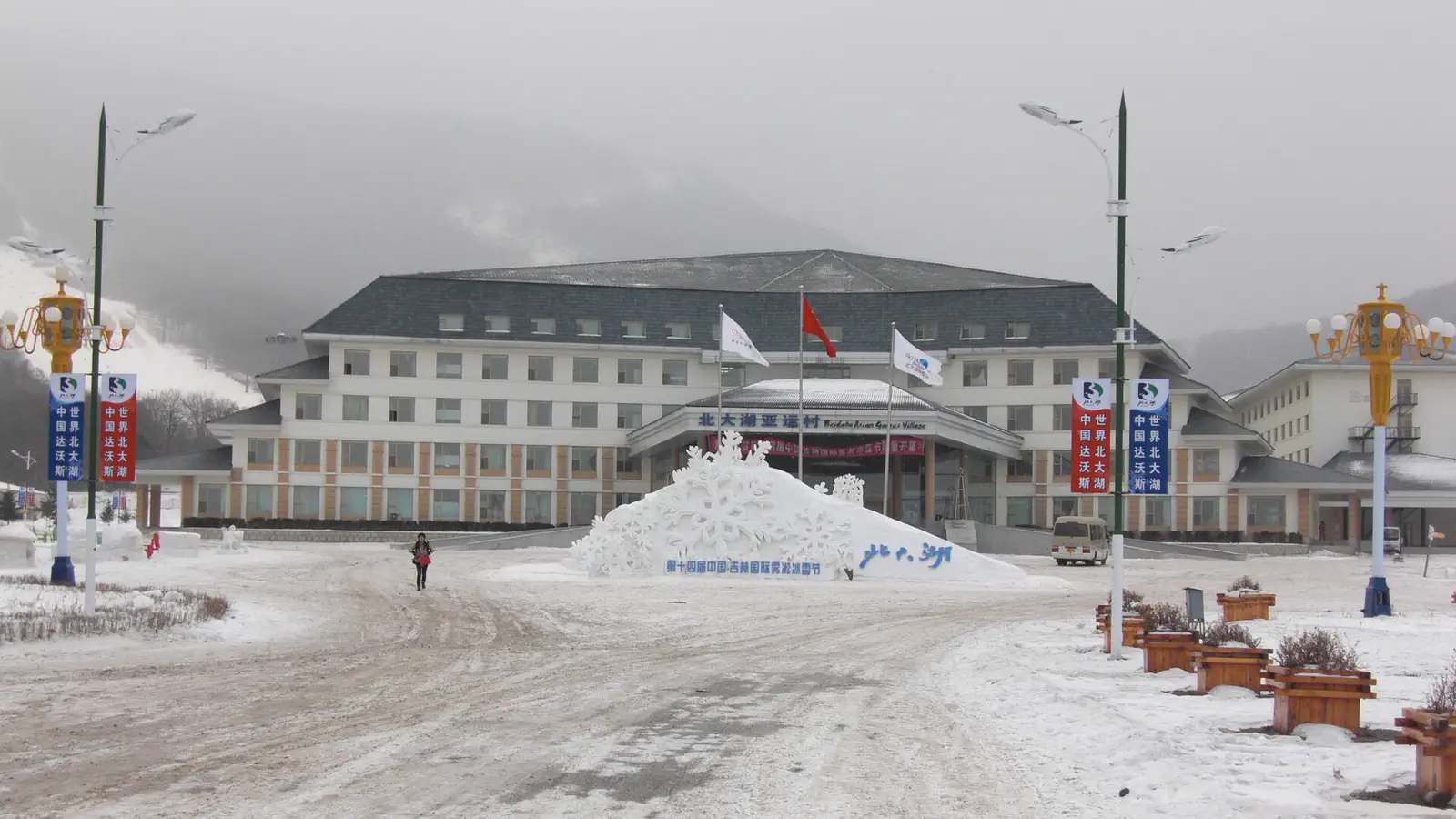
Beidahu — the name translates loosely as 'North Big Lake' — is a ski resort settled into a forested valley in the Changbai Mountain foothills, 56 km southeast of Jilin City. Though small as a settlement, it punches above its weight in the Chinese ski world: 43 runs covering a variety of gradients, a vertical drop of around 900 metres, and a mountain orientation that favours cold, dry, continental snowfall from November through March create conditions that consistently outperform the larger but lower-quality resorts near Beijing.
The mountain's northeast-facing aspect is the key to its reputation. Cold air pooling in the valley keeps temperatures low enough that the light, dry powder colloquially called 'cold smoke' accumulates without bonding into the heavier, wetter snow found further south or at lower altitude. Advanced skiers rate the upper bowl terrain, which is accessible by the main gondola and offers genuine off-piste skiing after a powder day.
Beidahu is also the principal viewing location for the rime-ice (wusong, 雾凇) phenomenon — one of the four natural spectacles for which Jilin City is known. When the Songhua River, warmed by the Fengman hydroelectric reservoir, meets the cold winter air, fog forms and freezes onto the riverside trees in layers of crystalline ice, creating scenes of extraordinary delicacy. The Songhua Lake below Beidahu contributes to this effect in the immediate resort area, coating the larch and birch forest in white ice sculptures on the coldest mornings. The effect is most pronounced in January when temperature differentials are greatest.
The resort village is compact — a small cluster of hotels, restaurants, and rental shops at the lift base. Chinese cuisine dominates, with strong northeast (dongbei) influences: pork stews, fermented vegetable dishes, and hearty dumplings suited to a cold-weather appetite. The ski school offers instruction in Mandarin and increasingly in English for international guests.
What to see
- Beidahu Ski Resort — 43 runs, 900 m vertical, northeast-facing powder terrain
- Rime-ice (wusong) spectacle — frozen fog coating the trees in crystalline ice, most dramatic in January
- Songhua Lake — reservoir below the resort, contributing to the rime-ice microclimate
- Upper bowl off-piste terrain — accessible from the main gondola on good snow days
- Jilin City (56 km) — provincial city with Confucius Temple, Catholic Cathedral, and Songhua River waterfront
- Jilin Wusong Island — dedicated rime-ice viewing park on the Songhua River, best in January
What to eat
- Northeast Chinese pork stew (猪肉炖粉条) — braised pork with glass noodles, the classic dongbei winter dish
- Guo bao rou (锅包肉) — crispy sweet-and-sour pork, the flagship dish of northeast Chinese cuisine
- Jilin sour cabbage (酸菜) — fermented Chinese cabbage used as a condiment and in stews
- Large northeastern dumplings (东北大饺子) — thick-skinned with generous pork, cabbage, or chive fillings
- Barbecued lamb skewers from evening stalls at the resort base
- Corn-based snacks — Jilin is a major corn-producing province and corn features in local street food
Getting there
The nearest airport is Jilin Ertaizi Airport (JIL), approximately 80 km from Beidahu — a road transfer of 1.5 hours. Harbin Taiping International Airport (HRB) is a larger hub about 3 hours away by road. High-speed rail serves Jilin City, from which shuttle buses run to Beidahu during the ski season. No rail station serves Beidahu directly.
Getting around
The resort is compact and walkable between the lift base, hotel cluster, and restaurants. The gondola and chairlifts handle mountain access. Shuttle buses or taxis are needed for the journey to Jilin City.
Where to stay
Resort accommodation ranges from mid-range ski hotels at the base area to budget guesthouses in the village. Book during Chinese New Year and the rime-ice season (January) well in advance as domestic demand is high. Some visitors base themselves in Jilin City and make a day trip, though this is demanding given the transfer time.
We list neighbourhoods, not specific hotels — we don't endorse hotels.
When to go
Ski season runs approximately late November through March. The prime window for both skiing and rime-ice is January, when temperatures are coldest. February is popular due to the Chinese New Year holiday. Summer visitors find a quiet mountain village with forest trails but no ski infrastructure operating.
Budget guide (CNY per day)
| Backpacker | ¥300 |
| Mid-range | ¥800 |
| Comfortable | ¥2200 |
Safety notes
January temperatures at Beidahu frequently drop below -25°C. Full winter equipment — insulated ski pants, goggles, balaclava — is essential. Frostbite can develop quickly on exposed skin in these conditions.
Other cities in Jilin
- Changbaishan长白山
Gateway town to the Changbai Mountain Nature Reserve on the Chinese-Korean border, centred on Tianchi — the caldera lake at the summit of the dormant volcano — with significant ski infrastructure, hot springs, and the cultural landscape of the Yanbian Korean Autonomous Prefecture.
- Changchun长春
Capital of Jilin and former capital of the Japanese puppet state of Manchukuo (1932–45). Manchurian palace, automobile industry, Lake Songhua winter sports nearby.
- Yanji延吉
Capital of Yanbian Korean Autonomous Prefecture in Jilin, close to the North Korean border. The Korean-Chinese culture of Yanbian gives the city a distinct culinary and social character; Changbai Mountain (Baekdu/Tianchi) is 200 km south.
Itineraries visiting Beidahu
Food of Northeastern China
- Di San Xian地三鲜
A simple Dongbei stir-fry of aubergine, potato and green pepper — the vegetarian staple of northeastern China.
- Dongbei Braised Pork Stew东北乱炖
A robust northeastern 'everything pot' of pork ribs, aubergine, potato, beans and corn braised together in a clay pot.
- Guo Bao Rou锅包肉
Crispy battered pork slices in a sweet-and-sour vinegar sauce — a northeastern Chinese dish created in Harbin.
- Pickled Cabbage and Pork Stew酸菜炖猪肉
A long-simmered northeastern stew of fermented cabbage with fatty pork — warming, sour and deeply satisfying.
Beidahu weather by month
| Month | Jan | Feb | Mar | Apr | May | Jun | Jul | Aug | Sep | Oct | Nov | Dec |
|---|---|---|---|---|---|---|---|---|---|---|---|---|
| High °C | -8 | -3 | 7 | 14 | 20 | 24 | 28 | 25 | 21 | 13 | 2 | -8 |
| Low °C | -18 | -14 | -4 | 1 | 8 | 14 | 19 | 17 | 12 | 3 | -6 | -16 |
| Rain mm | 9 | 10 | 22 | 40 | 65 | 174 | 154 | 231 | 121 | 31 | 63 | 10 |
| Rain days | 3 | 4 | 5 | 7 | 10 | 17 | 17 | 18 | 11 | 6 | 8 | 3 |
2019–2023 average via Open-Meteo ERA5 (ERA5 reanalysis). "Rain days" = days per month with ≥1 mm precipitation.
Frequently asked questions
- When is the best time to visit Beidahu?
- The best months to visit Beidahu are December, January, February, and March. Ski season runs approximately late November through March. The prime window for both skiing and rime-ice is January, when temperatures are coldest.
- How many days do you need in Beidahu?
- Plan 3 days for Beidahu if you want to see the headline sights without rushing — Beidahu Ski Resort, Rime, Songhua Lake. Add an extra day for day trips from the city or for repeat visits to your favourite neighbourhood.
- Is Beidahu safe for tourists?
- January temperatures at Beidahu frequently drop below -25°C. Full winter equipment — insulated ski pants, goggles, balaclava — is essential. Frostbite can develop quickly on exposed skin in these conditions.
- How do you get around Beidahu?
- The resort is compact and walkable between the lift base, hotel cluster, and restaurants. The gondola and chairlifts handle mountain access. Shuttle buses or taxis are needed for the journey to Jilin City.
- What's the daily budget for Beidahu?
- Budget guide for Beidahu: backpackers from around ¥300/day, mid-range travellers ¥800/day, comfortable trips from ¥2200/day. These ranges cover accommodation, food, local transport and one paid sight per day, and exclude flights to and from the city.
- Where should you stay in Beidahu?
- Resort accommodation ranges from mid-range ski hotels at the base area to budget guesthouses in the village. Book during Chinese New Year and the rime-ice season (January) well in advance as domestic demand is high. Some visitors base themselves in Jilin City and make a day trip, though this is demanding given the transfer time.
Spotted something out of date? Submit a correction.
Research
Cross-checked against primary sources
Verified
Address, hours, fees confirmed at the date shown
Updated
Re-verified periodically; corrections welcome