Historic site · HUNAN
Yueyang Tower
岳阳楼 · Yuèyáng Lóu
About
Tang-origin pavilion overlooking Dongting Lake. The third of the Three Great Towers of the South. Famous for Fan Zhongyan's 11th-century essay.
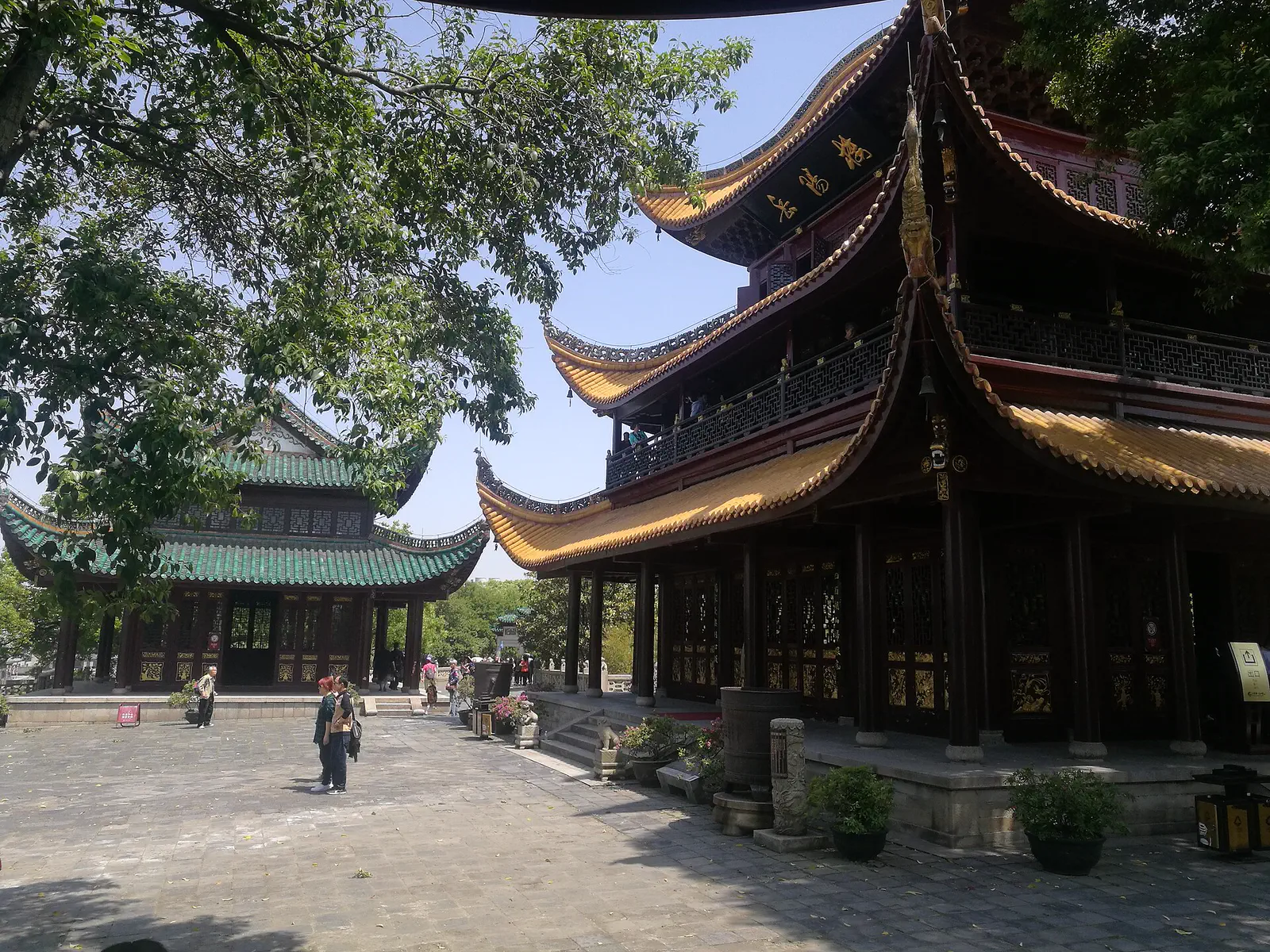
Yueyang Tower stands on the western shore of Dongting Lake — China's second-largest freshwater lake — on the site of a viewing pavilion that has existed in some form since the Eastern Han period. The original military observation tower was rebuilt as a literary pavilion by the Tang general Zhang Yue in 716 CE; successive reconstructions followed as floods, fires, and warfare periodically destroyed the timber structure. The current three-storey wooden building, 19.72 metres high with a distinctive yellow-tiled double-eave helm-shaped roof, dates from a Qing reconstruction of 1880 and is considered a faithful continuation of the historical form.
Yueyang Tower occupies an important position in Chinese literary culture for a specific reason: in 1046 CE, the Northern Song statesman and reformer Fan Zhongyan wrote the essay 'Yueyang Tower' (Yueyang Lou Ji) at the request of his friend Teng Zongding, who had rebuilt the tower and wanted a commemorative text. Fan Zhongyan used the occasion to articulate a statement of Confucian civic duty: that the true official worries about the people's concerns before they worry, and enjoys the pleasures of peace only after others have enjoyed them — 'first in the world to worry about the world's troubles; last in the world to enjoy the world's pleasures.' The line became one of the most quoted formulations of public service ethics in Chinese culture and was memorised by generations of examination candidates. The essay is inscribed on tablets displayed in the tower.
The site includes several associated structures and gardens; Junshan Island, a small island in Dongting Lake visible from the tower and accessible by boat, grows the tea known as Junshan Yinzhen (Silver Needle), one of China's ten famous teas. The combination of tower visit and Junshan Island boat trip makes a reasonable half-day from Yueyang city.
How to get there
HSR to Yueyang (~1 hour from Changsha).
When to visit
Spring or autumn.
Other attractions in Changsha
Other historic sites in China
- Ancient Villages of Southern Anhui — Xidi and Hongcun皖南古村落—西递、宏村
UNESCO · UNESCO-listed pair of Ming-Qing Huizhou merchant villages in southern Anhui, renowned for whitewashed walls, inky horsehead gables and moon-shaped ponds.
- Anqing Zhenfeng Pagoda安庆振风塔
A seven-storey Ming Dynasty pagoda standing on the bank of the Yangtze River in Anqing, considered one of the finest riverside pagodas in southern China and long used as a navigation landmark by Yangtze river pilots.
- Archaeological Ruins of Liangzhu City良渚古城遗址
UNESCO · UNESCO-listed archaeological site in Hangzhou preserving the remains of a 5,000-year-old city with a sophisticated water-management system, jade ritual culture and social hierarchy — regarded as one of the earliest state-level societies in East Asia.
- Capital Cities and Tombs of the Ancient Koguryo Kingdom高句丽王城、王陵及贵族墓葬
UNESCO · UNESCO-listed capital cities and royal tombs of the Koguryo Kingdom in Jian, Jilin — the Chinese portion of a transnational heritage property shared with North Korea, representing one of the most powerful states of ancient East Asia.
- Classical Gardens of Suzhou (UNESCO)苏州古典园林
UNESCO · UNESCO-listed collection of private gardens in Suzhou — four inscribed in 1997 and five more added in 2000 — representing the pinnacle of Chinese garden design through the refined integration of architecture, water, rock and plant.
- Danba Tibetan Watchtowers丹巴碉楼
Clusters of ancient stone watchtowers rising above Tibetan village complexes in the Dadu River valley, said to be among the oldest surviving examples of Tibetan defensive architecture.
- Drum Tower and Bell Tower鼓楼钟楼
Yuan-dynasty drum and bell towers that kept official time for imperial Beijing. Climbable; daily drum performances.
- Dujiangyan Irrigation System都江堰
UNESCO · 2,300-year-old irrigation system on the Min River. Still in use. UNESCO-listed jointly with Mt Qingcheng. Engineering rather than architecture, but one of the great works.
Frequently asked questions
- How much does Yueyang Tower cost to visit?
- Adult entry to Yueyang Tower is ¥78, ¥39 for children.
- When is Yueyang Tower open?
- Yueyang Tower opening hours: 7:30am–6:30pm Apr–Oct; 8am–5:30pm Nov–Mar.
- How long do you need at Yueyang Tower?
- Allow 3–5 hours for Yueyang Tower. Add buffer time if you plan to visit at peak season or include nearby sights in the same trip.
- When is the best time to visit Yueyang Tower?
- Spring or autumn.
- How do you get to Yueyang Tower?
- HSR to Yueyang (~1 hour from Changsha).
Spotted something out of date? Submit a correction.
Research
Cross-checked against primary sources
Verified
Address, hours, fees confirmed at the date shown
Updated
Re-verified periodically; corrections welcome