Natural site · ZHEJIANG · UNESCO
West Lake
西湖 · Xīhú
About
The most-painted body of water in Chinese landscape art. UNESCO-listed since 2011. Causeways, pagodas, tea villages, full circumnavigation in half a day.
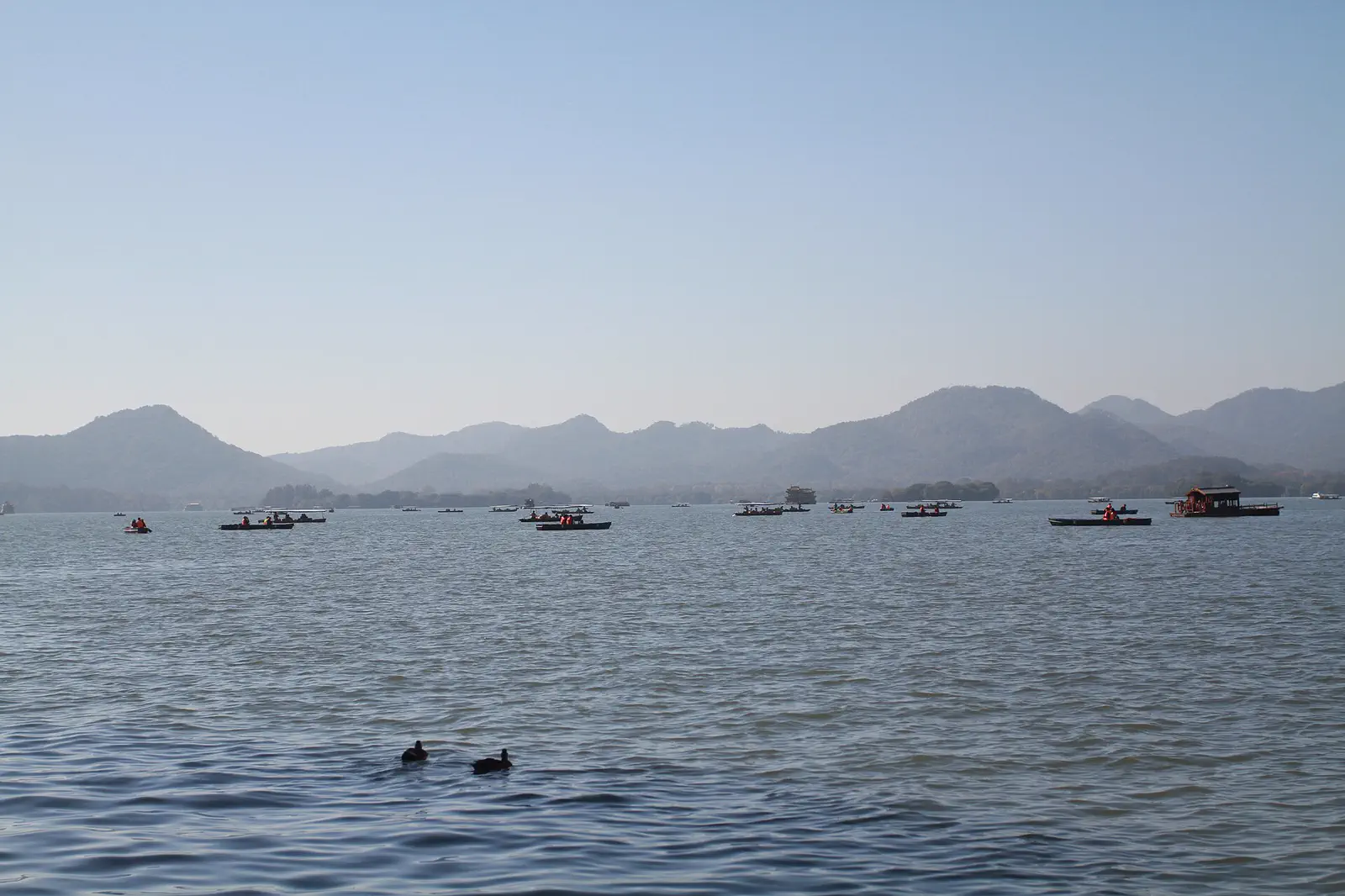
West Lake (Xihu) has been a celebrated landscape since the Tang dynasty and the central image of southern-Chinese landscape art for over a thousand years. UNESCO-listed in 2011 specifically for its layered cultural and aesthetic significance — the pavilions, causeways and views are not natural but the result of repeated imperial-era landscape design.
The lake measures 6.4 km north-south and 2.8 km east-west. The Su Causeway (created by the Song poet Su Shi when he was governor) and the Bai Causeway (named for an even earlier poet) divide the lake into smaller bodies. Lei Feng Pagoda, the Broken Bridge, the Three Pools Mirroring the Moon islet — all are subjects of Chinese poetry. A full perimeter walk takes 3–4 hours; cycling is faster.
How to get there
Metro Line 1 to Longxiangqiao for the central east bank.
When to visit
April–May for blossom; October–November for clearer light. Sunset at Lei Feng Pagoda.
History and context
The lake's cultural framing dates to the Tang and Song dynasties. Bai Juyi — governor in the 820s — built the earlier Bai Ti causeway; Su Shi followed in the 1090s with the longer Su Ti using dredged silt. The canonical Ten Views were codified under the Southern Song at Hangzhou (then Lin'an) and standardised through poetry and landscape painting. UNESCO listed the lake in 2011 as a cultural landscape — the citation names the causeways and layered aesthetic tradition rather than natural features.
What the visit is like
The perimeter runs roughly 15 km. Walking the full circuit takes 3–4 hours; a rental bike halves that but the lakeside paths are shared with pedestrians and can be slow at weekends. Boat cruises cover the central islets faster but skip the shoreline detail. The paved north shore near Broken Bridge draws the densest crowds — the south and southwest banks stay quieter. In a cold winter you might catch the Broken Bridge with partial snow cover — the classical view.
Photography
Best light falls in the early morning window before the mist lifts off the water — usually 6–8am from March through October. Leifeng Pagoda catches warm side-light for the final 30 minutes before sunset from the Su Ti mid-point. Lotus flowers peak in July around the Quyuan Fenghe gardens. In late October and November the osmanthus trees near Manjuelong turn — the scent carries further than the colour photographs.
Overlooked details
The Longjing tea village sits in the hills southwest of the lake — the terraces still supply the Dragon Well leaf and the walk up from Hupao Spring passes working plantations. The Broken Bridge is not broken — the name is a Song-era pun on how melting snow along its arch makes it appear severed from a distance. The tomb of the Song general Yue Fei sits on the north shore at Qixia Ling — the buried remains were moved there in 1163.
UNESCO inscription
“West Lake is surrounded on three sides by 'cloud-capped hills' and on the fourth by the city of Hangzhou. Its beauty has been celebrated by writers and artists since the Tang Dynasty (AD 618-907). In order to make it more beautiful, its islands, causeways and the lower slopes of its hills have been 'improved' by the addition of numerous temples, pagodas, pavilions, gardens and ornamental trees which merge with farmed landscape. The main artificial elements of the lake, two causeways and three islands, were created from repeated dredgings between the 9th and 12th centuries. Since the Southern Song Dynasty (thirteenth century) ten poetically named scenic places have been identified as embodying idealised, classic landscapes - that manifest the perfect fusion between man and nature. West Lake is an outstanding example of a cultural landscape that display with great clarity the ideals of Chi”
Where to eat nearby
Longjing shrimp — small river prawns stir-fried with Dragon Well tea leaves — is the signature Hangzhou dish; Louwailou on Gushan island cooks a defensible version at tourist prices. West Lake vinegar fish (grass carp in a sweet-sour glaze) is harder to find done well — the same restaurant is acceptable but locals rate Zhiweiguan on Renhe Road higher. Grandma Song's Fish Soup traces to a Song-dynasty recipe — the branch at Gushan is a re-creation rather than a continuous lineage.
Common misconceptions
West Lake is not a natural lake — it began as a tidal lagoon of the Qiantang River and silted off from the sea perhaps 2,000 years ago. The current outline and depth are the product of Ming and Qing dredging on top of the Song causeway work — without periodic clearing it would revert to marsh. The Ten Views are a viewing convention drawn from poetry — several refer to seasonal or weather-dependent effects rather than fixed spots on a map.
Other attractions in Hangzhou
Itineraries featuring this site
- Shanghai–Suzhou–Hangzhou triangle in 5 days
5d · Two days in Shanghai, a day and a half in Suzhou's classical gardens, then West Lake and Hangzhou.
- Vegetarian and vegan China in 7 days
7d · Hangzhou (Buddhist vegetarian temples) to Putuoshan (sacred Buddhist island) to Suzhou to Shanghai. A seven-day itinerary following the tradition of Chinese Buddhist vegetarian cuisine, with reliable meat-free and vegan options at each stop.
- Classical gardens circuit in 7 days
7d · Suzhou (Humble Administrator's Garden, Lingering Garden, Master of Nets) to Yangzhou (Geyuan, Heyuan) to Hangzhou. A focused circuit around China's most significant private garden tradition, pairing the UNESCO-listed Suzhou gardens with the less-visited Yangzhou examples and Hangzhou's West Lake landscape.
- China for seniors in 10 days
10d · Beijing to Suzhou to Hangzhou to Shanghai, built around lift-accessible accommodation, manageable walking distances, gentler pacing, and accessible attractions. Designed for travellers in their 60s, 70s, and beyond who want to see China without the physical demands of the standard tourist circuit.
Other natural sites in China
- Badain Jaran Desert — Lakes and Dunes巴丹吉林沙漠—沙山湖泊群
UNESCO · UNESCO Natural World Heritage site in Inner Mongolia — the third largest desert in China, featuring some of the world's tallest stationary dunes and a unique network of freshwater and saline lakes sustained by a still-unexplained subterranean water system.
- China Danxia中国丹霞
UNESCO · UNESCO Natural World Heritage site — a serial property of six Danxia landscapes across six provinces, representing China's defining red-cliff-and-pillar sandstone landform type, including Danxia Mountain, Zhangye, Taining and Langshan.
- Crescent Lake & Mingsha Mountain月牙泉与鸣沙山
Spring-fed crescent-shaped lake at the foot of 250m sand dunes, 5 km south of Dunhuang. Camel rides, sand-sledding, sunset viewing.
- Daocheng Yading Nature Reserve稻城亚丁
A remote highland sanctuary in south-western Sichuan centred on three sacred snow peaks venerated by Tibetan Buddhism, often called the 'last Shangri-La'.
- Dianchi Lake Kunming滇池
The largest freshwater lake in Yunnan at 300 km², historically the scenic centrepiece of the Kunming basin and now being restored after decades of water-quality degradation.
- Erhai Lake洱海
250 km² freshwater lake east of Dali Old Town. 130 km cycling loop; Bai-minority lakeside villages on the eastern shore.
- Fanjingshan梵净山
UNESCO · UNESCO Natural World Heritage site in Guizhou — an isolated mountain island rising from subtropical forest, home to two critically endangered endemic species: the Guizhou snub-nosed monkey and the Fanjingshan fir.
- Hailuogou Glacier National Park海螺沟冰川
The lowest-altitude glacier accessible in Asia, flowing from the slopes of Mount Gongga down through a bamboo and subtropical forest valley to just 2,980 m above sea level.
Other UNESCO World Heritage sites in China
- Ancient Villages of Southern Anhui — Xidi and Hongcun皖南古村落—西递、宏村
UNESCO-listed pair of Ming-Qing Huizhou merchant villages in southern Anhui, renowned for whitewashed walls, inky horsehead gables and moon-shaped ponds.
- Archaeological Ruins of Liangzhu City良渚古城遗址
UNESCO-listed archaeological site in Hangzhou preserving the remains of a 5,000-year-old city with a sophisticated water-management system, jade ritual culture and social hierarchy — regarded as one of the earliest state-level societies in East Asia.
- Badain Jaran Desert — Lakes and Dunes巴丹吉林沙漠—沙山湖泊群
UNESCO Natural World Heritage site in Inner Mongolia — the third largest desert in China, featuring some of the world's tallest stationary dunes and a unique network of freshwater and saline lakes sustained by a still-unexplained subterranean water system.
- Capital Cities and Tombs of the Ancient Koguryo Kingdom高句丽王城、王陵及贵族墓葬
UNESCO-listed capital cities and royal tombs of the Koguryo Kingdom in Jian, Jilin — the Chinese portion of a transnational heritage property shared with North Korea, representing one of the most powerful states of ancient East Asia.
- China Danxia中国丹霞
UNESCO Natural World Heritage site — a serial property of six Danxia landscapes across six provinces, representing China's defining red-cliff-and-pillar sandstone landform type, including Danxia Mountain, Zhangye, Taining and Langshan.
- Classical Gardens of Suzhou (UNESCO)苏州古典园林
UNESCO-listed collection of private gardens in Suzhou — four inscribed in 1997 and five more added in 2000 — representing the pinnacle of Chinese garden design through the refined integration of architecture, water, rock and plant.
- Couple's Retreat Garden耦园
UNESCO-listed Suzhou garden organised symmetrically around a central residence. Less crowded than the four most-visited gardens.
- Drepung Monastery哲蚌寺
Once the largest monastery in the world (10,000+ monks). 8 km west of Lhasa. Active Gelugpa monastery; debating courtyard sessions in the afternoon.
Related reading
- Chinese Toilets: The Realistic Version
Blog · The Chinese toilet situation is not as bad as the reputation suggests in cities, and occasionally worse in rural areas. Paper policies, squat design, and the 2015–2020 Toilet Revolution have all shaped what you will find.
- Hanfu Wearing Today: What the Revival Looks Like in 2026
Blog · In 2026, hanfu is visible at temple fairs, scenic areas, photography studios, university campuses, and sometimes just on the street. The movement has moved well beyond enthusiast circles into commercial fashion. Here is the cultural landscape behind the clothing.
- Song Dynasty Intellectuals: China's Age of Print and Philosophy
Blog · The Song dynasty is often overshadowed by the Tang in popular history, but it was arguably more transformative: moveable type printing, the civil examination system at scale, Su Dongpo, Zhu Xi, and the emergence of the scholar-official as China's dominant social type.
- Hangzhou and the Tang-Song poetic landscape
Blog · Hangzhou's West Lake reads as a 1,200-year literary landscape — Bai Juyi's Tang causeway, Su Shi's Song dredging and poems, the Southern Song imperial capital, Marco Polo, the canonical Ten Scenes. Why the lake is the most-painted body of water in Chinese landscape art.
- Mid-Autumn Festival — the cultural context
Blog · Mid-Autumn Festival's cultural context — Chang'e and Hou Yi, the Mongol-resistance mooncake story, the full-moon viewing tradition, and where to celebrate in 2026.
Frequently asked questions
- How much does West Lake cost to visit?
- Entry to West Lake is free. Lake free; some sites (Lingyin Temple, Leifeng Pagoda) ticketed.
- When is West Lake open?
- West Lake opening hours: 24/7.
- How long do you need at West Lake?
- Allow 4–8 hours for West Lake. Add buffer time if you plan to visit at peak season or include nearby sights in the same trip.
- When is the best time to visit West Lake?
- April–May for blossom; October–November for clearer light. Sunset at Lei Feng Pagoda.
- How do you get to West Lake?
- Metro Line 1 to Longxiangqiao for the central east bank.
Spotted something out of date? Submit a correction.
Research
Cross-checked against primary sources
Verified
Address, hours, fees confirmed at the date shown
Updated
Re-verified periodically; corrections welcome