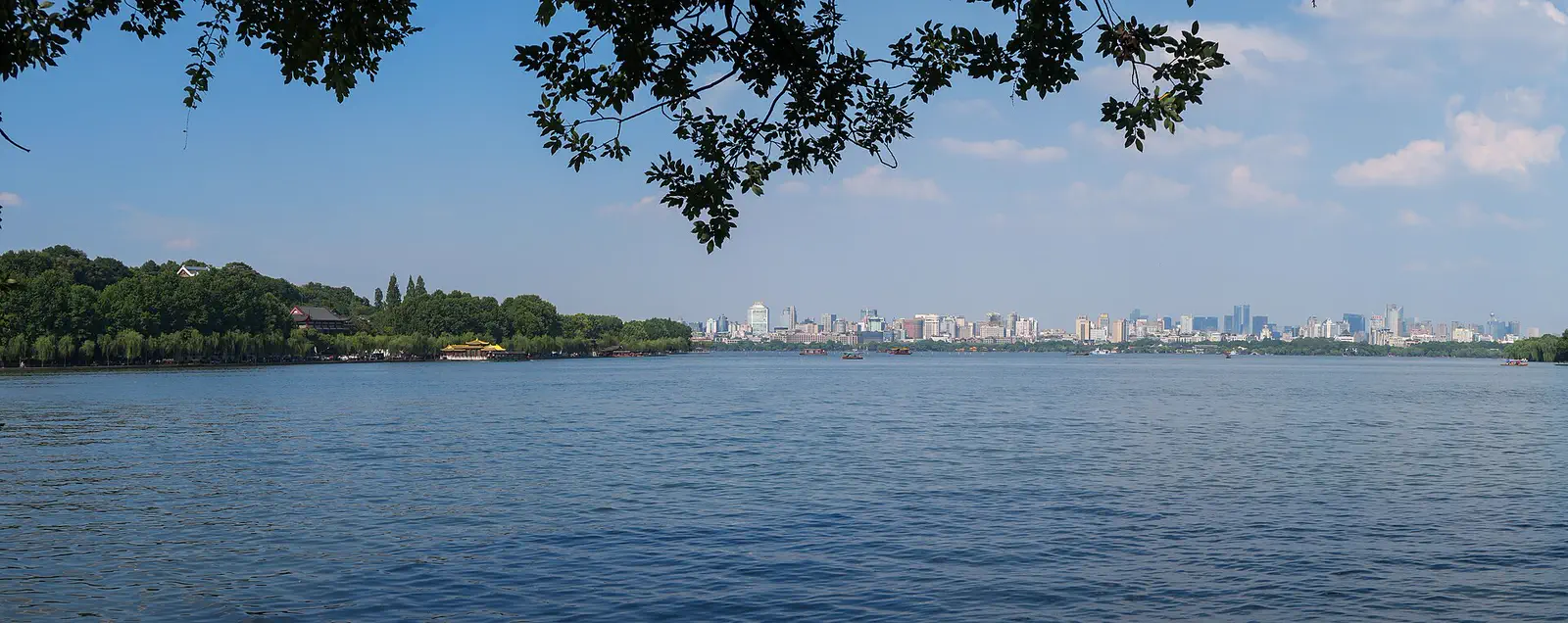
Historic site · ZHEJIANG · UNESCO
West Lake Cultural Landscape of Hangzhou
杭州西湖文化景观 · Hángzhōu Xī Hú Wénhuà Jǐngguān
About
UNESCO Cultural Landscape inscribed in 2011 — the designed lakeside landscape of Hangzhou's West Lake, shaped by more than 1,000 years of interaction between natural scenery and human artistic and cultural tradition.
The West Lake Cultural Landscape of Hangzhou was inscribed on the UNESCO World Heritage List in 2011, recognising the 10 km² lake and its immediate surroundings as an exemplary designed cultural landscape that has profoundly influenced garden and landscape design across East Asia for over a millennium. The UNESCO citation notes that West Lake influenced garden designers in Japan and Korea and was repeatedly referenced in Chinese poetry, painting and gardening literature from the Song dynasty onwards.
The lake and its islets, causeways and surrounding hills were progressively shaped through the efforts of administrators, poets and imperial patrons. The Bai Causeway was associated with the Tang-dynasty poet-governor Bai Juyi, who served in Hangzhou in the 9th century; the Su Causeway was built during a dredging programme overseen by poet Su Dongpo when he served as governor in 1089. The Leifeng Pagoda, rebuilt on its original foundations in 2002, overlooks the lake from the south; the Lingyin Temple complex sits in the hills to the west.
The 'Ten Scenes of West Lake' — a set of named views established during the Southern Song dynasty when Hangzhou served as imperial capital — continue to define the aesthetic framework through which the lake is experienced. These include Three Pools Mirroring the Moon (viewed from the central island Santan Yinyue), Autumn Moon on the Calm Lake, and Dawn on the Su Causeway in Spring.
The lake itself is largely free to visit, and walking or cycling the causeways and lakeside paths is the primary visitor activity. Boat hire to the central islands is available from the Yue Miao and other docks.
How to get there
High-speed rail from Shanghai to Hangzhou (40 min). From Hangzhou East or Hangzhou South stations, take Metro Line 1 or 4 to the lakeside area (approximately 20–30 min). The lake is 5 km west of the city centre.
When to visit
March–April (lotus preparation, willow green on the causeways), June–July (lotus in bloom) and October (clearest skies, moon-viewing). Winter mornings can be misty and atmospheric.
Crowds: Weekends draw enormous crowds from Shanghai and Hangzhou. Cycling the Su Causeway before 08:00 offers a calm experience. The northern shore near Beishan Road is less congested than the southern Nanshan Road.
UNESCO inscription
“West Lake is surrounded on three sides by 'cloud-capped hills' and on the fourth by the city of Hangzhou. Its beauty has been celebrated by writers and artists since the Tang Dynasty (AD 618-907). In order to make it more beautiful, its islands, causeways and the lower slopes of its hills have been 'improved' by the addition of numerous temples, pagodas, pavilions, gardens and ornamental trees which merge with farmed landscape. The main artificial elements of the lake, two causeways and three islands, were created from repeated dredgings between the 9th and 12th centuries. Since the Southern Song Dynasty (thirteenth century) ten poetically named scenic places have been identified as embodying idealised, classic landscapes - that manifest the perfect fusion between man and nature. West Lake is an outstanding example of a cultural landscape that display with great clarity the ideals of Chi”
Other attractions in Hangzhou
Itineraries featuring this site
- Shanghai–Suzhou–Hangzhou triangle in 5 days
5d · Two days in Shanghai, a day and a half in Suzhou's classical gardens, then West Lake and Hangzhou.
- Classical Gardens Circuit — Suzhou, Hangzhou, and Beyond, 12 days
12d · China's finest classical gardens in sequence: Suzhou's UNESCO garden quartet, Hangzhou's West Lake landscape, Yangzhou's slender garden tradition, and Shaoxing's canal-town context.
Other historic sites in China
- Ancient Villages of Southern Anhui — Xidi and Hongcun皖南古村落—西递、宏村
UNESCO · UNESCO-listed pair of Ming-Qing Huizhou merchant villages in southern Anhui, renowned for whitewashed walls, inky horsehead gables and moon-shaped ponds.
- Anqing Zhenfeng Pagoda安庆振风塔
A seven-storey Ming Dynasty pagoda standing on the bank of the Yangtze River in Anqing, considered one of the finest riverside pagodas in southern China and long used as a navigation landmark by Yangtze river pilots.
- Archaeological Ruins of Liangzhu City良渚古城遗址
UNESCO · UNESCO-listed archaeological site in Hangzhou preserving the remains of a 5,000-year-old city with a sophisticated water-management system, jade ritual culture and social hierarchy — regarded as one of the earliest state-level societies in East Asia.
- Capital Cities and Tombs of the Ancient Koguryo Kingdom高句丽王城、王陵及贵族墓葬
UNESCO · UNESCO-listed capital cities and royal tombs of the Koguryo Kingdom in Jian, Jilin — the Chinese portion of a transnational heritage property shared with North Korea, representing one of the most powerful states of ancient East Asia.
- Classical Gardens of Suzhou (UNESCO)苏州古典园林
UNESCO · UNESCO-listed collection of private gardens in Suzhou — four inscribed in 1997 and five more added in 2000 — representing the pinnacle of Chinese garden design through the refined integration of architecture, water, rock and plant.
- Danba Tibetan Watchtowers丹巴碉楼
Clusters of ancient stone watchtowers rising above Tibetan village complexes in the Dadu River valley, said to be among the oldest surviving examples of Tibetan defensive architecture.
- Drum Tower and Bell Tower鼓楼钟楼
Yuan-dynasty drum and bell towers that kept official time for imperial Beijing. Climbable; daily drum performances.
- Dujiangyan Irrigation System都江堰
UNESCO · 2,300-year-old irrigation system on the Min River. Still in use. UNESCO-listed jointly with Mt Qingcheng. Engineering rather than architecture, but one of the great works.
Other UNESCO World Heritage sites in China
- Ancient Villages of Southern Anhui — Xidi and Hongcun皖南古村落—西递、宏村
UNESCO-listed pair of Ming-Qing Huizhou merchant villages in southern Anhui, renowned for whitewashed walls, inky horsehead gables and moon-shaped ponds.
- Archaeological Ruins of Liangzhu City良渚古城遗址
UNESCO-listed archaeological site in Hangzhou preserving the remains of a 5,000-year-old city with a sophisticated water-management system, jade ritual culture and social hierarchy — regarded as one of the earliest state-level societies in East Asia.
- Badain Jaran Desert — Lakes and Dunes巴丹吉林沙漠—沙山湖泊群
UNESCO Natural World Heritage site in Inner Mongolia — the third largest desert in China, featuring some of the world's tallest stationary dunes and a unique network of freshwater and saline lakes sustained by a still-unexplained subterranean water system.
- Capital Cities and Tombs of the Ancient Koguryo Kingdom高句丽王城、王陵及贵族墓葬
UNESCO-listed capital cities and royal tombs of the Koguryo Kingdom in Jian, Jilin — the Chinese portion of a transnational heritage property shared with North Korea, representing one of the most powerful states of ancient East Asia.
- China Danxia中国丹霞
UNESCO Natural World Heritage site — a serial property of six Danxia landscapes across six provinces, representing China's defining red-cliff-and-pillar sandstone landform type, including Danxia Mountain, Zhangye, Taining and Langshan.
- Classical Gardens of Suzhou (UNESCO)苏州古典园林
UNESCO-listed collection of private gardens in Suzhou — four inscribed in 1997 and five more added in 2000 — representing the pinnacle of Chinese garden design through the refined integration of architecture, water, rock and plant.
- Couple's Retreat Garden耦园
UNESCO-listed Suzhou garden organised symmetrically around a central residence. Less crowded than the four most-visited gardens.
- Drepung Monastery哲蚌寺
Once the largest monastery in the world (10,000+ monks). 8 km west of Lhasa. Active Gelugpa monastery; debating courtyard sessions in the afternoon.
Frequently asked questions
- When is West Lake Cultural Landscape of Hangzhou open?
- West Lake Cultural Landscape of Hangzhou opening hours: Lake and causeways: 24 hours, free. Boat services: approximately 07:00–17:00. Pagoda and temples: 08:00–17:30.
- How long do you need at West Lake Cultural Landscape of Hangzhou?
- Allow 3–6 hours for West Lake Cultural Landscape of Hangzhou. Add buffer time if you plan to visit at peak season or include nearby sights in the same trip.
- When is the best time to visit West Lake Cultural Landscape of Hangzhou?
- March–April (lotus preparation, willow green on the causeways), June–July (lotus in bloom) and October (clearest skies, moon-viewing). Winter mornings can be misty and atmospheric.
- How do you get to West Lake Cultural Landscape of Hangzhou?
- High-speed rail from Shanghai to Hangzhou (40 min). From Hangzhou East or Hangzhou South stations, take Metro Line 1 or 4 to the lakeside area (approximately 20–30 min). The lake is 5 km west of the city centre.
- How do you avoid the crowds at West Lake Cultural Landscape of Hangzhou?
- Weekends draw enormous crowds from Shanghai and Hangzhou. Cycling the Su Causeway before 08:00 offers a calm experience. The northern shore near Beishan Road is less congested than the southern Nanshan Road.
Spotted something out of date? Submit a correction.
Research
Cross-checked against primary sources
Verified
Address, hours, fees confirmed at the date shown
Updated
Re-verified periodically; corrections welcome