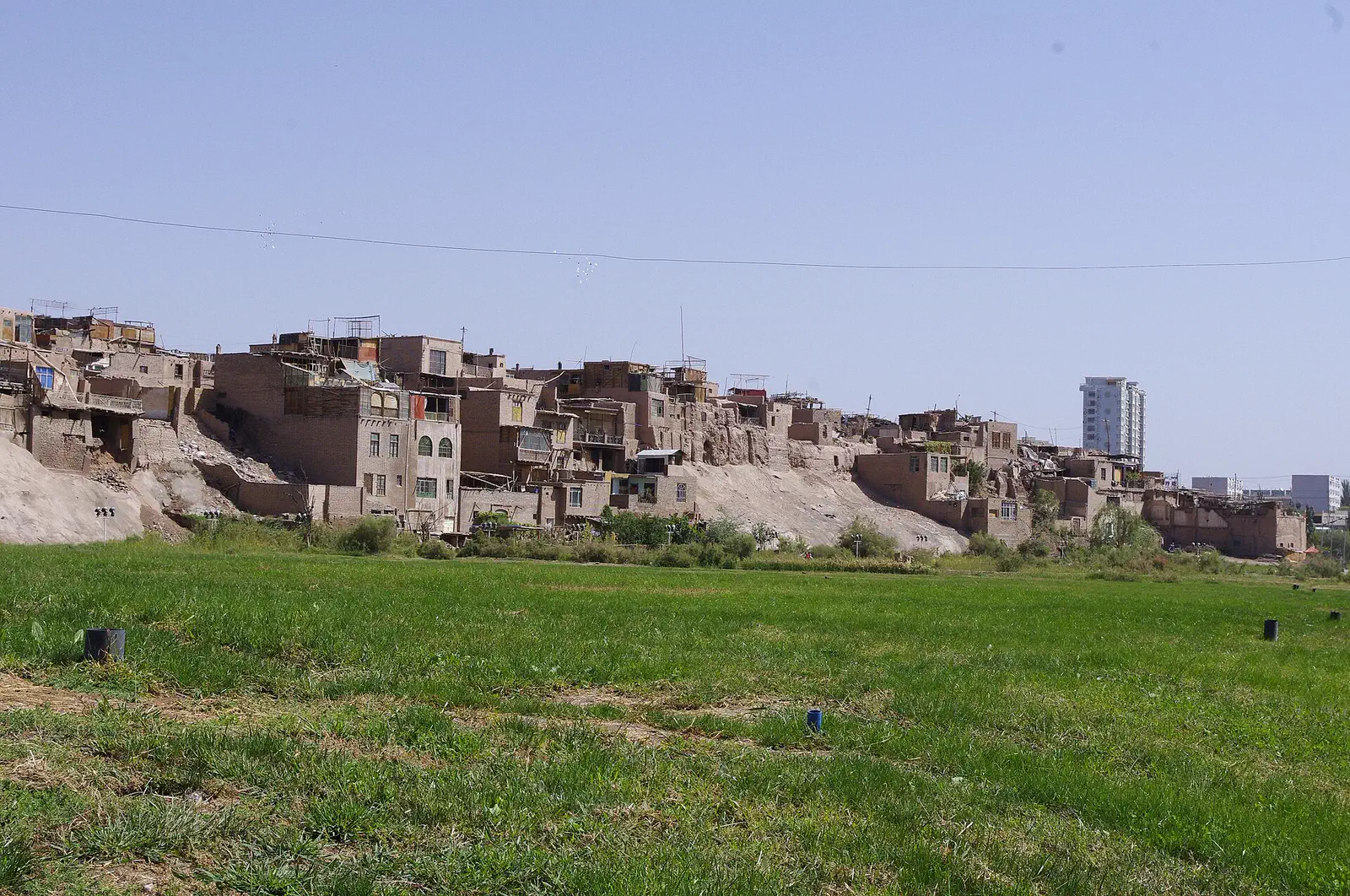
Historic site · XINJIANG
Kashgar Old City
喀什老城 · Kāshí Lǎochéng
About
The most-restored Uyghur old town in Xinjiang. Mud-brick alleys, Id Kah Mosque, the Sunday Animal Bazaar.
Kashgar is the westernmost city of China, sitting at 1,290 metres in the Tarim Basin at the foot of the Pamir Mountains, where the northern and southern Silk Road routes rejoined after crossing the Taklamakan Desert. For over two millennia it was one of the most significant trading cities in Central Asia — a market at the convergence of routes to China, India, Persia, and the steppe. The Uyghur population, who constitute the majority, are Turkic-speaking Muslims whose cultural and linguistic connections run westward into Central Asia more than eastward into Han China.
The Old City district is Kashgar's historical centre and the area that visitors come specifically to experience. It has been the subject of major reconstruction since approximately 2010: large sections of the original densely packed earthen-brick housing were demolished and rebuilt in a regularised version of the traditional architectural style. The reconstruction is contested — preservation arguments focused on the organic spatial character of the original lanes, officials cited seismic safety concerns. The rebuilt district retains the surface characteristics of a Uyghur mud-brick neighbourhood (carved wooden balconies, narrow alleys, courtyard houses) while lacking the accretion of genuine historical settlement. The Id Kah Mosque at the centre of the old town, dating in its current form to 1442 and one of the largest mosques in China, predates the reconstruction and is the most historically significant structure in the city.
The Sunday Animal Bazaar, located approximately 12 kilometres from the city centre, is a weekly livestock market that draws traders from across the surrounding region — cattle, camels, horses, and sheep change hands in a market format that reflects the pastoral economy of the Pamirs and Karakoram. It operates Sunday mornings and is a different register from the reconstructed old town. Security checks for foreign visitors entering Kashgar have been extensive in recent years; independent travellers should research current procedures before visiting.
How to get there
Fly to Kashgar (KHG); HSR from Urumqi under expansion.
When to visit
May–June, September–October.
Other attractions in Kashgar
Itineraries featuring this site
- Northern Silk Road — Urumqi, Heavenly Lake, Turpan and Kashgar, 7 days
7d · Seven days in Xinjiang's Silk Road cities: Urumqi, the alpine Heavenly Lake, the desert ruins around Turpan, and the Uighur old city of Kashgar near the Kyrgyzstan border.
- Silk Road — Xi'an to Kashgar, 14 days
14d · The full Hexi Corridor route from Xi'an west through Lanzhou, Dunhuang and the Taklamakan edge to Turpan and Kashgar — the historical Silk Road across northwest China.
Other historic sites in China
- Ancient Villages of Southern Anhui — Xidi and Hongcun皖南古村落—西递、宏村
UNESCO · UNESCO-listed pair of Ming-Qing Huizhou merchant villages in southern Anhui, renowned for whitewashed walls, inky horsehead gables and moon-shaped ponds.
- Anqing Zhenfeng Pagoda安庆振风塔
A seven-storey Ming Dynasty pagoda standing on the bank of the Yangtze River in Anqing, considered one of the finest riverside pagodas in southern China and long used as a navigation landmark by Yangtze river pilots.
- Archaeological Ruins of Liangzhu City良渚古城遗址
UNESCO · UNESCO-listed archaeological site in Hangzhou preserving the remains of a 5,000-year-old city with a sophisticated water-management system, jade ritual culture and social hierarchy — regarded as one of the earliest state-level societies in East Asia.
- Capital Cities and Tombs of the Ancient Koguryo Kingdom高句丽王城、王陵及贵族墓葬
UNESCO · UNESCO-listed capital cities and royal tombs of the Koguryo Kingdom in Jian, Jilin — the Chinese portion of a transnational heritage property shared with North Korea, representing one of the most powerful states of ancient East Asia.
- Classical Gardens of Suzhou (UNESCO)苏州古典园林
UNESCO · UNESCO-listed collection of private gardens in Suzhou — four inscribed in 1997 and five more added in 2000 — representing the pinnacle of Chinese garden design through the refined integration of architecture, water, rock and plant.
- Danba Tibetan Watchtowers丹巴碉楼
Clusters of ancient stone watchtowers rising above Tibetan village complexes in the Dadu River valley, said to be among the oldest surviving examples of Tibetan defensive architecture.
- Drum Tower and Bell Tower鼓楼钟楼
Yuan-dynasty drum and bell towers that kept official time for imperial Beijing. Climbable; daily drum performances.
- Dujiangyan Irrigation System都江堰
UNESCO · 2,300-year-old irrigation system on the Min River. Still in use. UNESCO-listed jointly with Mt Qingcheng. Engineering rather than architecture, but one of the great works.
Frequently asked questions
- How much does Kashgar Old City cost to visit?
- Adult entry to Kashgar Old City is ¥45, ¥22 for children.
- When is Kashgar Old City open?
- Kashgar Old City opening hours: Old town 24/7; bazaar Sundays.
- How long do you need at Kashgar Old City?
- Allow 24–48 hours for Kashgar Old City. Add buffer time if you plan to visit at peak season or include nearby sights in the same trip.
- When is the best time to visit Kashgar Old City?
- May–June, September–October.
- How do you get to Kashgar Old City?
- Fly to Kashgar (KHG); HSR from Urumqi under expansion.
Spotted something out of date? Submit a correction.
Research
Cross-checked against primary sources
Verified
Address, hours, fees confirmed at the date shown
Updated
Re-verified periodically; corrections welcome