Itinerary · 10 days · balanced
Halal-friendly northwest China in 10 days
Beijing (Niujie Mosque) to Xi'an (Muslim Quarter and Great Mosque) to Yinchuan (Ningxia Hui heartland) to Lanzhou (hand-pulled noodles capital) to Xining (Ta'er Monastery and Hui culture). A route through the Hui Muslim heartland with halal food throughout and mosque visits at each stop.
China has approximately 20–25 million Hui Muslims — the country's largest Muslim ethnic group, distinguished from the Uyghur Muslim population by their Han Chinese cultural characteristics and Mandarin as their primary language. The Hui presence is strongest across the northwest: Ningxia Hui Autonomous Region, Gansu, Qinghai, and Shaanxi, as well as historic communities in Beijing and Xi'an.
This itinerary follows the Hui heartland from east to west, stopping at the major Islamic sites and areas where halal food is reliably, abundantly available. It is not exclusively a religious itinerary — the route passes through some of China's most historically significant cities — but the halal food and mosque visits provide a coherent thread across the journey. Muslim visitors will find this route significantly more comfortable than a standard tourist circuit, which requires researching halal options in each city.
Note that Xinjiang (primarily Uyghur Muslim) is not included in this route — the Uyghur cultural and political situation is a distinct matter from the Hui northwest, and the travel logistics differ substantially.
Day by day
Day 1 · beijing
Arrive Beijing — Niujie Mosque area
Check in to a hotel. Afternoon visit to Niujie (牛街, 'Ox Street') — Beijing's Muslim quarter in Xuanwu District, home to the largest mosque in the capital. The Niujie Mosque dates from 996 CE and follows Chinese architectural style with Arabic calligraphy. The surrounding street has halal restaurants, pastry shops, and a genuine neighbourhood community. Dinner at Niujie — the hand-pulled noodles and beef sesame flatbreads are the standards.
Day 2 · beijing
Beijing — Palace Museum and great wall
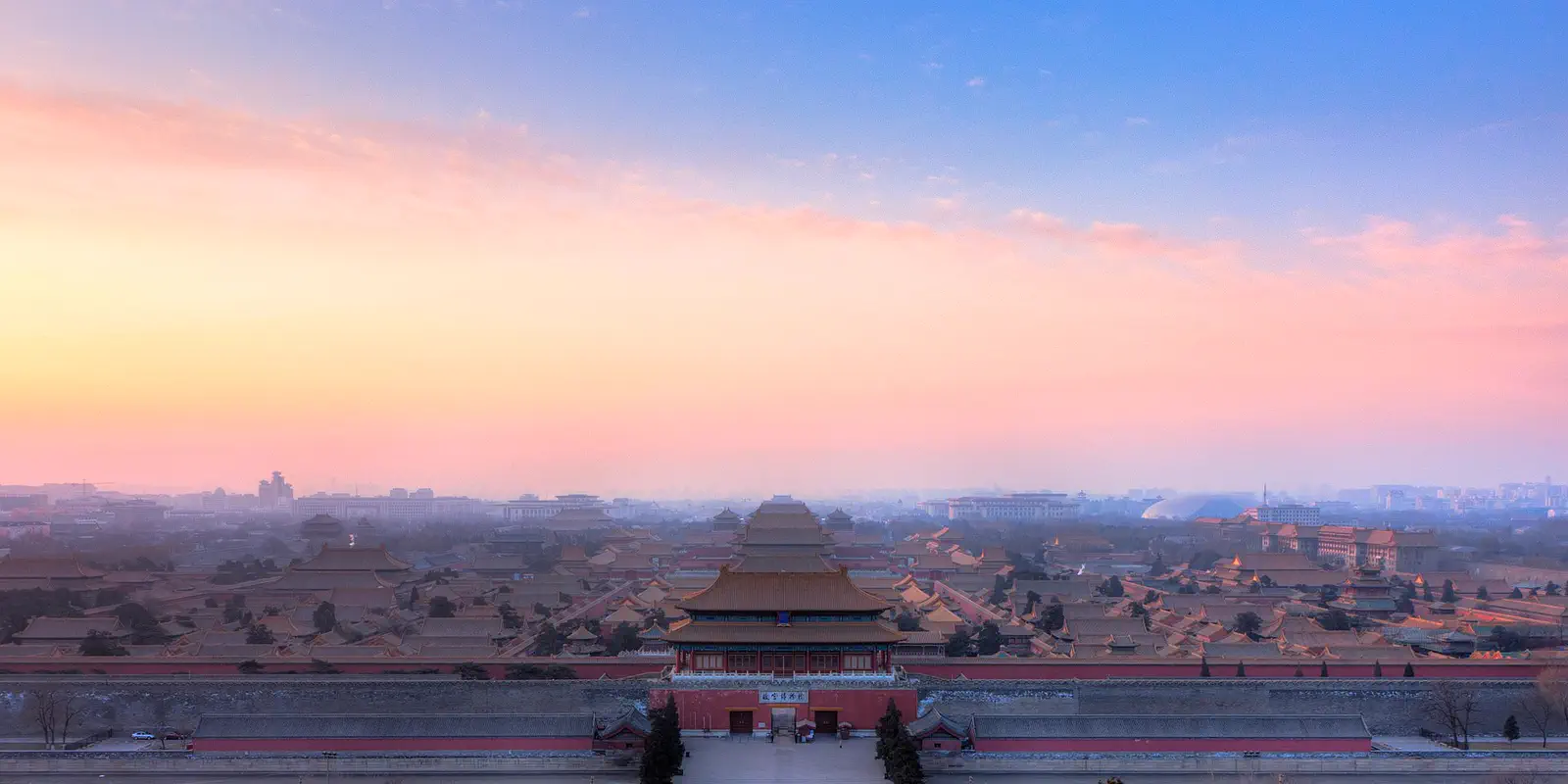
Standard Beijing sights in company with the halal food base. The Palace Museum (Forbidden City) is fully accessible and the surrounding area has halal restaurants toward Wangfujing. Afternoon: Jingshan Park for the panoramic view over the Forbidden City. Halal dinner options are concentrated on Niujie and around Wangfujing.
Attractions: the-forbidden-city, jingshan-park
Day 3 · xian
Fly to Xi'an — Muslim Quarter evening
Flight Beijing to Xi'an (1.5 hours) or high-speed rail (4.5 hours). Check into a hotel near the Bell Tower — the most central location for both the Muslim Quarter and the main sights. Evening walk through the Xi'an Muslim Quarter (回民街, Huímínjīe) — the most extensive Muslim commercial and food street in China, running from the Drum Tower area north to the Great Mosque. Grilled meats, biang biang noodles, roujiamo (pork-free lamb version), persimmon cakes.
Attractions: xian-muslim-quarter
Day 4 · xian
Xi'an — Great Mosque and Terracotta Warriors
Morning: Xi'an Great Mosque (大清真寺) — founded 742 CE, one of the oldest mosques in China, architecturally Chinese with Arabic interiors. Non-Muslim visitors can usually enter the courtyard with appropriate dress; the prayer hall itself is for worshippers. Afternoon: Terracotta Warriors, 40 km east of the city (approximately 1 hour by bus). Full visit takes 2–3 hours. Return to the Muslim Quarter for dinner.
Attractions: terracotta-warriors, xian-great-mosque
Day 5 · xian
Xi'an — city walls and Tang dynasty sites
Morning cycle on top of the Ming city walls (14 km circuit). Afternoon at the Shaanxi History Museum — one of the best provincial history museums in China, with Tang dynasty gold and silver artefacts. Evening: another sweep of the Muslim Quarter for provisions and dinner before departure the following morning.
Attractions: xian-city-walls, shaanxi-history-museum
Day 6 · yinchuan
Fly to Yinchuan — Ningxia capital
Flight Xi'an to Yinchuan (1 hour). Yinchuan is the capital of Ningxia Hui Autonomous Region — the only region in China with Hui Muslim majority administrative status. Check in. Afternoon: Yinchuan old city, Haibao Pagoda (North Pagoda, Tang dynasty), and the local halal food market near the Zhongshan Park area. The lamb-based Ningxia cuisine — lamb hotpot, hand-grasped lamb, Ningxia-style roujiamo — is excellent and reliably halal.
Day 7 · yinchuan
Yinchuan — Western Xia tombs and Helan Mountains
Day excursion west of Yinchuan to the Western Xia Imperial Tombs (西夏王陵) — the burial complex of the Tangut Western Xia kingdom (1038–1227), a civilisation effectively destroyed by the Mongols. The earthen mound tombs against the Helan Mountain backdrop are one of China's more atmospheric lesser-known archaeological sites. Afternoon visit to Helan Mountain rock carvings. Return to Yinchuan for evening.
Attractions: western-xia-imperial-tombs
Day 8 · lanzhou
Train to Lanzhou — noodles city
High-speed rail or conventional train Yinchuan to Lanzhou (2.5–4 hours depending on service). Lanzhou is the capital of Gansu and the origin of China's most consumed noodle dish: Lanzhou beef hand-pulled noodles (兰州拉面, Lánzhōu lāmiàn). The original restaurants are around the Zhongshan Bridge area. Afternoon: Zhongshan Bridge (the Iron Bridge, 1909), Yellow River waterfront.
Attractions: lanzhou-yellow-river-waterfront
Day 9 · xining
Travel to Xining — Dongguan Mosque
Train or bus Lanzhou to Xining (45 minutes by high-speed rail). Xining is the Qinghai capital and has a substantial Hui population alongside Tibetan communities. Afternoon: Dongguan Mosque (东关清真大寺) — one of the largest mosques in northwest China, with a prayer hall capacity for several thousand. The surrounding Shuijing Lane area has halal restaurants and the famous Qinghai yoghurt stalls.
Attractions: dongguan-mosque-xining
Day 10 · xining
Xining — Ta'er Monastery and depart
Morning: Ta'er Monastery (Kumbum) — 25 km south of Xining, one of Tibetan Buddhism's six great monasteries. The butter sculpture gallery is extraordinary; the monastery complex is active and large. Note: this is a Tibetan Buddhist site, not a Muslim one — it is included because Xining's multicultural character is part of the city's identity, and the monastery is one of China's most significant religious sites. Afternoon return to Xining. Depart from Xining airport or continue by Qinghai-Tibet Railway (permit required for Lhasa).
Attractions: taer-monastery-xining
Budget guide (CNY per day)
| Backpacker | ¥500 |
| Mid-range | ¥1400 |
| Comfortable | ¥3200 |
Three domestic flights (Beijing–Xi'an, Xi'an–Yinchuan, Yinchuan optional; train for other legs) add approximately ¥1,000–2,000 per person. Halal food throughout this route is excellent value — Lanzhou noodles ¥15–20, Xi'an Muslim Quarter meals ¥30–60. Budget for Western Xia tombs entrance.
Cities covered
Attractions covered
Other itineraries visiting Beijing
- Beijing–Tianjin long weekend in 3 days
3d · One day on Beijing's sites, a day-trip to Tianjin's Italian quarter and food street, return same evening.
- Beijing 3-day blitz — first-timer fast pass
3d · Three full days in Beijing covering the Forbidden City, Great Wall at Mutianyu, the Temple of Heaven and the hutong lanes — the absolute core of the capital for visitors with limited time.
- Beijing weekend — 3 days in the capital
3d · Three days in Beijing covering the Forbidden City, Great Wall at Mutianyu and the Temple of Heaven — the irreducible core of the capital, managed at a pace that avoids pure exhaustion.
- Beijing in 4 days
4d · Forbidden City, Wall, Temple of Heaven, hutongs, museums.
- China in 5 days: fastest first-timer route
5d · Beijing's big three sights, a flight south, and two days navigating Shanghai's contrasts.
- Beijing + Shanghai — 5-day first-timer classic
5d · Two of China's three great cities in five days: imperial Beijing followed by the modern skyline of Shanghai, linked by a quick domestic flight or overnight train.