CITY · SHANDONG
Mount Tai (Taishan)
泰山 · Tàishān
Overview
The foremost of China's Five Sacred Mountains, a UNESCO World Heritage site revered by Confucians, Daoists and emperors alike, rising from the Shandong plain near the city of Tai'an.
Mount Tai — Taishan — has held a unique place in Chinese civilisation for over three thousand years. Of the Five Sacred Daoist Mountains, it is considered the greatest, and the tradition of emperors climbing to the summit to conduct Feng Shan sacrifices, affirming the mandate of heaven, gave the mountain a political and spiritual significance without parallel in Chinese geography. Seventy-two emperors are recorded as having made the ascent, beginning with the first Qin emperor in 219 BCE. The mountain and its surrounding historic area were inscribed as a UNESCO World Heritage Site in 1987, one of the first in China.
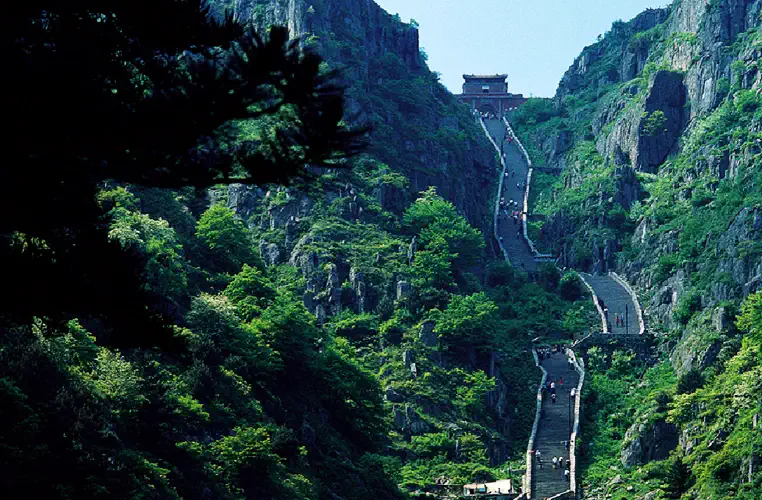
The mountain rises from the flat Shandong plain to 1,545 metres above sea level, a dramatic vertical gain of around 1,400 metres from Tai'an city at its base. The main pilgrim route — the Central Route — ascends approximately 7,200 stone steps through a succession of archways, temples, inscribed cliff faces and rest pavilions that accumulate across the ascent. The Dai Temple at the mountain's base is a major imperial complex of the Song dynasty, housing ancient bronze vessels, a Han-dynasty cypress grove, and the Hall of Heavenly Blessing. The summit holds the Jade Emperor Temple and the Azure Clouds Temple, both active Daoist sites.
The custom of watching the sunrise from the summit has continued uninterrupted from ancient times into the present. Many visitors arrive at the top in darkness — either having climbed through the night or having taken the cable car to the upper station — to watch the sun rise over the Shandong plain below. The experience remains genuinely atmospheric on clear mornings.
The gateway city for Taishan is Tai'an, a pleasant and navigable city on the Beijing-Shanghai high-speed rail line. Jinan, the provincial capital of Shandong, is 75 km north and offers a much larger range of accommodation and onward connections.
Cultural & access notes
The mountain is an active religious site. Daoist temples along the route and at the summit hold regular ceremonies. Incense burning is central to worship; smoke can be heavy at temple entrances. Respect the pilgrimage traditions of other visitors — many are on genuinely devotional journeys rather than recreational hikes.
What to see
- Dai Temple (Daizong Temple) — magnificent imperial complex at the mountain base
- Central Route (Zhong Lu) — the classic 7,200-step pilgrim ascent
- South Heaven Gate — the iconic archway at the summit zone
- Azure Clouds Temple — active Daoist temple at the summit
- Jade Emperor Peak — the actual summit at 1,545 m
- Sunrise viewpoint — the historic dawn-watching tradition
- Inscribed cliff faces — 20,000+ carved characters across the mountain
- Cable car — western cable car from mid-mountain to summit (for those not walking)
What to eat
- Taishan tofu — locally made firm tofu, a regional staple
- Pancakes with mountain vegetables (cong you bing style)
- Grilled corn and sweet potato — sold by vendors on the ascent path
- Shandong-style braised pork belly (hong shao rou)
- Tai'an-style fresh noodles with sesame paste
Getting there
Tai'an station on the Beijing-Shanghai high-speed rail line is the primary gateway — from Beijing South approximately 1.5 hours, from Shanghai Hongqiao approximately 3 hours. Jinan Yaoqiang Airport (TNA) is 90 km north; taxis or coaches connect to Tai'an in about 1.5 hours. The mountain entrance is a 10-minute taxi or bus ride from Tai'an railway station.
Getting around
The main Central Route ascent on foot takes 4–6 hours up; the western cable car reduces the upper section to 10 minutes. Electric shuttle buses run within the scenic area on the mountain road. The summit area has a small cluster of accommodation and food stalls.
Where to stay
Tai'an city has a full range of hotels at every price point. Staying on the summit — in the small guesthouses near the Jade Emperor Temple — is expensive and basic but essential for those wanting to witness the sunrise without a pre-dawn start from the base.
We list neighbourhoods, not specific hotels — we don't endorse hotels.
When to go
April–May and September–October offer the best conditions: clear visibility, moderate temperatures, autumn colour in October. June and July are hot and often foggy with summer haze. January and February see snow and ice on the steps; crampons are occasionally sold at the base.
Budget guide (CNY per day)
| Backpacker | ¥200 |
| Mid-range | ¥450 |
| Comfortable | ¥900 |
Safety notes
The stone steps are steep and uneven in places; proper footwear is important. In wet conditions the steps become slippery. The summit can be significantly colder and windier than the base — bring an extra layer regardless of the season. The ascent is physically demanding; those with heart or knee issues should use the cable car.
Nearby attractions
Day trips within 150 km
Other cities in Shandong
- Jinan济南
Capital of Shandong, 'City of Springs' — 72 named natural springs run through the old town, with Baotu Spring as the centrepiece.
- Qingdao青岛
German colonial-era port on the Shandong coast — red roofs, beer that came over with the Germans in 1903, and the cleanest beaches on the eastern coast.
- Qufu曲阜
Confucius's hometown in southwestern Shandong. The Confucius Temple, Confucius Family Mansion, and Confucius Forest — collectively UNESCO-listed.
- Tai'an泰安
City at the foot of Mount Tai (Taishan) — the most sacred of China's Five Sacred Mountains and a UNESCO World Heritage site. Dai Temple in the city centre is the ceremonial gateway; the mountain summit sunrise draws pilgrims and hikers in every season.
- Weifang潍坊
Shandong city known internationally as the Kite Capital of the World. The Weifang International Kite Festival in April is the largest kite event on earth; the city also preserves Yangliuqing woodblock print tradition and Qing-dynasty Yangjiabu folk art village.
- Weihai威海
Cleanest air in eastern China by AQI — a small coastal Shandong city with substantial Korean tourism, the Liu Gong Island naval-history park, and the country's most-photographed coastal cycling route.
- Yantai烟台
Coastal Shandong port and wine region. The Changyu Wine Culture Museum documents the 1892 founding of China's first modern winery; nearby Penglai is the legendary 'Eight Immortals' coast.
- Zibo淄博
Shandong city with more than 2,700 years of ceramic and glass-making history, centred on the ancient state of Qi whose capital Linzi once rivalled the Zhou royal court. The Zibo Ceramic Museum and the Linzi historic site are the primary draws; a barbecue craze in 2023 briefly made it a viral domestic tourism phenomenon.
Itineraries visiting Mount Tai (Taishan)
- Confucius and Mencius Pilgrimage — Qufu and Zoucheng, 4 days
4d · A dedicated Confucian pilgrimage: two days at the Qufu UNESCO complex, a half-day at Mencius's birthplace Zoucheng, and an ascent of Mount Tai to visit its Confucian inscription steles.
- Shandong Classic — Qufu and Mount Tai, 5 days
5d · The most essential Shandong circuit: Confucius's hometown Qufu, the sacred summit of Mount Tai, and a half-day in Qingdao. Suitable as an add-on from Beijing or Shanghai.
- Shandong Coastal Loop — Jinan to Qingdao, 7 days
7d · Shandong's coast, sacred mountain and Confucian heartland in one loop: Jinan springs, Confucius's birthplace Qufu, Mount Tai sunrise, and the German-flavoured port city of Qingdao.
Food of Eastern China
- Beggar's Chicken叫花鸡
A whole chicken stuffed with aromatics, wrapped in lotus leaves and clay, then slow-baked until the meat steams in its own juices.
- Drunken Chicken醉鸡
Chicken steamed and marinated in Shaoxing rice wine, served chilled. A Shanghai banquet starter.
- Eight-Treasure Rice八宝饭
A steamed dome of glutinous rice layered with red bean paste and decorated with eight types of preserved fruits and nuts.
- Hairy Crab大闸蟹
Yangcheng Lake mitten crab — the autumn delicacy of the Yangtze Delta. Eaten steamed with vinegar dip.
Mount Tai (Taishan) weather by month
| Month | Jan | Feb | Mar | Apr | May | Jun | Jul | Aug | Sep | Oct | Nov | Dec |
|---|---|---|---|---|---|---|---|---|---|---|---|---|
| High °C | -2 | 1 | 9 | 13 | 19 | 25 | 24 | 23 | 20 | 13 | 6 | -2 |
| Low °C | -10 | -7 | -2 | 3 | 8 | 15 | 16 | 16 | 12 | 5 | -2 | -9 |
| Rain mm | 10 | 18 | 14 | 47 | 33 | 76 | 192 | 220 | 72 | 47 | 42 | 11 |
| Rain days | 2 | 3 | 3 | 7 | 5 | 10 | 16 | 13 | 8 | 5 | 4 | 3 |
2019–2023 average via Open-Meteo ERA5 (ERA5 reanalysis). "Rain days" = days per month with ≥1 mm precipitation.
Frequently asked questions
- When is the best time to visit Mount Tai (Taishan)?
- The best months to visit Mount Tai (Taishan) are April, May, September, and October. April–May and September–October offer the best conditions: clear visibility, moderate temperatures, autumn colour in October. June and July are hot and often foggy with summer haze.
- How many days do you need in Mount Tai (Taishan)?
- Plan 4 to 5 days for Mount Tai (Taishan) if you want to see the headline sights without rushing — Dai Temple (Daizong Temple), Central Route (Zhong Lu), South Heaven Gate. Add an extra day for day trips from the city or for repeat visits to your favourite neighbourhood.
- Is Mount Tai (Taishan) safe for tourists?
- The stone steps are steep and uneven in places; proper footwear is important. In wet conditions the steps become slippery. The summit can be significantly colder and windier than the base — bring an extra layer regardless of the season.
- How do you get around Mount Tai (Taishan)?
- The main Central Route ascent on foot takes 4–6 hours up; the western cable car reduces the upper section to 10 minutes. Electric shuttle buses run within the scenic area on the mountain road. The summit area has a small cluster of accommodation and food stalls.
- What's the daily budget for Mount Tai (Taishan)?
- Budget guide for Mount Tai (Taishan): backpackers from around ¥200/day, mid-range travellers ¥450/day, comfortable trips from ¥900/day. These ranges cover accommodation, food, local transport and one paid sight per day, and exclude flights to and from the city.
- Where should you stay in Mount Tai (Taishan)?
- Tai'an city has a full range of hotels at every price point. Staying on the summit — in the small guesthouses near the Jade Emperor Temple — is expensive and basic but essential for those wanting to witness the sunrise without a pre-dawn start from the base.
Spotted something out of date? Submit a correction.
Research
Cross-checked against primary sources
Verified
Address, hours, fees confirmed at the date shown
Updated
Re-verified periodically; corrections welcome