Religious site · SHANDONG · UNESCO
Mt Tai
泰山 · Tàishān
About
UNESCO-listed sacred mountain in Shandong — the foremost of the Five Sacred Mountains. Imperial pilgrimage site for two millennia.
Mt Tai (Taishan) stands at 1,545 metres in central Shandong and holds a cultural position in China that no other mountain quite matches. It is the eastern and foremost of the Five Sacred Mountains, associated in Chinese cosmology with sunrise, renewal, and imperial legitimacy. From the First Emperor of Qin (who performed the Feng and Shan sacrificial ceremonies here in 219 BCE) through to the last pre-modern dynasties, successful emperors climbed Mt Tai to announce their mandate to heaven — 72 emperors and innumerable officials left inscriptions on the stone. UNESCO listed the mountain as a combined Cultural and Natural Heritage Site in 1987.
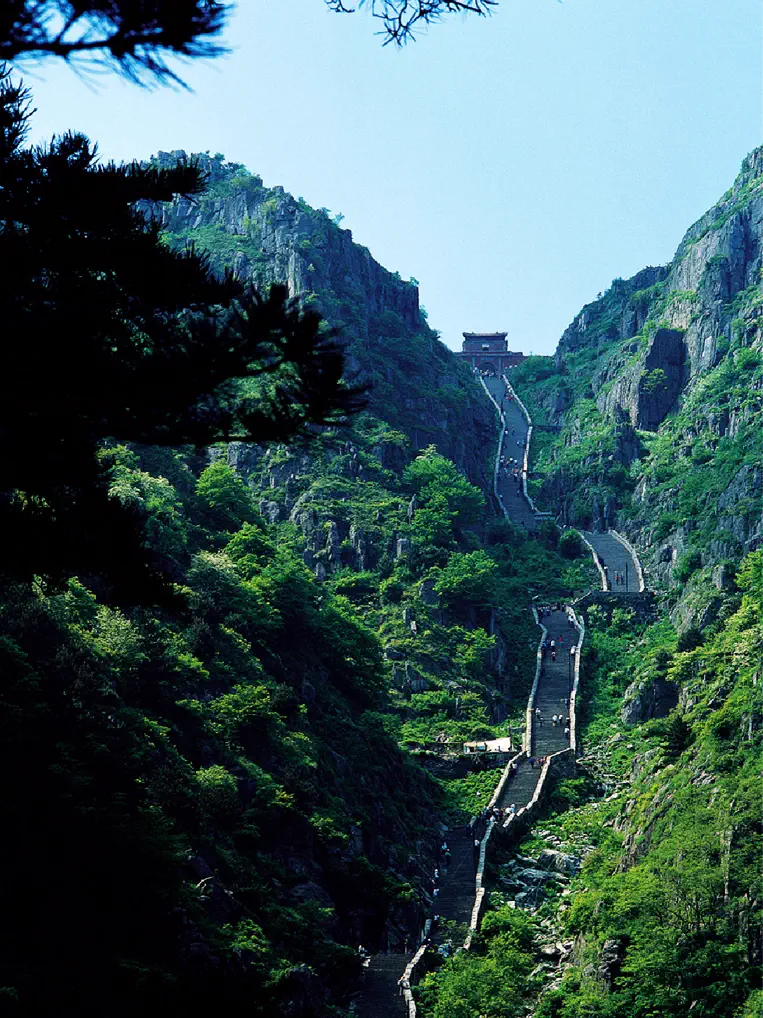
The Central Route ascent from Tai'an city below climbs 6,660 stone steps to the summit plateau — a climb of around 1,400 vertical metres that takes three to four hours at a moderate pace. The steps are the original pilgrimage route and are lined with inscribed stelae, memorial gateways, and small temples at intervals. The Red Gate (Hongmen) marks the start of the formal pilgrimage section; the South Heaven Gate (Nantianmen) near the top marks entry to the summit zone. Jade Emperor Temple at the highest point contains a Jade Emperor shrine. Cable cars from the midway point allow partial ascents. The Western Route descent is quieter than the Central Route and passes through forest.
The canonical Mt Tai experience is watching sunrise from the summit — the sea of cloud below the peak illuminated by the first light, a sight Chinese poets have written about for two thousand years. Jade Emperor Peak faces east and offers an unobstructed view when cloud conditions are right. Summit accommodation books many weeks ahead on weekends and holidays; staying overnight to catch the sunrise requires planning. The descent via the Central Steps in full daylight is worthwhile for reading the accumulated inscriptions, which function as a vertical museum of Chinese calligraphic styles across 22 centuries.
How to get there
HSR from Jinan or Beijing to Tai'an, then shuttle.
When to visit
April–November. Avoid the Spring Festival peak.
Itineraries featuring this site
- Confucius and Mencius Pilgrimage — Qufu and Zoucheng, 4 days
4d · A dedicated Confucian pilgrimage: two days at the Qufu UNESCO complex, a half-day at Mencius's birthplace Zoucheng, and an ascent of Mount Tai to visit its Confucian inscription steles.
- Shandong Classic — Qufu and Mount Tai, 5 days
5d · The most essential Shandong circuit: Confucius's hometown Qufu, the sacred summit of Mount Tai, and a half-day in Qingdao. Suitable as an add-on from Beijing or Shanghai.
- Shandong Coastal Loop — Jinan to Qingdao, 7 days
7d · Shandong's coast, sacred mountain and Confucian heartland in one loop: Jinan springs, Confucius's birthplace Qufu, Mount Tai sunrise, and the German-flavoured port city of Qingdao.
Other religious sites in China
- Big Wild Goose Pagoda大雁塔
Tang-dynasty Buddhist pagoda, built 652 CE to house the sutras brought back by Xuanzang. 64m, seven storeys, climbable.
- Donglin Temple (East Forest Monastery)东林寺
One of the most important Buddhist monasteries in Chinese history, founded in 386 CE at the foot of Mount Lu and considered the birthplace of Pure Land Buddhism in China.
- Drepung Monastery哲蚌寺
UNESCO · Once the largest monastery in the world (10,000+ monks). 8 km west of Lhasa. Active Gelugpa monastery; debating courtyard sessions in the afternoon.
- Famen Temple法门寺
1,700-year-old Buddhist temple 110 km west of Xi'an. The 1987 discovery of a finger relic of the Buddha in its underground crypt was a major archaeological event.
- Ganden Monastery甘丹寺
The mother monastery of the Gelug school of Tibetan Buddhism, founded in 1409 by Tsongkhapa atop Wangbur Mountain 47 km east of Lhasa, offering sweeping plateau views and an important kora trail.
- Gyantse Kumbum Stupa江孜白居寺
A nine-storey mandala stupa built in 1427 containing 108 chapels on multiple floors, considered one of the finest examples of Tibetan religious architecture and the most important landmark in Gyantse.
- Hanging Temple悬空寺
1,500-year-old wooden temple complex pinned to the side of a 75m cliff at Mt Heng. Engineered with horizontal posts driven into the rock face.
- Jade Buddha Temple玉佛寺
Active urban Buddhist temple in central Shanghai. Famous for two life-size jade Buddhas brought from Burma in 1882.
Other UNESCO World Heritage sites in China
- Ancient Villages of Southern Anhui — Xidi and Hongcun皖南古村落—西递、宏村
UNESCO-listed pair of Ming-Qing Huizhou merchant villages in southern Anhui, renowned for whitewashed walls, inky horsehead gables and moon-shaped ponds.
- Archaeological Ruins of Liangzhu City良渚古城遗址
UNESCO-listed archaeological site in Hangzhou preserving the remains of a 5,000-year-old city with a sophisticated water-management system, jade ritual culture and social hierarchy — regarded as one of the earliest state-level societies in East Asia.
- Badain Jaran Desert — Lakes and Dunes巴丹吉林沙漠—沙山湖泊群
UNESCO Natural World Heritage site in Inner Mongolia — the third largest desert in China, featuring some of the world's tallest stationary dunes and a unique network of freshwater and saline lakes sustained by a still-unexplained subterranean water system.
- Capital Cities and Tombs of the Ancient Koguryo Kingdom高句丽王城、王陵及贵族墓葬
UNESCO-listed capital cities and royal tombs of the Koguryo Kingdom in Jian, Jilin — the Chinese portion of a transnational heritage property shared with North Korea, representing one of the most powerful states of ancient East Asia.
- China Danxia中国丹霞
UNESCO Natural World Heritage site — a serial property of six Danxia landscapes across six provinces, representing China's defining red-cliff-and-pillar sandstone landform type, including Danxia Mountain, Zhangye, Taining and Langshan.
- Classical Gardens of Suzhou (UNESCO)苏州古典园林
UNESCO-listed collection of private gardens in Suzhou — four inscribed in 1997 and five more added in 2000 — representing the pinnacle of Chinese garden design through the refined integration of architecture, water, rock and plant.
- Couple's Retreat Garden耦园
UNESCO-listed Suzhou garden organised symmetrically around a central residence. Less crowded than the four most-visited gardens.
- Drepung Monastery哲蚌寺
Once the largest monastery in the world (10,000+ monks). 8 km west of Lhasa. Active Gelugpa monastery; debating courtyard sessions in the afternoon.
Frequently asked questions
- How much does Mt Tai cost to visit?
- Adult entry to Mt Tai is ¥115, ¥57 for children. Plus cable car ¥100 each way.
- When is Mt Tai open?
- Mt Tai opening hours: 24/7 on the mountain.
- How long do you need at Mt Tai?
- Allow 8–24 hours for Mt Tai. Add buffer time if you plan to visit at peak season or include nearby sights in the same trip.
- When is the best time to visit Mt Tai?
- April–November. Avoid the Spring Festival peak.
- How do you get to Mt Tai?
- HSR from Jinan or Beijing to Tai'an, then shuttle.
Spotted something out of date? Submit a correction.
Research
Cross-checked against primary sources
Verified
Address, hours, fees confirmed at the date shown
Updated
Re-verified periodically; corrections welcome