Historic site · FUJIAN · UNESCO
Gulangyu Island
鼓浪屿 · Gǔlàngyǔ
About
UNESCO-listed car-free island off Xiamen, with around 1,000 European-style colonial-era villas. Walkable, music-school heritage, beaches.
Gulangyu is a 1.88 square kilometre island separated from Xiamen by a 600-metre strait. Following the First Opium War, the 1842 Treaty of Nanking opened Xiamen (Amoy) as a treaty port, and Gulangyu was established as an International Settlement in 1902, shared between thirteen nations including Britain, the United States, Germany, Japan, Spain, and the Netherlands. The settlement attracted merchants, missionaries, and colonial administrators who built approximately a thousand villas in an eclectic mix of European Baroque, Romanesque, Modernist, and Sino-European styles on the island's hilly terrain. The built environment from this period survives in unusually dense concentration — most island architecture is from the 1870s–1940s — and UNESCO listed Gulangyu in 2017 as a Historic International Settlement.
The island gained a secondary identity through music. The concentration of Western missionary schools, a conservatory, and a culture of piano instruction among Gulangyu families produced a disproportionate number of Chinese pianists in the 20th century; the island is nicknamed the 'Island of Pianos' and the Piano Museum in the northwest collects historic instruments. The streets carry no motor vehicles — the ban on private cars and motorcycles makes the island navigable on foot — and the combination of quiet lanes, coastal paths, and villa architecture is considerably more pleasant than most urban Chinese tourist sites of equivalent popularity.
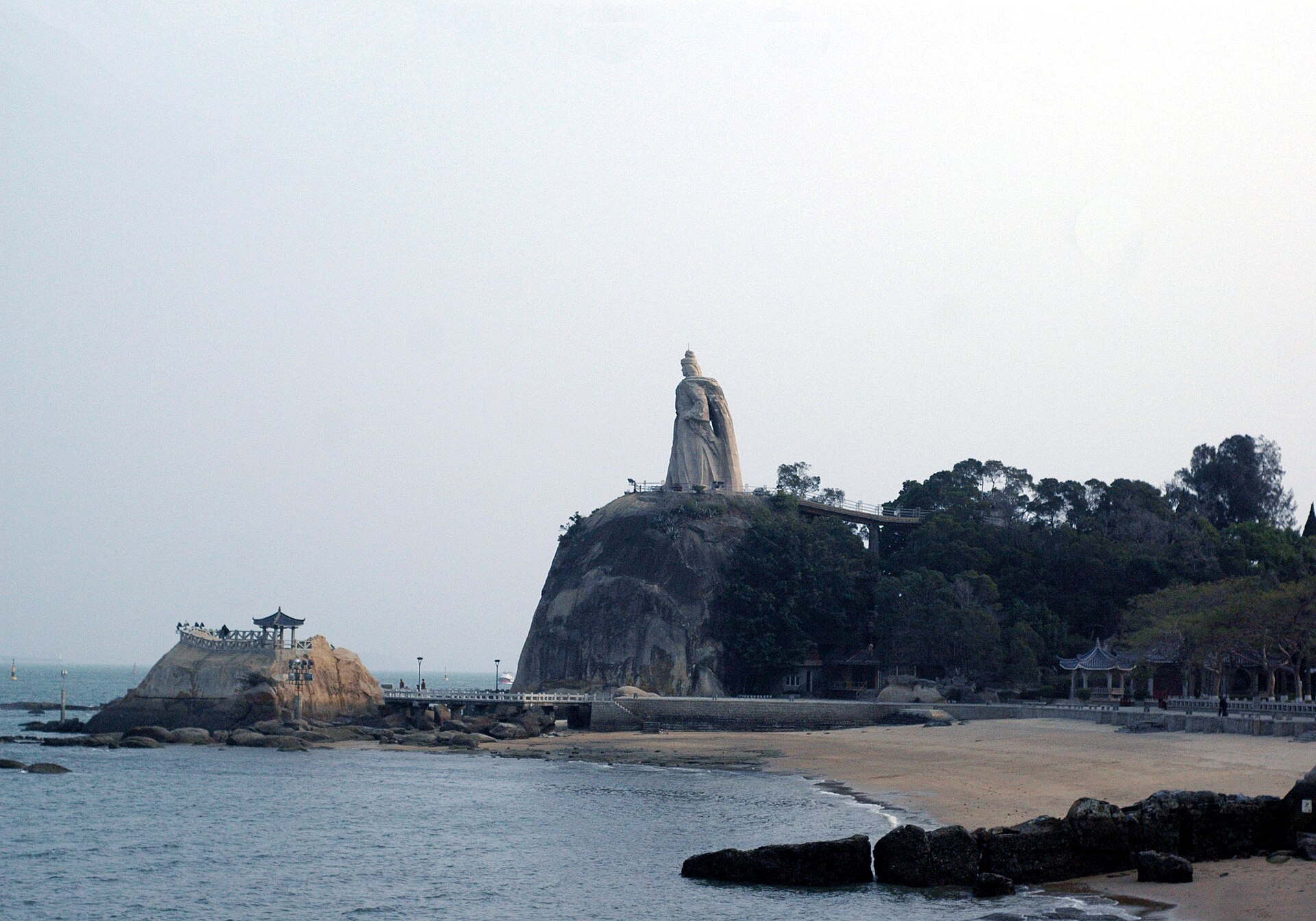
Visitors reach Gulangyu by ferry from Xiamen's International Cruise Terminal (Songyu Pier), which is the designated tourist terminal; the Lujiang Wharf nearer the old town centre is restricted to residents. The crossing takes approximately five minutes. The island's main attractions — Sunlight Rock viewpoint, Shuzhuang Garden, the piano museum, and the Haoyue Garden with its Zheng Chenggong (Koxinga) statue — are spread across the island and reward a half-day to full-day walk. The beaches on the southern shore are small and crowded in summer. Overnight stays in restored villa guesthouses are feasible and allow the island to be experienced before the day-trip crowds arrive by ferry.
How to get there
Ferry from Xiamen International Cruise Terminal (Songyu) — visitors must use this terminal, not the Lujiang one which is locals-only.
When to visit
October–April. Avoid summer typhoons.
UNESCO inscription
“Kulangsu is a tiny island located on the estuary of the Chiu-lung River, facing the city of Xiamen. With the opening of a commercial port at Xiamen in 1843, and the establishment of the island as an international settlement in 1903, this island off the southern coast of the Chinese empire suddenly became an important window for Sino-foreign exchanges. Kulangsu is an exceptional example of the cultural fusion that emerged from these exchanges, which remain legible in its urban fabric. There is a mixture of different architectural styles including Traditional Southern Fujian Style, Western Classical Revival Style and Veranda Colonial Style. The most exceptional testimony of the fusion of various stylistic influences is a new architectural movement, the Amoy Deco Style, which is a synthesis of the Modernist style of the early 20th century and Art Deco.”
Gallery
Other attractions in Xiamen
Itineraries featuring this site
Other historic sites in China
- Ancient Villages of Southern Anhui — Xidi and Hongcun皖南古村落—西递、宏村
UNESCO · UNESCO-listed pair of Ming-Qing Huizhou merchant villages in southern Anhui, renowned for whitewashed walls, inky horsehead gables and moon-shaped ponds.
- Anqing Zhenfeng Pagoda安庆振风塔
A seven-storey Ming Dynasty pagoda standing on the bank of the Yangtze River in Anqing, considered one of the finest riverside pagodas in southern China and long used as a navigation landmark by Yangtze river pilots.
- Archaeological Ruins of Liangzhu City良渚古城遗址
UNESCO · UNESCO-listed archaeological site in Hangzhou preserving the remains of a 5,000-year-old city with a sophisticated water-management system, jade ritual culture and social hierarchy — regarded as one of the earliest state-level societies in East Asia.
- Capital Cities and Tombs of the Ancient Koguryo Kingdom高句丽王城、王陵及贵族墓葬
UNESCO · UNESCO-listed capital cities and royal tombs of the Koguryo Kingdom in Jian, Jilin — the Chinese portion of a transnational heritage property shared with North Korea, representing one of the most powerful states of ancient East Asia.
- Classical Gardens of Suzhou (UNESCO)苏州古典园林
UNESCO · UNESCO-listed collection of private gardens in Suzhou — four inscribed in 1997 and five more added in 2000 — representing the pinnacle of Chinese garden design through the refined integration of architecture, water, rock and plant.
- Danba Tibetan Watchtowers丹巴碉楼
Clusters of ancient stone watchtowers rising above Tibetan village complexes in the Dadu River valley, said to be among the oldest surviving examples of Tibetan defensive architecture.
- Drum Tower and Bell Tower鼓楼钟楼
Yuan-dynasty drum and bell towers that kept official time for imperial Beijing. Climbable; daily drum performances.
- Dujiangyan Irrigation System都江堰
UNESCO · 2,300-year-old irrigation system on the Min River. Still in use. UNESCO-listed jointly with Mt Qingcheng. Engineering rather than architecture, but one of the great works.
Other UNESCO World Heritage sites in China
- Ancient Villages of Southern Anhui — Xidi and Hongcun皖南古村落—西递、宏村
UNESCO-listed pair of Ming-Qing Huizhou merchant villages in southern Anhui, renowned for whitewashed walls, inky horsehead gables and moon-shaped ponds.
- Archaeological Ruins of Liangzhu City良渚古城遗址
UNESCO-listed archaeological site in Hangzhou preserving the remains of a 5,000-year-old city with a sophisticated water-management system, jade ritual culture and social hierarchy — regarded as one of the earliest state-level societies in East Asia.
- Badain Jaran Desert — Lakes and Dunes巴丹吉林沙漠—沙山湖泊群
UNESCO Natural World Heritage site in Inner Mongolia — the third largest desert in China, featuring some of the world's tallest stationary dunes and a unique network of freshwater and saline lakes sustained by a still-unexplained subterranean water system.
- Capital Cities and Tombs of the Ancient Koguryo Kingdom高句丽王城、王陵及贵族墓葬
UNESCO-listed capital cities and royal tombs of the Koguryo Kingdom in Jian, Jilin — the Chinese portion of a transnational heritage property shared with North Korea, representing one of the most powerful states of ancient East Asia.
- China Danxia中国丹霞
UNESCO Natural World Heritage site — a serial property of six Danxia landscapes across six provinces, representing China's defining red-cliff-and-pillar sandstone landform type, including Danxia Mountain, Zhangye, Taining and Langshan.
- Classical Gardens of Suzhou (UNESCO)苏州古典园林
UNESCO-listed collection of private gardens in Suzhou — four inscribed in 1997 and five more added in 2000 — representing the pinnacle of Chinese garden design through the refined integration of architecture, water, rock and plant.
- Couple's Retreat Garden耦园
UNESCO-listed Suzhou garden organised symmetrically around a central residence. Less crowded than the four most-visited gardens.
- Drepung Monastery哲蚌寺
Once the largest monastery in the world (10,000+ monks). 8 km west of Lhasa. Active Gelugpa monastery; debating courtyard sessions in the afternoon.
Frequently asked questions
- How much does Gulangyu Island cost to visit?
- Entry to Gulangyu Island is free. Island entry free; combined-site through-ticket ¥100. Ferry ¥35–¥50.
- When is Gulangyu Island open?
- Gulangyu Island opening hours: Streets 24/7. Sites generally 8:30am–5:30pm.
- How long do you need at Gulangyu Island?
- Allow 4–8 hours for Gulangyu Island. Add buffer time if you plan to visit at peak season or include nearby sights in the same trip.
- When is the best time to visit Gulangyu Island?
- October–April. Avoid summer typhoons.
- How do you get to Gulangyu Island?
- Ferry from Xiamen International Cruise Terminal (Songyu) — visitors must use this terminal, not the Lujiang one which is locals-only.
Spotted something out of date? Submit a correction.
Research
Cross-checked against primary sources
Verified
Address, hours, fees confirmed at the date shown
Updated
Re-verified periodically; corrections welcome