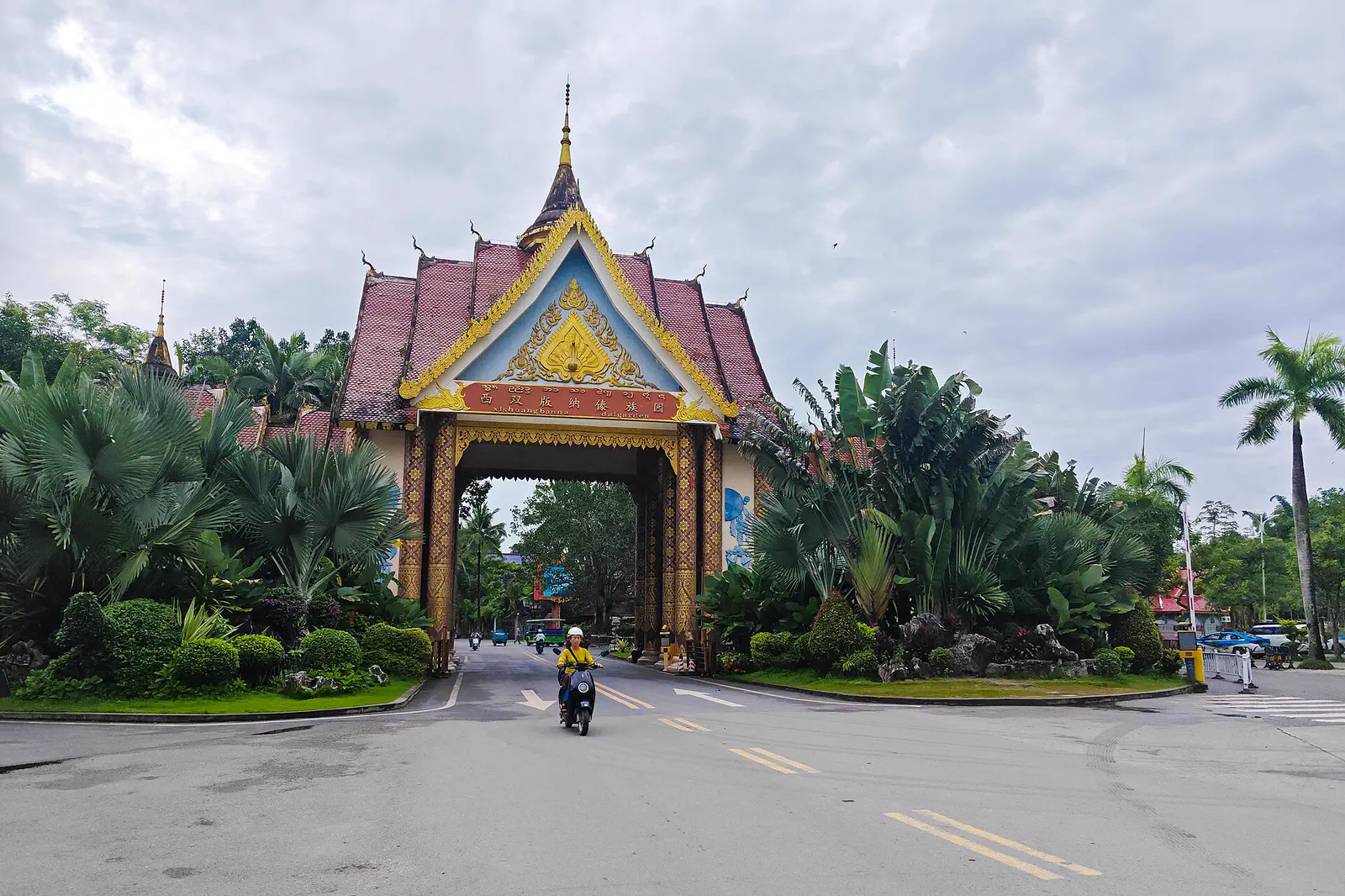
CITY · YUNNAN
Xishuangbanna
西双版纳 · Xīshuāngbǎnnà
Overview
A tropical Dai cultural homeland in southern Yunnan bordering Myanmar and Laos, known for its rainforest, Buddhist temples, ancient Pu'er tea forests and the Water-Splashing Festival.
Xishuangbanna — officially the Xishuangbanna Dai Autonomous Prefecture — occupies the southernmost tip of Yunnan province, sharing borders with Myanmar to the west and Laos to the south. The name derives from the Dai language: Sipsongpanna, meaning Twelve Thousand Rice Fields. The prefecture is home to the Dai people, a Theravada Buddhist culture closely related to the Thai, Lao and Shan peoples across the borders, as well as a dozen other minority nationalities including the Hani, Jinuo and Bulang.
The landscape is tropical: rubber plantations, banana groves, and significant remaining areas of subtropical monsoon rainforest, including the Xishuangbanna National Nature Reserve — one of the most biodiverse regions in China. Wild Asian elephants roam the forest reserves; elephant-watching has become a distinctive activity, with observation platforms at designated areas. The tea culture of the region is ancient — Pu'er tea takes its name from a city in the adjacent prefecture, but Xishuangbanna's Menghai, Mengla and Jinghong areas contain some of the oldest cultivated tea trees in the world, some exceeding several hundred years.
The prefecture capital is Jinghong, a subtropical riverside city on the Mekong (Lancang River), easily navigable and with strong Thai-influenced architecture in the temple district. The Water-Splashing Festival in mid-April — the Dai New Year — is the most celebrated annual event: three days of water throwing, boat racing, lantern floating and street markets that draw visitors from across China and from neighbouring countries.
Jinghong's airport (JHG) has direct flights from Kunming, Chengdu, Chongqing and other Chinese cities, making Xishuangbanna accessible without passing through Kunming for many visitors.
Cultural & access notes
The Dai are Theravada Buddhists and their temple culture resembles that of Thailand and Laos more than Han Chinese Buddhism. White-walled temples with multitiered roofs and gilded spires are the characteristic architecture. Remove shoes before entering any temple. Modest dress is expected at religious sites. The Dai script and language are distinct from Chinese — many older residents use Dai as their primary language.
What to see
- Manting Park — Dai royal garden with Buddhist pavilions and fountains in Jinghong
- Ganlanba (Olive Plain) — traditional Dai village area with working temples and weaving
- Xishuangbanna Tropical Botanical Garden — one of China's largest, with a remarkable collection
- Wild Elephant Valley (Yexianggu) — observation area for the wild Asian elephant population
- Mengla rainforest area and canopy walkways — treetop boardwalks above the forest floor
- Water-Splashing Festival (mid-April) — the Dai New Year, the liveliest public event
- Ancient tea gardens of Menghai County — multi-hundred-year-old tea trees in working forests
What to eat
- Dai-style grilled fish — spiced with galangal, lemongrass and chilli, wrapped in banana leaf
- Pineapple rice — glutinous rice steamed inside a fresh pineapple, a Dai staple
- Bamboo tube rice (zhu tong fan) — rice cooked in green bamboo sections over open fire
- Nanmi dipping sauces with sticky rice — Dai-style condiment spreads of fermented and fresh ingredients
- Pu'er tea — aged fermented tea with an earthy, complex character, widely available in specialist shops
Getting there
Jinghong Xishuangbanna Airport (JHG) has direct flights from Kunming (50 minutes), Chengdu, Chongqing, Guangzhou and other major cities. From Kunming, long-distance coaches take about 10 hours via the mountain highways. A high-speed rail line connecting Kunming to the Laos border via Xishuangbanna is operational at Jinghong station.
Getting around
Jinghong city is navigable by taxi, didi ride-share and rented electric bicycle. Tourist shuttle buses connect to the main scenic areas. Bicycle and motorbike rental is popular for reaching the villages and tea gardens in the surrounding countryside.
Where to stay
Jinghong has a full range of accommodation from budget guesthouses to riverside hotels. The Mekong riverfront area has boutique hotels with Thai-influenced architecture. Village guesthouses in the Ganlanba area offer a quieter, more rural experience.
We list neighbourhoods, not specific hotels — we don't endorse hotels.
When to go
November–April is the dry season and the most comfortable time to visit — sunny, warm (25–30°C) and free from the heavy monsoon rains. The Water-Splashing Festival in mid-April is the highlight of the year. May–October brings heavy monsoon rain; the rainforest is lush and elephants are more active, but some outdoor areas become muddy and occasionally flooded.
Budget guide (CNY per day)
| Backpacker | ¥200 |
| Mid-range | ¥420 |
| Comfortable | ¥850 |
Safety notes
Wild elephant encounters in the forest reserves are possible — follow guides' instructions strictly and do not approach. The border areas with Myanmar and Laos require proper documentation; some border crossing zones require additional permits. Mosquito protection (repellent, long sleeves at dusk) is advisable year-round.
Nearby attractions
China Visit Guide
Mengla Tropical Rainforest Reserve
Mengla Tropical Rainforest Reserve 勐腊热带雨林
China's southernmost tropical rainforest zone in Mengla County, bordering Laos, with extraordinary biodiversity including wild Asian elephants, gibbons, and one of China's richest plant assemblages.
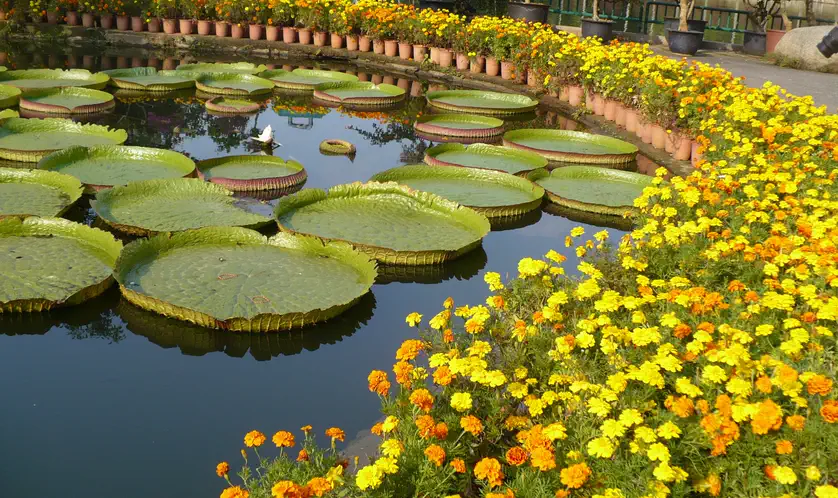
Xishuangbanna Tropical Botanical Garden 西双版纳植物园
1,125-hectare botanical garden in tropical southern Yunnan, on a Mekong tributary. The Chinese Academy of Sciences' largest research botanical garden.
Day trips within 150 km
Other cities in Yunnan
- Dali大理
Walled Bai-minority old town between Erhai Lake and the Cangshan Mountains in northwest Yunnan. Three Pagodas, lakeside cycling, a relaxed travellers' base.
- Heshun和顺
Ancient village on the outskirts of Tengchong in western Yunnan, built by Han Chinese emigrants whose descendants became traders across Burma, Thailand and India. Ancestral halls, the first rural library in China, and well-preserved Ming-Qing domestic architecture.
- Jianshui建水
Late-Ming walled town in southern Yunnan. The Confucian Temple (the second-largest in China after Qufu), 700-year-old wells supplying the local tofu industry, and a meter-gauge railway built by the French in 1910.
- Kunming昆明
Capital of Yunnan, the 'Spring City' — at 1,900m elevation it has mild weather year-round. Gateway to the Yunnan loop (Dali, Lijiang, Shangri-La) and to the Stone Forest.
- Lijiang丽江
UNESCO-listed Naxi old town in northwest Yunnan, beneath the snow-capped Jade Dragon Snow Mountain. Cobbled lanes, water canals, the Naxi minority's pictographic Dongba script.
- Lugu Lake泸沽湖
High-altitude alpine lake on the Yunnan-Sichuan border, homeland of the Mosuo people. Pig-trough dugout canoes, Mosuo matrilineal villages, and clear mountain water at 2,685 m.
- Pu'er普洱
The source city of Pu'er tea in southern Yunnan, with ancient cultivated tea forests in Jingmai Mountain and surrounding hills, and a gateway to the Lancang River region and multiple ethnic minority cultures.
- Shangri-La (Zhongdian)香格里拉
Tibetan-cultural area at 3,290m on the edge of the Tibetan plateau, renamed from Zhongdian in 2001 after the James Hilton novel. Songzanlin Monastery, Pudacuo National Park, Tibetan grassland life.
Itineraries visiting Xishuangbanna
Food of Southwestern China
- Baba Flatbread粑粑
Yunnan's daily flatbread — a thick wheat or rice-flour round cooked on a griddle and eaten plain or stuffed.
- Bang Bang Chicken棒棒鸡
Cold poached chicken shredded by hand, dressed in chilli oil, sesame paste and Sichuan peppercorn.
- Boiled Fish in Chilli Oil水煮鱼
Fish slices submerged in a deep pool of chilli oil and Sichuan peppercorns. Served bubbling.
- Chongqing Hotpot重庆火锅
The original mala hotpot — a simmering cauldron of beef tallow, Pixian doubanjiang and Sichuan peppercorn for communal dipping.
Xishuangbanna weather by month
| Month | Jan | Feb | Mar | Apr | May | Jun | Jul | Aug | Sep | Oct | Nov | Dec |
|---|---|---|---|---|---|---|---|---|---|---|---|---|
| High °C | 25 | 28 | 32 | 33 | 34 | 32 | 31 | 30 | 30 | 29 | 28 | 25 |
| Low °C | 12 | 13 | 16 | 18 | 22 | 23 | 23 | 23 | 22 | 20 | 17 | 13 |
| Rain mm | 31 | 37 | 22 | 65 | 116 | 219 | 304 | 368 | 245 | 183 | 85 | 35 |
| Rain days | 5 | 4 | 3 | 7 | 12 | 25 | 23 | 27 | 21 | 17 | 8 | 7 |
2019–2023 average via Open-Meteo ERA5 (ERA5 reanalysis). "Rain days" = days per month with ≥1 mm precipitation.
Frequently asked questions
- When is the best time to visit Xishuangbanna?
- The best months to visit Xishuangbanna are November, December, January, February, March, and April. November–April is the dry season and the most comfortable time to visit — sunny, warm (25–30°C) and free from the heavy monsoon rains. The Water-Splashing Festival in mid-April is the highlight of the year.
- How many days do you need in Xishuangbanna?
- Plan 3 days for Xishuangbanna if you want to see the headline sights without rushing — Manting Park, Ganlanba (Olive Plain), Xishuangbanna Tropical Botanical Garden. Add an extra day for day trips from the city or for repeat visits to your favourite neighbourhood.
- Is Xishuangbanna safe for tourists?
- Wild elephant encounters in the forest reserves are possible — follow guides' instructions strictly and do not approach. The border areas with Myanmar and Laos require proper documentation; some border crossing zones require additional permits. Mosquito protection (repellent, long sleeves at dusk) is advisable year-round.
- How do you get around Xishuangbanna?
- Jinghong city is navigable by taxi, didi ride-share and rented electric bicycle. Tourist shuttle buses connect to the main scenic areas. Bicycle and motorbike rental is popular for reaching the villages and tea gardens in the surrounding countryside.
- What's the daily budget for Xishuangbanna?
- Budget guide for Xishuangbanna: backpackers from around ¥200/day, mid-range travellers ¥420/day, comfortable trips from ¥850/day. These ranges cover accommodation, food, local transport and one paid sight per day, and exclude flights to and from the city.
- Where should you stay in Xishuangbanna?
- Jinghong has a full range of accommodation from budget guesthouses to riverside hotels. The Mekong riverfront area has boutique hotels with Thai-influenced architecture. Village guesthouses in the Ganlanba area offer a quieter, more rural experience.
Spotted something out of date? Submit a correction.
Research
Cross-checked against primary sources
Verified
Address, hours, fees confirmed at the date shown
Updated
Re-verified periodically; corrections welcome