CITY · LIAONING
Shenyang
沈阳 · Shěnyáng
Overview
Capital of Liaoning and historic capital of the Manchu Qing dynasty before they moved to Beijing in 1644. The Shenyang Imperial Palace is a UNESCO-listed smaller cousin of the Forbidden City.
Shenyang is the capital of Liaoning province and the largest city in China's northeast, carrying the Manchu name Mukden that it held when it was the capital of the pre-conquest Qing state. The Manchu people under Nurhaci and his son Hong Taiji built Shenyang into a functioning imperial capital in the early seventeenth century, before the collapse of the Ming dynasty gave them the opportunity to take Beijing. From 1644, Shenyang became the Qing dynasty's secondary capital — still used for coronation ceremonies and major rites, and treated with the same imperial apparatus as Beijing, just at smaller scale.
The Mukden Palace (Shenyang Gugong) is the principal surviving monument. Built between 1625 and 1636, it is the only surviving imperial palace complex outside Beijing and is listed as a UNESCO World Heritage extension of the Forbidden City. The architecture is distinctly different from the Ming-built Forbidden City: less axially formal, incorporating Tibetan Buddhist and Shamanist Manchu design elements alongside Chinese conventions. The throne hall, the imperial residential quarters, and the ten pavilions of the ten-banner system used by the Manchu military are all preserved and accessible. The scale is more comprehensible than the Forbidden City — you can see the entire complex in a morning.
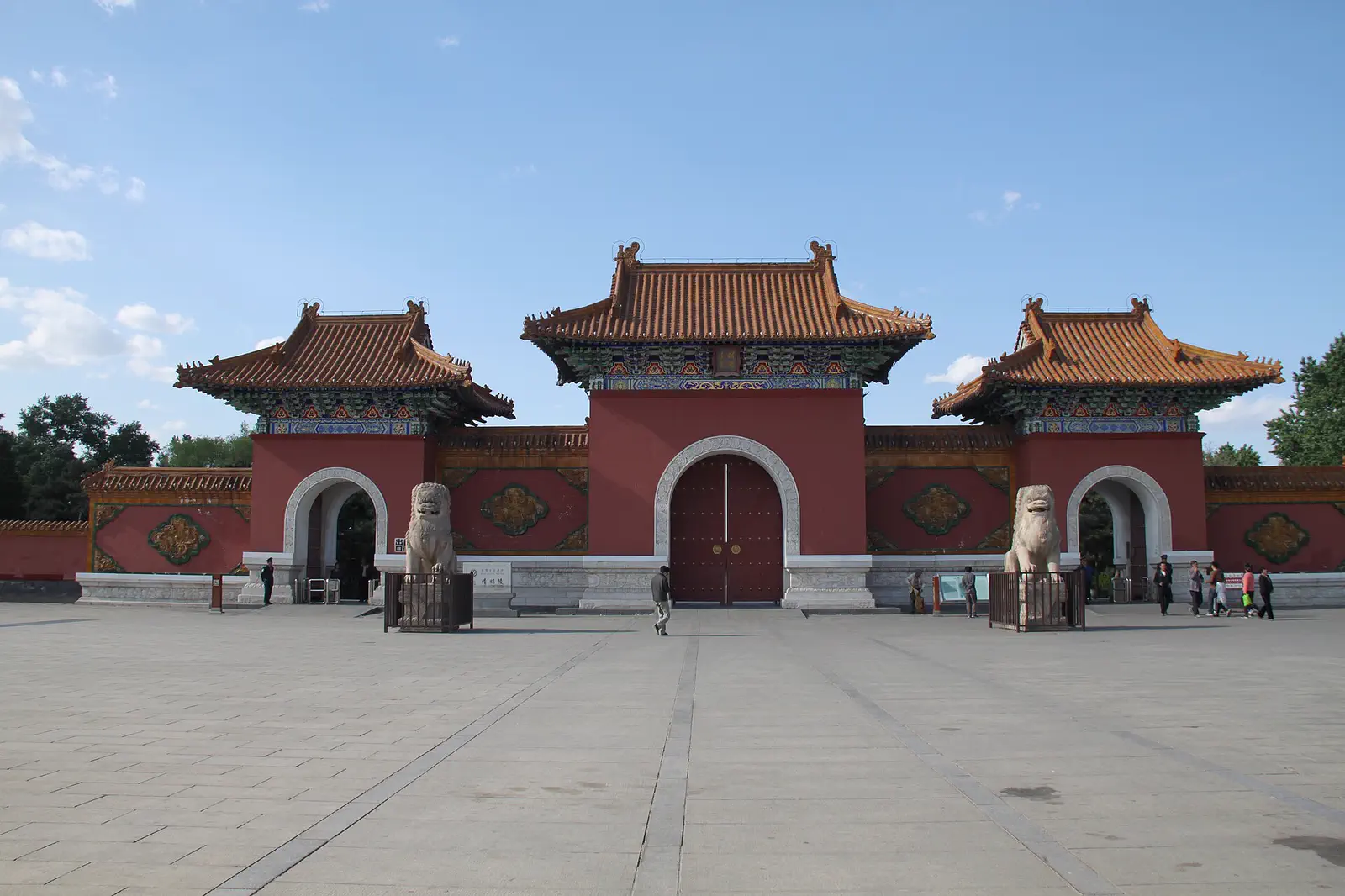
Two royal tombs on the northern and eastern edges of the city are also UNESCO-listed: Beiling (Zhaoling), the tomb of Hong Taiji, set in a large park; and Dongling (Fuling), the tomb of Nurhaci, in forested hills to the east. Both combine the formal Manchu-Qing burial architecture with substantial parkland.
The 9.18 Historical Museum stands at the site of the Mukden Incident of 18 September 1931, when the Japanese Kwantung Army staged an explosion on the South Manchurian Railway as a pretext for the invasion of Manchuria. The museum presents the event from the Chinese perspective with an extensive collection of documents, photographs, and physical evidence.
Shenyang is the cultural capital of Dongbei — the broader northeast identity that encompasses Liaoning, Jilin, and Heilongjiang provinces, with its own distinctive dialect, food, humour tradition (the errenzhuan comic dialogue is the Dongbei equivalent of music hall), and winter culture. The food is winter-appropriate: stewed pork with preserved sauerkraut (suancai) and vermicelli; large dumplings; cold noodle soup. Winters are long and dark; the city is very different in July than in January.
What to see
- Mukden Palace (UNESCO)
- Beiling Park and the Tomb of Hong Taiji
- Dongling Park and Fuling Tomb (UNESCO)
- 9.18 Historical Museum (Mukden Incident memorial)
- Zhongjie pedestrian street
What to eat
- Stewed pork with sauerkraut and vermicelli (酸菜白肉)
- Dongbei dumplings
- Cold-noodle soup
- Grilled mutton skewers
Getting there
Shenyang Taoxian (SHE) airport, 20 km south. Shenyang North HSR station: Beijing 4h, Harbin 1h 30m, Dalian 1h 30m.
Getting around
Metro and bus. Old town walking around the Mukden Palace.
Where to stay
Around the Mukden Palace for the historic core. North station for transport convenience.
We list neighbourhoods, not specific hotels — we don't endorse hotels.
When to go
May–October; winter is well below freezing.
Budget guide (CNY per day)
| Backpacker | ¥250 |
| Mid-range | ¥550 |
| Comfortable | ¥1300 |
Other cities in Liaoning
- Dalian大连
Northeast China's port and resort city, on a hilly Liaodong peninsula coast. Russian and Japanese colonial-era architecture, beaches, seafood, and the cleanest air in the northeast.
- Panjin盘锦
A coastal city in Liaoning with the Red Beach — one of the largest Suaeda salsa wetland ecosystems in the world, which turns vivid red in autumn — and significant rice and crab agriculture.
Itineraries visiting Shenyang
Food of Northeastern China
- Di San Xian地三鲜
A simple Dongbei stir-fry of aubergine, potato and green pepper — the vegetarian staple of northeastern China.
- Dongbei Braised Pork Stew东北乱炖
A robust northeastern 'everything pot' of pork ribs, aubergine, potato, beans and corn braised together in a clay pot.
- Guo Bao Rou锅包肉
Crispy battered pork slices in a sweet-and-sour vinegar sauce — a northeastern Chinese dish created in Harbin.
- Pickled Cabbage and Pork Stew酸菜炖猪肉
A long-simmered northeastern stew of fermented cabbage with fatty pork — warming, sour and deeply satisfying.
Shenyang weather by month
| Month | Jan | Feb | Mar | Apr | May | Jun | Jul | Aug | Sep | Oct | Nov | Dec |
|---|---|---|---|---|---|---|---|---|---|---|---|---|
| High °C | -4 | 1 | 10 | 17 | 24 | 27 | 30 | 28 | 24 | 16 | 5 | -3 |
| Low °C | -13 | -9 | -2 | 4 | 12 | 17 | 22 | 20 | 15 | 6 | -3 | -12 |
| Rain mm | 4 | 8 | 17 | 27 | 73 | 116 | 143 | 208 | 92 | 50 | 60 | 7 |
| Rain days | 1 | 2 | 4 | 5 | 8 | 12 | 14 | 13 | 9 | 5 | 6 | 2 |
2019–2023 average via Open-Meteo ERA5 (ERA5 reanalysis). "Rain days" = days per month with ≥1 mm precipitation.
Frequently asked questions
- When is the best time to visit Shenyang?
- The best months to visit Shenyang are May, June, September, and October. May–October; winter is well below freezing.
- How many days do you need in Shenyang?
- Plan 3 days for Shenyang if you want to see the headline sights without rushing — Mukden Palace (UNESCO), Beiling Park and the Tomb of Hong Taiji, Dongling Park and Fuling Tomb (UNESCO). Add an extra day for day trips from the city or for repeat visits to your favourite neighbourhood.
- How do you get around Shenyang?
- Metro and bus. Old town walking around the Mukden Palace.
- What's the daily budget for Shenyang?
- Budget guide for Shenyang: backpackers from around ¥250/day, mid-range travellers ¥550/day, comfortable trips from ¥1300/day. These ranges cover accommodation, food, local transport and one paid sight per day, and exclude flights to and from the city.
- Where should you stay in Shenyang?
- Around the Mukden Palace for the historic core. North station for transport convenience.
Spotted something out of date? Submit a correction.
Research
Cross-checked against primary sources
Verified
Address, hours, fees confirmed at the date shown
Updated
Re-verified periodically; corrections welcome