CITY · YUNNAN
Yuanyang
元阳 · Yuányáng
Overview
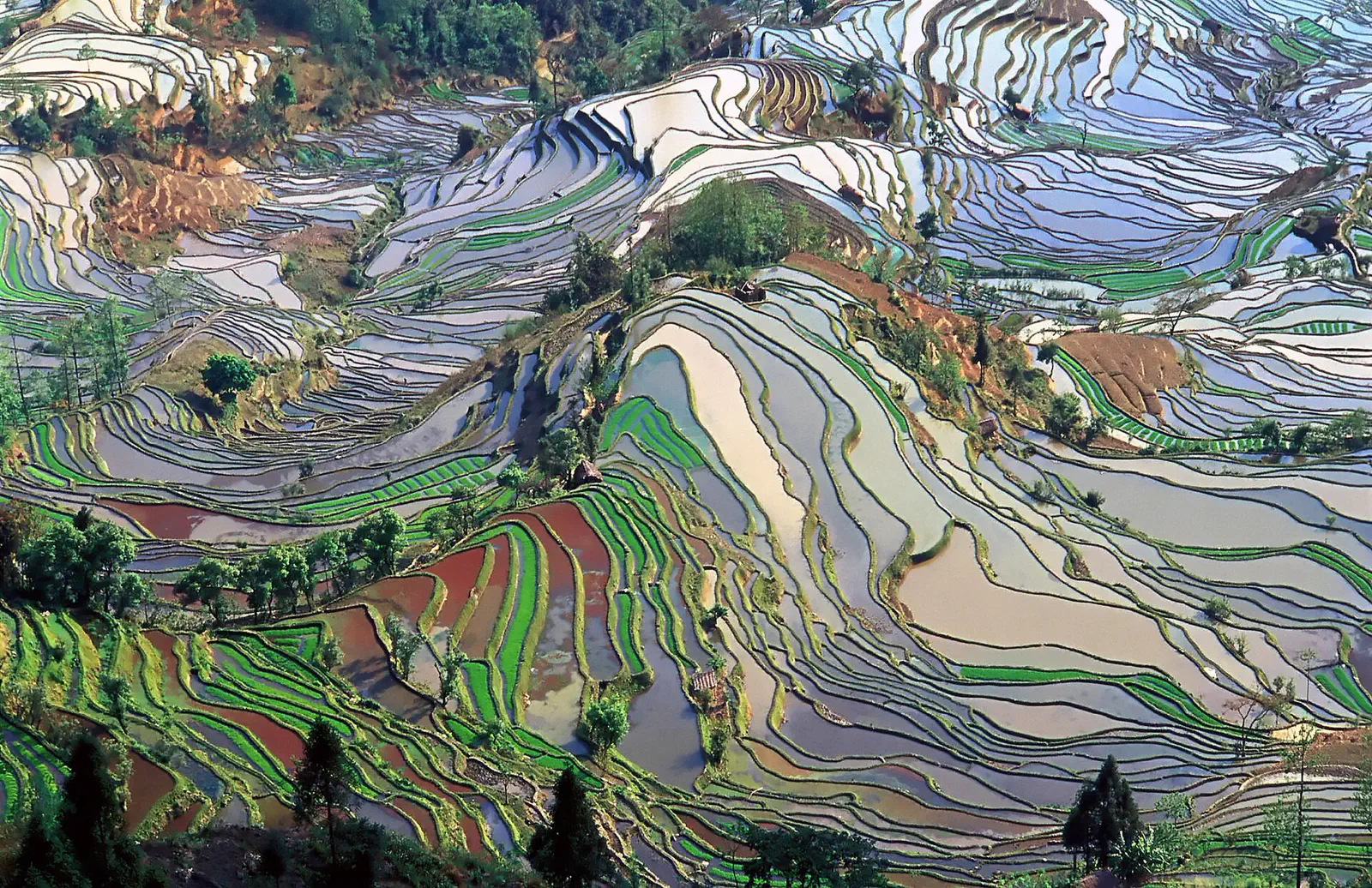
A Hani minority county in southern Yunnan famous for the Honghe Hani Rice Terraces — one of the world's great agricultural landscapes, UNESCO-listed, at its most spectacular when winter water flooding fills the stepped fields.
Yuanyang County lies in the southern part of Yunnan province, in the Honghe Hani and Yi Autonomous Prefecture. It is the centre of the Honghe Hani Rice Terraces, inscribed as a UNESCO World Heritage Site in 2013. The terraces were carved from the mountains by the Hani people over a period of approximately 1,300 years, creating a tiered agricultural system that descends from forest-covered mountain tops through habitation zones to flooded rice paddies that step down to the Honghe (Red River) valley below at elevations ranging from 140 to 2,000 metres.
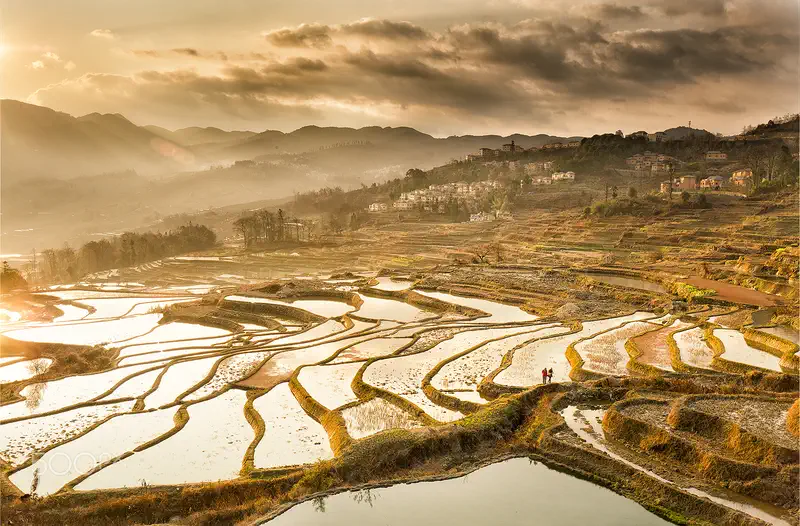
The Hani people maintain the terrace system through an intricate communal water management network, directing water from the mountain forests through channels to the fields. The system remains functional and the terraces are still cultivated. The landscape's visual character changes dramatically through the agricultural cycle: in winter and early spring (November–April), the terraces are flooded and reflect the sky — sunrises and sunsets turn the water mirrors into sheets of colour. In summer, the green rice plants fill the fields. Autumn brings the harvest gold before the flooding begins again.
The main viewpoints are concentrated in a core scenic area around Duoyishu, Bada and Laohuzui (Tiger's Mouth), each offering different aspects of the terrace landscape and different qualities of light. Yuanyang county town (Nansha) is at the foot of the terraces at low altitude; the scenic area and the Hani villages are at higher altitude around Xinjie township, which serves as the practical base for visitors.
Mengzi and Jianshui — both larger cities with more accommodation options — are the regional access hubs, roughly 100 km from Yuanyang.
Cultural & access notes
The Hani people are the creators and custodians of this landscape. Their water management system is communally maintained and depends on every household fulfilling obligations. The terraces are not a heritage site but an actively farmed system — walk only on designated paths. Hani festivals follow the lunar calendar; the Ku Zha Zha (June festival) and the Spring Festival are the most significant community celebrations.
What to see
- Duoyishu viewpoint — the sunrise viewpoint above a sea of stepped water mirrors
- Bada terraces — a wide, more open terrace basin, good for sunset
- Laohuzui (Tiger's Mouth) — a dramatic narrow terrace descent into the valley
- Hani villages — traditional earthen mushroom-shaped Hani houses at Pugao Old Village and others
- Yuanyang mushroom-house village cluster — the distinctive cylindrical thatched Hani architecture
- Winter flooding season — December–March when the terraces are filled with water and sky reflections are at their finest
What to eat
- Hani rice wine — fermented glutinous rice wine in ceramic pots
- Roasted pork and smoked sausage dishes — Hani smoking and preservation tradition
- Terrace rice — the local heritage glutinous rice varieties, eaten plain or in sticky rice cakes
- Wild mushroom hot pot — mountain mushrooms foraged from the surrounding forests
- Dog meat dishes — a Hani culinary tradition, offered at local restaurants [cultural context: common in Hani areas]
Getting there
Yuanyang does not have its own airport. From Kunming, long-distance coaches travel via Jianshui to Yuanyang (Xinjie town) in approximately 5–6 hours. From Jianshui by road approximately 2 hours. High-speed rail from Kunming to Jianshui station takes about 1.5 hours, then a bus connection. Some tour operators run direct overnight coaches from Kunming.
Getting around
Xinjie town (the scenic area base) has taxis and mini-buses to the main viewpoints. Hiring a driver for a day to cover Duoyishu, Bada and Laohuzui is the most efficient approach. The viewpoints are spread over 15–20 km — walking between them is impractical.
Where to stay
Xinjie has a good range of guesthouses and mid-range hotels, including several with rooftop terraces facing the mountain landscape. Staying in one of the Hani villages (guesthouses available in Pugao and Azheke villages) is a more atmospheric option.
We list neighbourhoods, not specific hotels — we don't endorse hotels.
When to go
December–March is the primary season: the terraces are flooded and the light at dawn and dusk is exceptional. January–February coincides with the Hani Spring Festival celebrations. Summer (June–September) has the green paddy scenery and harvest activity. October–November is the draining period — the least visually compelling phase.
Budget guide (CNY per day)
| Backpacker | ¥180 |
| Mid-range | ¥380 |
| Comfortable | ¥750 |
Safety notes
The narrow paths around the terrace edges can be slippery in wet or misty conditions. The morning pre-dawn drives to viewpoints are on mountain roads in darkness — hire only experienced local drivers. Altitude at the viewpoints (1,800–2,000 m) is generally manageable.
Nearby attractions
Other cities in Yunnan
- Dali大理
Walled Bai-minority old town between Erhai Lake and the Cangshan Mountains in northwest Yunnan. Three Pagodas, lakeside cycling, a relaxed travellers' base.
- Heshun和顺
Ancient village on the outskirts of Tengchong in western Yunnan, built by Han Chinese emigrants whose descendants became traders across Burma, Thailand and India. Ancestral halls, the first rural library in China, and well-preserved Ming-Qing domestic architecture.
- Jianshui建水
Late-Ming walled town in southern Yunnan. The Confucian Temple (the second-largest in China after Qufu), 700-year-old wells supplying the local tofu industry, and a meter-gauge railway built by the French in 1910.
- Kunming昆明
Capital of Yunnan, the 'Spring City' — at 1,900m elevation it has mild weather year-round. Gateway to the Yunnan loop (Dali, Lijiang, Shangri-La) and to the Stone Forest.
- Lijiang丽江
UNESCO-listed Naxi old town in northwest Yunnan, beneath the snow-capped Jade Dragon Snow Mountain. Cobbled lanes, water canals, the Naxi minority's pictographic Dongba script.
- Lugu Lake泸沽湖
High-altitude alpine lake on the Yunnan-Sichuan border, homeland of the Mosuo people. Pig-trough dugout canoes, Mosuo matrilineal villages, and clear mountain water at 2,685 m.
- Pu'er普洱
The source city of Pu'er tea in southern Yunnan, with ancient cultivated tea forests in Jingmai Mountain and surrounding hills, and a gateway to the Lancang River region and multiple ethnic minority cultures.
- Shangri-La (Zhongdian)香格里拉
Tibetan-cultural area at 3,290m on the edge of the Tibetan plateau, renamed from Zhongdian in 2001 after the James Hilton novel. Songzanlin Monastery, Pudacuo National Park, Tibetan grassland life.
Itineraries visiting Yuanyang
- Photography focus — Yunnan and Guilin, 10 days
10d · Ten days through two of China's most photogenic landscapes: Yunnan's terraced rice fields and highland villages, followed by the karst pinnacles and river mist of Guilin and Yangshuo.
- Yunnan deep loop — Kunming to Tengchong, 14 days
14d · Fourteen days through the full breadth of Yunnan: Kunming, Dali, Lijiang, Shangri-La, the Yuanyang terraces, Jianshui and the geothermal fields of Tengchong — the province's different climates, altitudes and minorities in one loop.
Food of Southwestern China
- Baba Flatbread粑粑
Yunnan's daily flatbread — a thick wheat or rice-flour round cooked on a griddle and eaten plain or stuffed.
- Bang Bang Chicken棒棒鸡
Cold poached chicken shredded by hand, dressed in chilli oil, sesame paste and Sichuan peppercorn.
- Boiled Fish in Chilli Oil水煮鱼
Fish slices submerged in a deep pool of chilli oil and Sichuan peppercorns. Served bubbling.
- Chongqing Hotpot重庆火锅
The original mala hotpot — a simmering cauldron of beef tallow, Pixian doubanjiang and Sichuan peppercorn for communal dipping.
Yuanyang weather by month
| Month | Jan | Feb | Mar | Apr | May | Jun | Jul | Aug | Sep | Oct | Nov | Dec |
|---|---|---|---|---|---|---|---|---|---|---|---|---|
| High °C | 15 | 17 | 21 | 23 | 24 | 24 | 24 | 24 | 23 | 21 | 19 | 15 |
| Low °C | 7 | 8 | 12 | 14 | 17 | 18 | 18 | 17 | 16 | 14 | 12 | 8 |
| Rain mm | 64 | 56 | 65 | 107 | 151 | 216 | 278 | 289 | 182 | 113 | 54 | 39 |
| Rain days | 9 | 8 | 11 | 15 | 21 | 27 | 27 | 28 | 23 | 17 | 11 | 9 |
2019–2023 average via Open-Meteo ERA5 (ERA5 reanalysis). "Rain days" = days per month with ≥1 mm precipitation.
Frequently asked questions
- When is the best time to visit Yuanyang?
- The best months to visit Yuanyang are December, January, February, and March. December–March is the primary season: the terraces are flooded and the light at dawn and dusk is exceptional. January–February coincides with the Hani Spring Festival celebrations.
- How many days do you need in Yuanyang?
- Plan 3 days for Yuanyang if you want to see the headline sights without rushing — Duoyishu viewpoint, Bada terraces, Laohuzui (Tiger's Mouth). Add an extra day for day trips from the city or for repeat visits to your favourite neighbourhood.
- Is Yuanyang safe for tourists?
- The narrow paths around the terrace edges can be slippery in wet or misty conditions. The morning pre-dawn drives to viewpoints are on mountain roads in darkness — hire only experienced local drivers. Altitude at the viewpoints (1,800–2,000 m) is generally manageable.
- How do you get around Yuanyang?
- Xinjie town (the scenic area base) has taxis and mini-buses to the main viewpoints. Hiring a driver for a day to cover Duoyishu, Bada and Laohuzui is the most efficient approach. The viewpoints are spread over 15–20 km — walking between them is impractical.
- What's the daily budget for Yuanyang?
- Budget guide for Yuanyang: backpackers from around ¥180/day, mid-range travellers ¥380/day, comfortable trips from ¥750/day. These ranges cover accommodation, food, local transport and one paid sight per day, and exclude flights to and from the city.
- Where should you stay in Yuanyang?
- Xinjie has a good range of guesthouses and mid-range hotels, including several with rooftop terraces facing the mountain landscape. Staying in one of the Hani villages (guesthouses available in Pugao and Azheke villages) is a more atmospheric option.
Spotted something out of date? Submit a correction.
Research
Cross-checked against primary sources
Verified
Address, hours, fees confirmed at the date shown
Updated
Re-verified periodically; corrections welcome