CITY · GUANGDONG
Shenzhen
深圳 · Shēnzhèn
Overview
Mainland China's youngest megacity, just over the Hong Kong border — the original Special Economic Zone, now home to Tencent, Huawei, DJI, BYD and a tech industry that powers most of what's in your pocket.
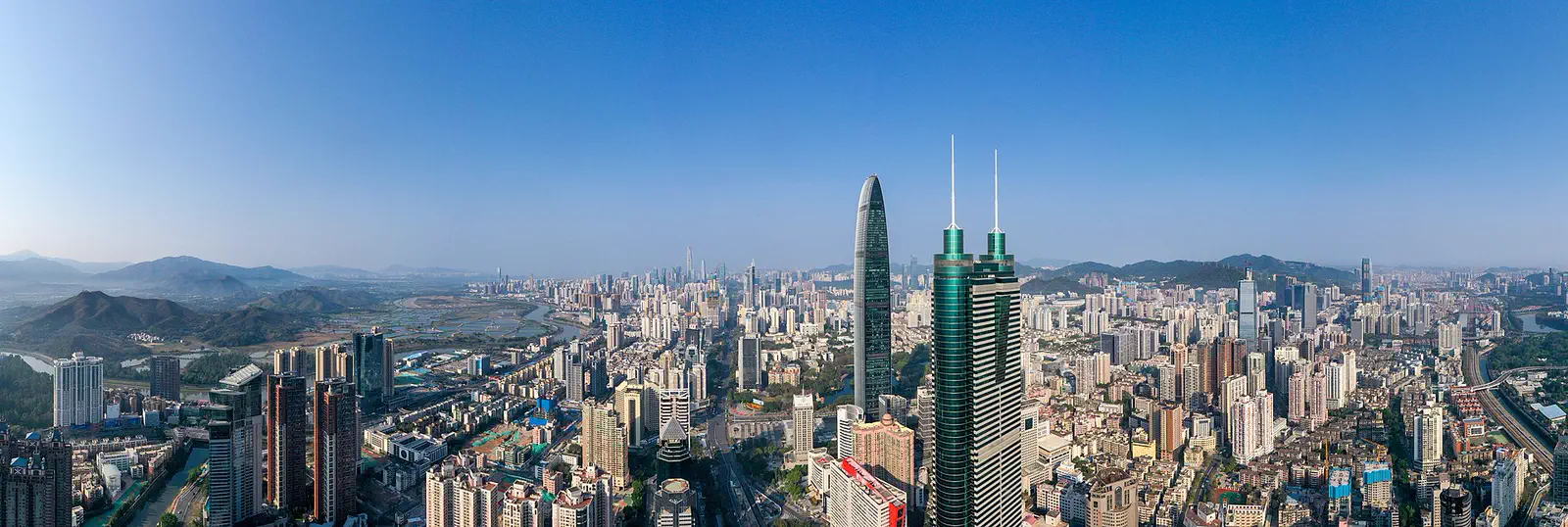
Shenzhen barely existed before 1980. It was a 30,000-person fishing town directly across the boundary from then-British Hong Kong. Designated as China's first Special Economic Zone, it became the country's experiment in market reform — and 45 years later it is a 17.8-million-person megacity, the third-richest in mainland China by GDP per capita, and the headquarters of Tencent (WeChat), Huawei, DJI, BYD, ZTE and the bulk of China's hardware industry.
It is the most modern Chinese megacity by some distance. The architecture is more or less all post-1985. The metro is one of the newest and fastest. The neighbourhood structure runs on tech-park clusters: Nanshan in the west (Tencent, the universities, the SoftBank-financed startups), Futian in the centre (the financial district and the border with Hong Kong), Luohu just east of Futian (the original 1980s SEZ, the Lo Wu border crossing, and most of the budget shopping and counterfeit markets), and Bao'an to the northwest (the airport, the manufacturing belt). Coastal Yantian and Dapeng to the east have beaches and an old-walled-town day trip.
For visitors, Shenzhen has fewer 'must-see' historic sights than Guangzhou and far fewer than Beijing — there is no imperial complex, no centuries-old temple district. What it offers is a window into how modern China actually looks, plus exceptional access to Hong Kong (15 minutes by metro/HSR) and the Pearl River Delta. Many travellers use Shenzhen as a base for visiting Hong Kong without paying Hong Kong hotel prices, especially since the new visa-free policies that allow same-day border crossings.
The climate is essentially the same as Guangzhou's — hot humid summers, mild dry winters, occasional typhoons July–September. November to early March is the comfortable window. Air quality is reliably better than Beijing's; the Pacific air keeps the city clean.
Cultural & access notes
Shenzhen has the youngest median age of any Chinese megacity — most residents are migrants from elsewhere in China, attracted by the tech industry and the SEZ wages. Putonghua (Mandarin) dominates over Cantonese in everyday speech, unlike Guangzhou. Shopping malls open late (until 10pm typical). Many restaurants take reservations via Dianping/Meituan apps.
What to see
- OCT-LOFT (Overseas Chinese Town Loft) — converted warehouse arts district in Nanshan
- Window of the World — outdoor theme park with scaled replicas of global landmarks (kitsch but locally famous)
- Splendid China and Folk Culture Village — China-in-miniature theme park
- Shenzhen Bay Park — long coastal promenade looking across to Hong Kong's Kowloon
- Lianhua Hill (Lianhuashan) Park — the Deng Xiaoping statue and the central skyline view
- Dafen Oil Painting Village — the world centre of replica oil-painting production
- Dapeng Fortress and Ancient Town — Ming-era walled town in the eastern beach district
- Coco Park / Mixc / The Mixc World — the major shopping/dining centres for an evening
- Sea World (Shekou) — old French liner Minghua docked as a restaurant, expat-area bars
- Pingshan Art Museum and Shenzhen Museum of Contemporary Art and Urban Planning
What to eat
- Cantonese dim sum — Shenzhen has every Hong Kong chain plus excellent local houses
- Chaozhou (Teochew) cuisine — Shenzhen has a large Chaozhou diaspora; cold marinated goose and fish-ball noodle soup are highlights
- Hakka cuisine — particularly the salt-baked chicken and stuffed tofu
- Hong Kong-style milk tea and pineapple buns at cha chaan teng (Hong Kong-style cafes)
- Seafood — Yantian is the seafood district
- Hot pot — both Sichuan and Cantonese-style; the city has more international hot pot chains than any other
Getting there
Shenzhen Bao'an (SZX) airport is in the northwest, 35 km from the city — Line 11 metro express to Futian in 35 minutes (¥7). Shenzhen North is the main HSR station: Hong Kong West Kowloon 14 minutes, Guangzhou South 30 minutes, Shanghai 8h, Beijing 8h 15m. Border crossings to Hong Kong: Lo Wu (Luohu, by metro Line 1), Lok Ma Chau (Futian, by metro Line 4 or HSR), Western Corridor / Shenzhen Bay (by bus). Hong Kong International Airport is reachable by ferry, by HSR plus the Airport Express, or by direct cross-border bus.
Getting around
Metro is the dominant mode — 17 lines, English signage, ¥2–¥14 per trip. Most tourist destinations are on Lines 1, 2, 5 and 11. Didi works. The city is large; budget metro time generously. Cross-border to Hong Kong is fastest by HSR (14 min) but the metro through Lo Wu/Luohu (¥45 for Hong Kong's MTR) is cheaper.
Where to stay
Futian for the central CBD and quickest border crossing. Nanshan / Houhai for the tech district and OCT. Luohu near Lo Wu for budget hotels and old-school shopping (Dongmen pedestrian street, Luohu Commercial City counterfeit market). Shekou for expat-area Sea World and ferry access to Hong Kong. Avoid Bao'an unless flying very early.
We list neighbourhoods, not specific hotels — we don't endorse hotels.
When to go
November to early March: dry, mild, low humidity, consistently the best window. Spring (March–April) is fine but humidifying. Mid-summer is hot, humid and prone to typhoons. The city does not stop in summer but you'll be hopping between air-conditioned malls.
Budget guide (CNY per day)
| Backpacker | ¥350 |
| Mid-range | ¥800 |
| Comfortable | ¥2000 |
Safety notes
Shenzhen is among the safer mainland cities — by official statistics safer than the average European capital. Petty crime concentrates around the Luohu border-crossing area (touts, fake-goods sellers). Counterfeit markets sell counterfeits — be aware of importation rules in your home country. Cross-border travellers should expect thorough customs checks at Lo Wu and Futian.
Nearby attractions
Day trips within 150 km
China Visit Guide
Hong Kong Disneyland
Hong Kong Disneyland 香港迪士尼乐园
Hong Kong Disneyland — the smaller of the two Chinese Disney parks but with classic-Disney charm. On Lantau.
≈ 25 km from Shenzhen
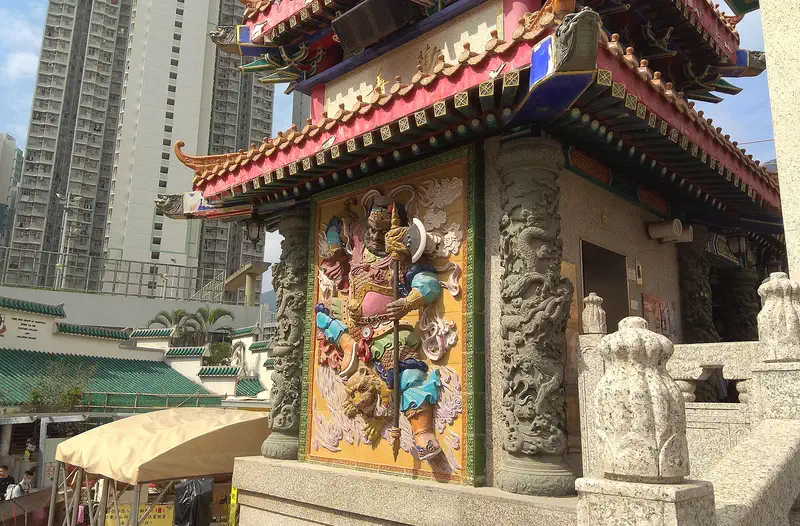
Wong Tai Sin Temple 黄大仙祠
Active Daoist-Buddhist-Confucian temple in Kowloon, famous for fortune-telling and the lunar-new-year incense offering.
≈ 25 km from Shenzhen
China Visit Guide
Temple Street Night Market
Temple Street Night Market 庙街夜市
Hong Kong's most famous night market, in Yau Ma Tei. Dim sum, hot pot, fortune-tellers, knock-off goods.
≈ 30 km from Shenzhen
More on Shenzhen
Living here?
We have a dedicated expat guide covering cost of living, neighbourhoods, international schools, hospitals, and community life in Shenzhen.
Shenzhen expat living guide →Other cities in Guangdong
- Dongguan东莞
Manufacturing megacity in the Pearl River Delta corridor between Guangzhou and Shenzhen, with a population of 7.5 million (most migrant workers). Home to Keyuan Garden, a preserved Lingnan classical garden, and the Yumin Garden. Provides an honest window into Pearl River Delta industrial urbanism.
- Foshan佛山
Pearl River Delta city famous for ceramics, Cantonese opera, and martial-arts heritage. Bruce Lee's family hometown; the modern Cantonese-opera tradition's institutional base.
- Guangzhou广州
Capital of Guangdong, the historic southern trading port and the home of Cantonese cooking. The first Chinese city to industrialise, the centre of dim sum, and a working megacity less polished than Shanghai but with deeper food roots.
- Zhuhai珠海
Special Economic Zone facing Macau across the Pearl River estuary. The most-walkable mainland Chinese city — a 53 km Lover's Road coastal promenade, 146 km of beaches, and the world's longest sea-crossing bridge.
Itineraries visiting Shenzhen
Food of Southern China
- Beef Chow Fun干炒牛河
Flat rice noodles dry-fried with silky marinated beef, beansprouts and spring onion over a fierce wok flame.
- Bubble Tea珍珠奶茶
Taiwanese milk tea served with chewy tapioca pearls (boba) through a wide straw. The foundational format — oolong or black tea shaken with milk and ice — has spawned hundreds of variations across China's enormous tea-chain industry.
- Buddha Jumps Over the Wall佛跳墙
Fujian's banquet centrepiece — a slow-simmered soup of dried abalone, sea cucumber, scallop, ham and 20+ other ingredients.
- Cantonese Roast Goose烧鹅
Whole goose roasted to crisp-skinned tenderness. The most prized of the Cantonese siu mei roasted meats.
Shenzhen weather by month
| Month | Jan | Feb | Mar | Apr | May | Jun | Jul | Aug | Sep | Oct | Nov | Dec |
|---|---|---|---|---|---|---|---|---|---|---|---|---|
| High °C | 21 | 22 | 25 | 26 | 29 | 30 | 32 | 30 | 31 | 28 | 26 | 21 |
| Low °C | 12 | 14 | 17 | 20 | 23 | 25 | 26 | 25 | 25 | 21 | 18 | 12 |
| Rain mm | 23 | 68 | 112 | 110 | 273 | 285 | 183 | 330 | 230 | 155 | 47 | 19 |
| Rain days | 5 | 8 | 12 | 14 | 22 | 26 | 23 | 27 | 21 | 10 | 5 | 4 |
2019–2023 average via Open-Meteo ERA5 (ERA5 reanalysis). "Rain days" = days per month with ≥1 mm precipitation.
Frequently asked questions
- When is the best time to visit Shenzhen?
- The best months to visit Shenzhen are November, December, January, February, and March. November to early March: dry, mild, low humidity, consistently the best window. Spring (March–April) is fine but humidifying.
- How many days do you need in Shenzhen?
- Plan 4 to 5 days for Shenzhen if you want to see the headline sights without rushing — OCT, Window of the World, Splendid China and Folk Culture Village. Add an extra day for day trips from the city or for repeat visits to your favourite neighbourhood.
- Is Shenzhen safe for tourists?
- Shenzhen is among the safer mainland cities — by official statistics safer than the average European capital. Petty crime concentrates around the Luohu border-crossing area (touts, fake-goods sellers). Counterfeit markets sell counterfeits — be aware of importation rules in your home country.
- How do you get around Shenzhen?
- Metro is the dominant mode — 17 lines, English signage, ¥2–¥14 per trip. Most tourist destinations are on Lines 1, 2, 5 and 11. Didi works.
- What's the daily budget for Shenzhen?
- Budget guide for Shenzhen: backpackers from around ¥350/day, mid-range travellers ¥800/day, comfortable trips from ¥2000/day. These ranges cover accommodation, food, local transport and one paid sight per day, and exclude flights to and from the city.
- Where should you stay in Shenzhen?
- Futian for the central CBD and quickest border crossing. Nanshan / Houhai for the tech district and OCT. Luohu near Lo Wu for budget hotels and old-school shopping (Dongmen pedestrian street, Luohu Commercial City counterfeit market).
Spotted something out of date? Submit a correction.
Research
Cross-checked against primary sources
Verified
Address, hours, fees confirmed at the date shown
Updated
Re-verified periodically; corrections welcome