Cultural site · SHANDONG
Penglai Pavilion Scenic Area
蓬莱阁 · Pénglái Gé
About
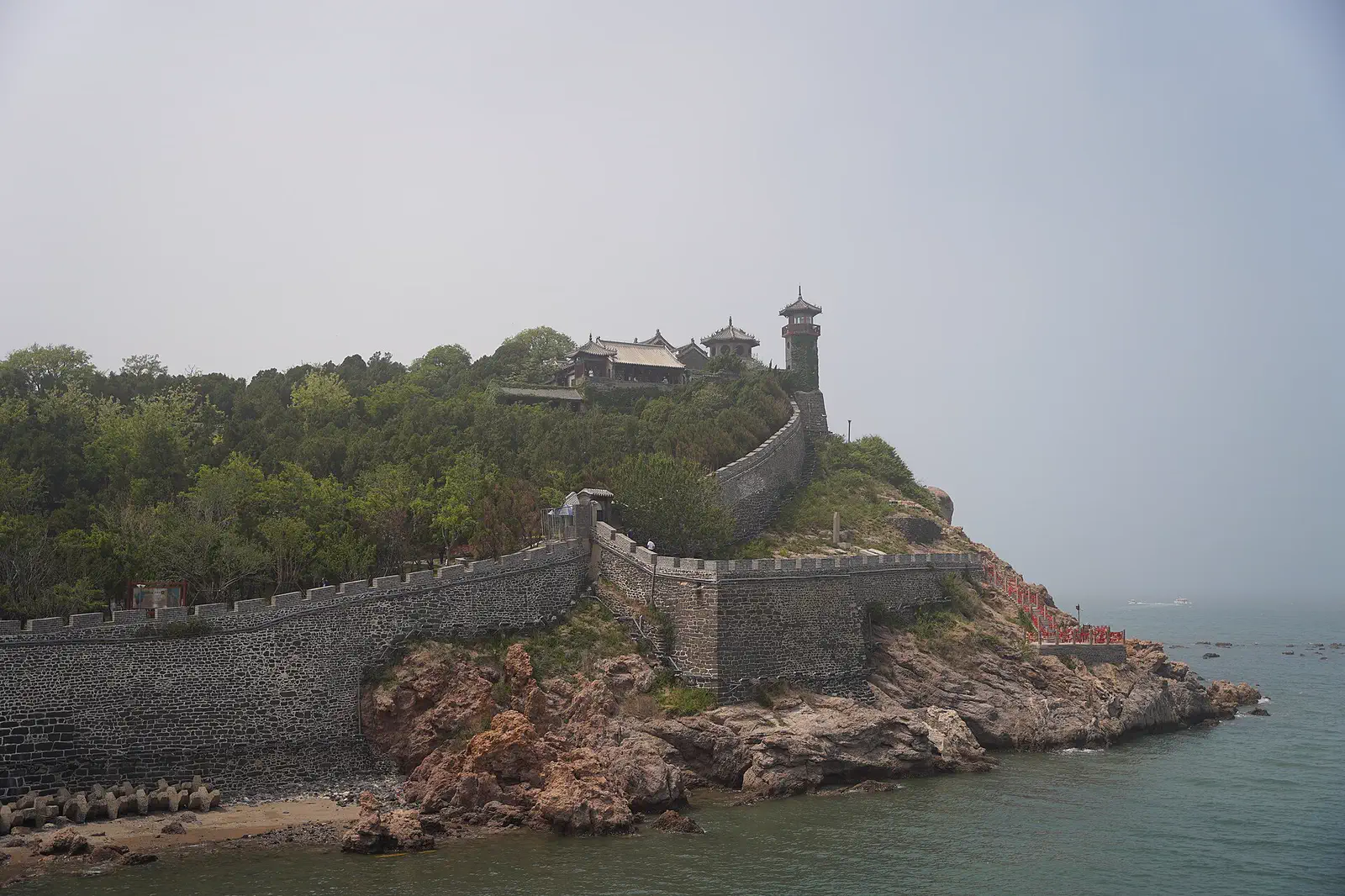
A clifftop complex of Daoist halls and multi-tiered pavilions overlooking the Bohai Strait, associated in Chinese legend with the Eight Immortals and the mythical island paradise of Penglai.
The Penglai Pavilion complex occupies a dramatic promontory above the Yellow Sea in northern Shandong. The site has been sacred since at least the Han Dynasty, when emperors sent expeditions searching for the mythical islands of the immortals said to lie offshore. The main pavilion, rebuilt repeatedly and last comprehensively restored in the Qing period, is a three-storey timber structure with sweeping upturned eaves that has become one of the most recognisable images of coastal northern China.
The complex contains a cluster of Daoist and folk-religious halls dedicated to various deities, with the Heavenly Queen Palace (Tianhou Palace) — dedicated to Mazu, the goddess of the sea — being of particular importance to the fishing communities of the Shandong coast. The Eight Immortals Hall commemorates the famous legend in which the Eight Immortals crossed the sea from Penglai, each using a different personal object rather than a boat, a story that remains one of the most widely known in Chinese popular culture.
The cliffs below the pavilion are a prime location for observing the mirage (haishi shenlou) that occasionally appears over the Bohai Strait in spring and summer — an atmospheric inversion that causes ships and distant landforms to appear suspended above the water line. Historical records going back over a thousand years document sightings of this natural phenomenon from the Penglai headland.
The site has expanded to include the Penglai Water City, an adjacent Song Dynasty naval fortress and harbour, and the Penglai Pavilion itself is the anchor of a larger scenic zone.
How to get there
From Penglai City bus terminal, bus route or taxi to the scenic area (10 minutes). Penglai is reached by bus or car from Yantai, approximately 90 minutes.
When to visit
Late April to early May for the best chance of seeing the Bohai mirage. Summer is busy but atmospheric.
Crowds: Chinese school groups visit heavily in May and October. Arrive at opening time to have the cliff walks mostly to yourself.
Other attractions in Yantai
Other cultural sites in China
- Barkhor Pilgrim Circuit八廓街
1 km clockwise pilgrim circuit around the Jokhang Temple. Pilgrims prostrate themselves around the route; Tibetan-traditional shopping plus daily life.
- Chen Clan Ancestral Hall陈家祠
The most ornate Lingnan-style courtyard complex in China, built 1894 as the academy and ancestral hall for the Chen clan of Guangdong.
- Couple's Retreat Garden耦园
UNESCO · UNESCO-listed Suzhou garden organised symmetrically around a central residence. Less crowded than the four most-visited gardens.
- Garden of Cultivation艺圃
UNESCO · UNESCO-listed Ming-era scholar's garden. Among the smallest and most atmospheric of Suzhou's classical gardens.
- Humble Administrator's Garden拙政园
UNESCO · The largest of Suzhou's UNESCO-listed classical gardens (5.2 hectares). 16th-century landscape with ponds, pavilions, rockeries, and an emphasis on water.
- Jingmai Mountain Ancient Tea Forest普洱景迈山古茶林文化景观
UNESCO · UNESCO Cultural Landscape in Yunnan's Pu'er region — ancient cultivated tea forests maintained by Blang and Dai ethnic communities for over 1,000 years, representing a living tradition of forest tea cultivation.
- Lingering Garden留园
UNESCO · UNESCO-listed Ming-Qing garden, famed for its rockeries and the 6.5m central limestone scholar's-rock 'Crown of Clouds'.
- Lion Grove Garden狮子林
UNESCO · Yuan-dynasty garden famous for its lion-shaped rockeries — a maze of Taihu limestone you can walk through.
Frequently asked questions
- How much does Penglai Pavilion Scenic Area cost to visit?
- Adult entry to Penglai Pavilion Scenic Area is ¥150, ¥75 for children. Combined ticket includes Penglai Pavilion and Water City. Under 1.2m free.
- When is Penglai Pavilion Scenic Area open?
- Penglai Pavilion Scenic Area opening hours: 8am–5:30pm (summer); 8:30am–5pm (winter). Open daily.
- How long do you need at Penglai Pavilion Scenic Area?
- Allow 2–4 hours for Penglai Pavilion Scenic Area. Add buffer time if you plan to visit at peak season or include nearby sights in the same trip.
- When is the best time to visit Penglai Pavilion Scenic Area?
- Late April to early May for the best chance of seeing the Bohai mirage. Summer is busy but atmospheric.
- How do you get to Penglai Pavilion Scenic Area?
- From Penglai City bus terminal, bus route or taxi to the scenic area (10 minutes). Penglai is reached by bus or car from Yantai, approximately 90 minutes.
- How do you avoid the crowds at Penglai Pavilion Scenic Area?
- Chinese school groups visit heavily in May and October. Arrive at opening time to have the cliff walks mostly to yourself.
Spotted something out of date? Submit a correction.
Research
Cross-checked against primary sources
Verified
Address, hours, fees confirmed at the date shown
Updated
Re-verified periodically; corrections welcome