CITY · ANHUI
Jiuhua Mountain
九华山 · Jiǔhuá Shān
Overview
One of China's Four Sacred Buddhist Mountains in Anhui province, associated with the Bodhisattva Ksitigarbha and home to over 90 active monasteries and temples.
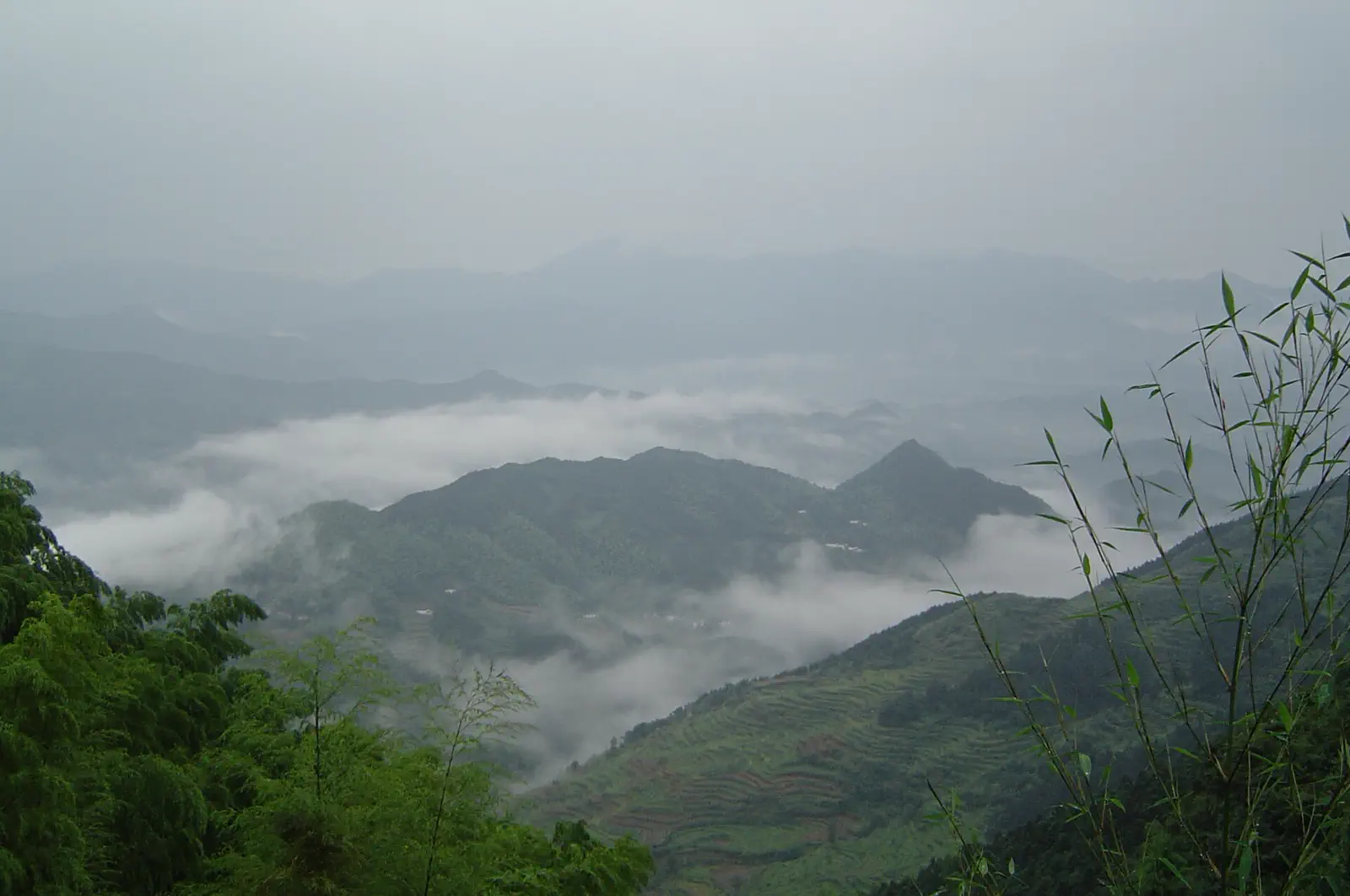
Jiuhua Mountain — Jiuhua Shan — is one of the Four Sacred Mountains of Chinese Buddhism, associated with Ksitigarbha (Dizang Pusa), the Bodhisattva who vows to remain in the realms of suffering until all beings are liberated. The mountain's name, meaning Nine Glorious Mountains, refers to the irregular cluster of peaks that the Tang poet Li Bai described as resembling nine lotus flowers rising from the earth. Over 90 monasteries and temples remain active on the mountain, making it one of the densest concentrations of Buddhist monastic life in China.
The mountain basin holds the main town of Jiuhua Jie, a bustling settlement of pilgrims, monasteries and guesthouses at around 600 metres elevation. The temples in and around the town include the Zhiyuan Temple, the largest on the mountain, and the Roushen Bao Dian (Flesh Body Precious Hall), which enshrines the preserved body of the Tang-dynasty monk Jinqiaojue — considered a manifestation of Ksitigarbha. The presence of incorrupt bodies in sealed glass reliquaries is a feature unique to this mountain among the Four Sacred sites.
Jiuhua Shan draws enormous numbers of domestic pilgrims, particularly during the major festivals of the Buddhist calendar. The atmosphere in the town on festival days is intense — incense clouds, chanting, prostrations, and the constant movement of saffron-robed monks. Outside festival periods the mountain is quieter and the forest trails to the higher peaks are peaceful.
The nearest significant city is Chizhou, about 40 km northwest on the Yangtze River. From Chizhou, coaches run directly to Jiuhua Shan scenic area. Huangshan (Tunxi) and Hefei are further regional hubs.
Cultural & access notes
Jiuhua Shan is first and foremost a functioning monastery complex, not a heritage park. Monks and nuns are engaged in religious practice throughout the day. Photography inside temple halls is typically not permitted during ceremonies. The preserved bodies in reliquaries are objects of worship — treat them with appropriate respect.
What to see
- Zhiyuan Temple — the mountain's largest monastery, with active daily ceremonies
- Roushen Bao Dian — hall containing the preserved body of the monk Jinqiaojue
- Tiantai Peak (1,306 m) — summit trail through forest to a panoramic hilltop temple
- Huacheng Temple — one of the mountain's oldest foundations
- Qiyuan Temple — active nunnery below the main town
- Dawn ceremony at major temples — monks and nuns chanting the morning liturgy
- Night-time incense burning at Zhiyuan Temple during festivals
What to eat
- Buddhist vegetarian cuisine — full multi-course temple meals at monastery-linked restaurants
- Jiuhua mao feng tea — local green tea grown on the mountain slopes
- Pickled mountain vegetables — a local speciality
- Tofu skin dishes — used extensively in mountain vegetarian cooking
- Huizhou-style braised bamboo shoots
Getting there
From Chizhou station (on the Shanghai-Chengdu rail line), direct tourist coaches to Jiuhua Shan take about 1 hour. Huangshan Tunxi Airport (TXN) is approximately 90 km south; Hefei Xinqiao Airport (HFE) is further but offers more routes. Long-distance coaches run from Nanjing, Hefei and Wuhu.
Getting around
The scenic area operates buses within the mountain basin and up to higher cable car stations. A cable car runs from the upper valley to near Tiantai Peak. The Jiuhua Jie town is walkable; the wider temple circuit requires the shuttle bus or hiking.
Where to stay
Jiuhua Jie town has monasteries offering pilgrim accommodation (simple, clean, inexpensive) as well as private guesthouses and mid-range hotels. Monastery stays include vegetarian meals. Book ahead during the Ksitigarbha festival period (around the 30th day of the 7th lunar month).
We list neighbourhoods, not specific hotels — we don't endorse hotels.
When to go
April–May and September–October are ideal. Summer (July–August) is hot and humid but the mountain is busy with domestic tourism. The Ksitigarbha festival brings the largest crowds of the year. Winter is cool, the mountain often misty, and some outer trails may be muddy.
Budget guide (CNY per day)
| Backpacker | ¥180 |
| Mid-range | ¥380 |
| Comfortable | ¥750 |
Safety notes
The mountain paths are well maintained. Festival crowds in the main town can be very dense — take care around burning incense and open flame. The Roushen Bao Dian hall requires respectful behaviour as it contains religious relics of particular significance.
Nearby attractions
Day trips within 150 km
Hongcun Ancient Village 宏村
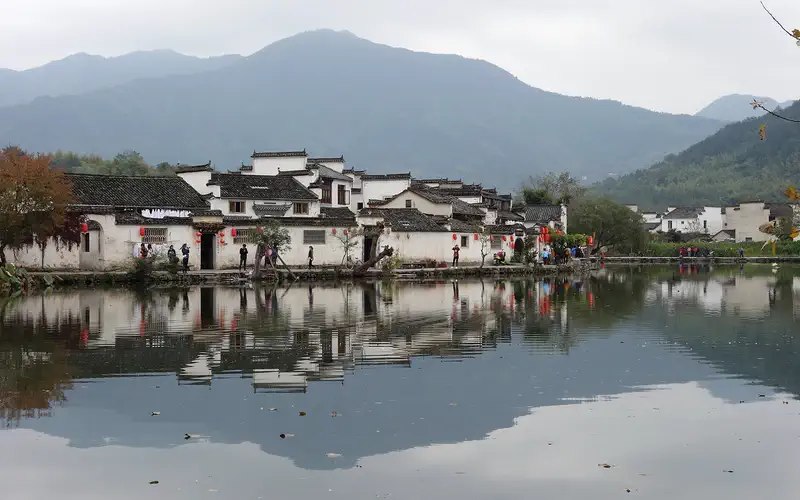
UNESCO-listed Ming-Qing village 60 km southeast of Mt Huangshan. The half-moon pond (Yuezhao) at the centre framed Crouching Tiger, Hidden Dragon's bridge scene.
≈ 55 km from Jiuhua Mountain
Xidi Ancient Village 西递
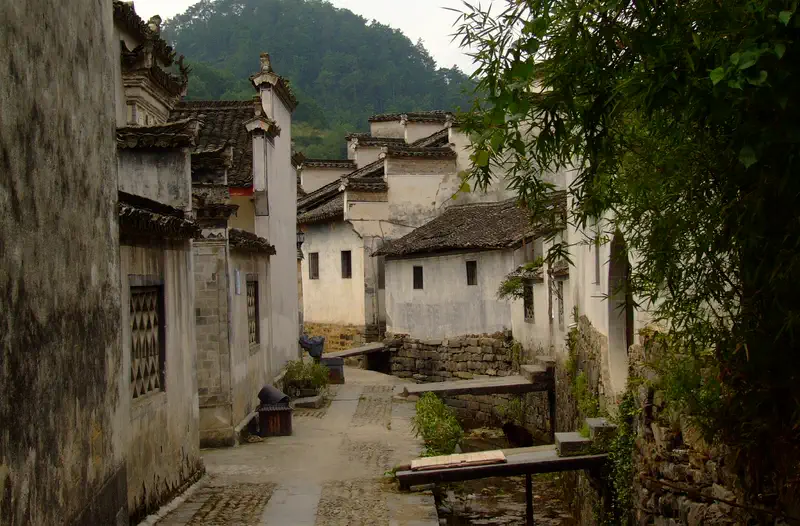
UNESCO-listed Hu-clan village (founded 1047), the canonical 'Anhui-style' merchant village with archway lanes, white-walled grey-tile houses and carved-stone doors.
≈ 65 km from Jiuhua Mountain
Other cities in Anhui
- Hefei合肥
Capital of Anhui, transport gateway to Mt Huangshan and the Hongcun-Xidi villages. Less of a destination, more of a transit hub.
- Huangshan / Yellow Mountain region黄山
UNESCO-listed mountain in Anhui, the most-painted mountain in Chinese landscape art. Granite peaks, sea-of-clouds, ancient pines. Combine with Hongcun and Xidi villages.
- Tunxi屯溪
The urban base for the Huizhou cultural region in southern Anhui — gateway to Huangshan mountain and the ancient villages of Hongcun and Xidi. The Old Street (Laoijie) along the Xin'an River preserves Song, Ming and Qing commercial architecture.
- Yixian黟县
Rural county in southern Anhui containing the UNESCO-listed Huizhou villages of Hongcun and Xidi, the best-preserved examples of vernacular merchant-class architecture in China. The county town itself is minor; the surrounding villages are the draw.
Itineraries visiting Jiuhua Mountain
- Four Buddhist Mountains Circuit, 10 days
10d · China's four sacred Buddhist mountains in sequence: Wutai (Shanxi), Jiuhua (Anhui), Emei (Sichuan), and Putuo (Zhejiang) — each dedicated to a different bodhisattva.
- Buddhist pilgrimage — Putuoshan, Wutaishan, Emei and Jiuhua, 10 days
10d · Ten days visiting the Four Sacred Buddhist Mountains of China — Putuo (Guanyin), Wutai (Manjushri), Emei (Samantabhadra) and Jiuhua (Ksitigarbha) — each with its own character and monastic tradition.
Food of Eastern China
- Beggar's Chicken叫花鸡
A whole chicken stuffed with aromatics, wrapped in lotus leaves and clay, then slow-baked until the meat steams in its own juices.
- Drunken Chicken醉鸡
Chicken steamed and marinated in Shaoxing rice wine, served chilled. A Shanghai banquet starter.
- Eight-Treasure Rice八宝饭
A steamed dome of glutinous rice layered with red bean paste and decorated with eight types of preserved fruits and nuts.
- Hairy Crab大闸蟹
Yangcheng Lake mitten crab — the autumn delicacy of the Yangtze Delta. Eaten steamed with vinegar dip.
Jiuhua Mountain weather by month
| Month | Jan | Feb | Mar | Apr | May | Jun | Jul | Aug | Sep | Oct | Nov | Dec |
|---|---|---|---|---|---|---|---|---|---|---|---|---|
| High °C | 5 | 7 | 13 | 17 | 22 | 25 | 27 | 28 | 24 | 18 | 13 | 6 |
| Low °C | -2 | 0 | 5 | 9 | 14 | 18 | 21 | 21 | 17 | 10 | 5 | -1 |
| Rain mm | 86 | 100 | 158 | 109 | 179 | 288 | 305 | 152 | 119 | 61 | 79 | 40 |
| Rain days | 11 | 13 | 15 | 12 | 15 | 17 | 22 | 16 | 12 | 8 | 10 | 7 |
2019–2023 average via Open-Meteo ERA5 (ERA5 reanalysis). "Rain days" = days per month with ≥1 mm precipitation.
Frequently asked questions
- When is the best time to visit Jiuhua Mountain?
- The best months to visit Jiuhua Mountain are April, May, September, and October. April–May and September–October are ideal. Summer (July–August) is hot and humid but the mountain is busy with domestic tourism.
- How many days do you need in Jiuhua Mountain?
- Plan 3 days for Jiuhua Mountain if you want to see the headline sights without rushing — Zhiyuan Temple, Roushen Bao Dian, Tiantai Peak (1,306 m). Add an extra day for day trips from the city or for repeat visits to your favourite neighbourhood.
- Is Jiuhua Mountain safe for tourists?
- The mountain paths are well maintained. Festival crowds in the main town can be very dense — take care around burning incense and open flame. The Roushen Bao Dian hall requires respectful behaviour as it contains religious relics of particular significance.
- How do you get around Jiuhua Mountain?
- The scenic area operates buses within the mountain basin and up to higher cable car stations. A cable car runs from the upper valley to near Tiantai Peak. The Jiuhua Jie town is walkable; the wider temple circuit requires the shuttle bus or hiking.
- What's the daily budget for Jiuhua Mountain?
- Budget guide for Jiuhua Mountain: backpackers from around ¥180/day, mid-range travellers ¥380/day, comfortable trips from ¥750/day. These ranges cover accommodation, food, local transport and one paid sight per day, and exclude flights to and from the city.
- Where should you stay in Jiuhua Mountain?
- Jiuhua Jie town has monasteries offering pilgrim accommodation (simple, clean, inexpensive) as well as private guesthouses and mid-range hotels. Monastery stays include vegetarian meals. Book ahead during the Ksitigarbha festival period (around the 30th day of the 7th lunar month).
Spotted something out of date? Submit a correction.
Research
Cross-checked against primary sources
Verified
Address, hours, fees confirmed at the date shown
Updated
Re-verified periodically; corrections welcome