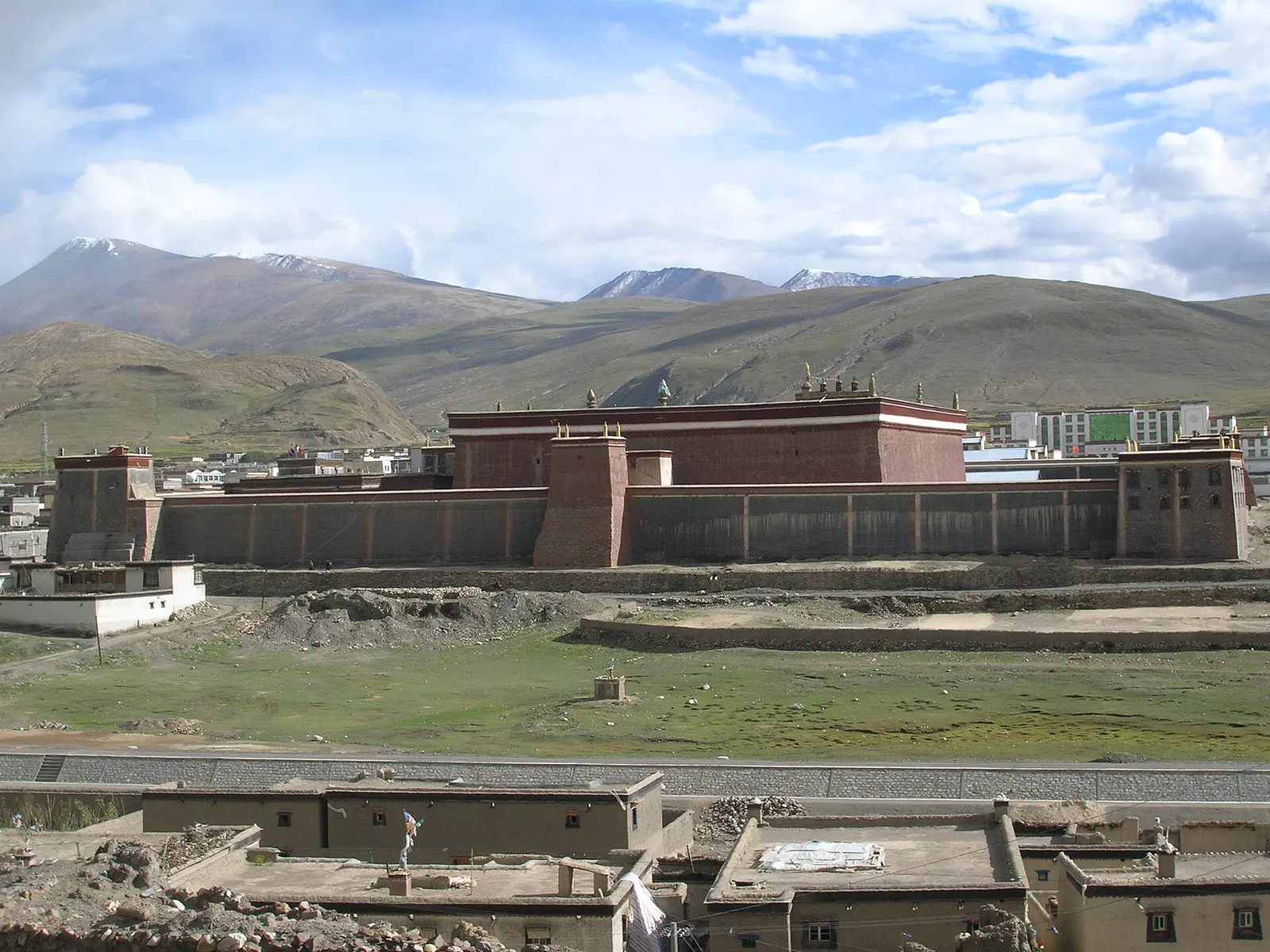
Religious site · TIBET AUTONOMOUS REGION
Sakya Monastery
萨迦寺 · Sàjiā Sì
About
The principal monastery of the Sakya school of Tibetan Buddhism, founded in 1073 and containing a legendary library of over 84,000 manuscript scrolls alongside extraordinary medieval murals and statues.
Sakya Monastery sits on the banks of the Zhongqu River in Sakya County, about 130 km south-west of Shigatse. It is the main seat of the Sakya school of Tibetan Buddhism, one of the four main schools alongside Gelug, Kagyu, and Nyingma. The Sakya school achieved its height of political power in the 13th and 14th centuries when the Sakya Trizins (throneholders) governed Tibet as viceroys of the Mongol Yuan Dynasty — a relationship that made Sakya effectively the administrative centre of Tibet for nearly a century.
The monastery's most striking feature is its colour scheme: the walls are painted in distinctive horizontal bands of grey, white, and red — colours associated in Tibetan iconography with the bodhisattvas Manjushri, Avalokitesvara, and Vajrapani respectively. The main monastery is divided into two sections by the river: the older northern monastery (now largely in ruins) and the walled southern monastery, which contains the principal assembly hall, chapels, and the famous library.
The library of Sakya Monastery is considered one of the most important collections of Tibetan manuscripts in existence. A wall-length shelf system 60 m long and 10 m high contains an estimated 84,000 scroll bundles, described by some scholars as the 'Tibetan Dunhuang' for its potential historical significance. Preservation and cataloguing projects have been under way for several decades.
The assembly hall's towering columns — said to be gifts from Kublai Khan — and the 12 m seated Sakya Pandita statue are among the most impressive works of medieval Tibetan art accessible to visitors.
How to get there
Approximately 130 km south-west of Shigatse on the road to Ngari/Ali Prefecture. Journey time 2.5–3 hours from Shigatse. Private vehicle with licensed Tibet guide required.
When to visit
May to October. The Sakya Mönlam prayer festival in spring is an important event.
Other attractions in Shigatse
Other religious sites in China
- Big Wild Goose Pagoda大雁塔
Tang-dynasty Buddhist pagoda, built 652 CE to house the sutras brought back by Xuanzang. 64m, seven storeys, climbable.
- Donglin Temple (East Forest Monastery)东林寺
One of the most important Buddhist monasteries in Chinese history, founded in 386 CE at the foot of Mount Lu and considered the birthplace of Pure Land Buddhism in China.
- Drepung Monastery哲蚌寺
UNESCO · Once the largest monastery in the world (10,000+ monks). 8 km west of Lhasa. Active Gelugpa monastery; debating courtyard sessions in the afternoon.
- Famen Temple法门寺
1,700-year-old Buddhist temple 110 km west of Xi'an. The 1987 discovery of a finger relic of the Buddha in its underground crypt was a major archaeological event.
- Ganden Monastery甘丹寺
The mother monastery of the Gelug school of Tibetan Buddhism, founded in 1409 by Tsongkhapa atop Wangbur Mountain 47 km east of Lhasa, offering sweeping plateau views and an important kora trail.
- Gyantse Kumbum Stupa江孜白居寺
A nine-storey mandala stupa built in 1427 containing 108 chapels on multiple floors, considered one of the finest examples of Tibetan religious architecture and the most important landmark in Gyantse.
- Hanging Temple悬空寺
1,500-year-old wooden temple complex pinned to the side of a 75m cliff at Mt Heng. Engineered with horizontal posts driven into the rock face.
- Jade Buddha Temple玉佛寺
Active urban Buddhist temple in central Shanghai. Famous for two life-size jade Buddhas brought from Burma in 1882.
Frequently asked questions
- How much does Sakya Monastery cost to visit?
- Adult entry to Sakya Monastery is ¥45, ¥22 for children. Tibet Travel Permit required. Photography of the library shelves may be restricted.
- When is Sakya Monastery open?
- Sakya Monastery opening hours: 9am–12pm and 3pm–6pm. Prayer ceremonies in the morning.
- How long do you need at Sakya Monastery?
- Allow 2–3 hours for Sakya Monastery. Add buffer time if you plan to visit at peak season or include nearby sights in the same trip.
- When is the best time to visit Sakya Monastery?
- May to October. The Sakya Mönlam prayer festival in spring is an important event.
- How do you get to Sakya Monastery?
- Approximately 130 km south-west of Shigatse on the road to Ngari/Ali Prefecture. Journey time 2.5–3 hours from Shigatse. Private vehicle with licensed Tibet guide required.
Spotted something out of date? Submit a correction.
Research
Cross-checked against primary sources
Verified
Address, hours, fees confirmed at the date shown
Updated
Re-verified periodically; corrections welcome